The Business Research Company’s 2026 market reports combine market attractiveness scoring, total addressable market sizing, company benchmarking matrices, interactive Excel dashboards, deeper supply chain intelligence, emerging startup tracking, and granular product-level insights to deliver research that is more actionable and strategically valuable.
What Is The Milk Protein Market Growth Rate? A 6.9% CAGR Outlook Through 2030
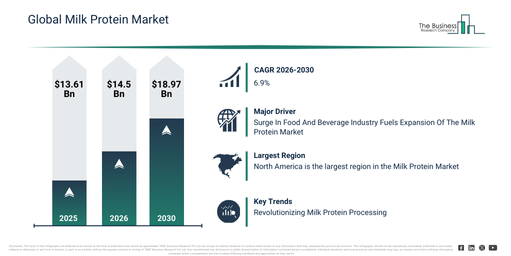
The milk protein market has experienced significant growth in recent years. It is projected to increase from $13.61 billion in 2025 to $14.5 billion in 2026, demonstrating a compound annual growth rate (CAGR) of 6.6%. The expansion witnessed in the past can be attributed to several factors, including the development of dairy processing industries, a surge in the consumption of protein-rich diets, the broadening of sports nutrition markets, the availability of sophisticated dairy fractionation technologies, and the growing incorporation of milk proteins into packaged food items.
The milk protein market size is projected to experience substantial growth over the coming years. By 2030, it is anticipated to reach $18.97 billion, exhibiting a compound annual growth rate (CAGR) of 6.9%. This expansion during the forecast period is driven by factors such as the increasing need for personalized nutrition products, a heightened emphasis on muscle health and aging demographics, the proliferation of ready-to-drink protein beverages, advancements in protein hydrolysates, and the wider reach of online nutrition channels. Key developments expected during this period involve a rising demand for functional foods rich in protein, greater incorporation of milk proteins in sports nutrition products, the broadening of infant formula uses, increased uptake of protein-fortified drinks, and a sharper focus on clean-label dairy proteins.
Access A Free Sample Of The Latest Milk Protein Market Analysis:
Why Is The Milk Protein Market Growing? The Key Demand Driver Explained
The expanding food and beverage industry is anticipated to fuel the growth of the milk protein market moving forward. This extensive sector, which covers the production, processing, distribution, and sale of food and beverages, is increasingly incorporating milk protein due to its unique functional and nutritional attributes that enhance the texture, flavor, and nutritional value of a wide array of products. For instance, according to the Agriculture and Agri-Food Department Canada, in 2024, the food and beverage processing sector remained Canada’s largest manufacturing industry by production value, generating $173.4 billion in goods. This accounted for 20.3% of all manufacturing sales and contributed 1.6% to the national GDP. Exports of processed food and beverage products reached a record $59.8 billion, marking an increase of 3.8% from 2023, and representing 34.5% of the industry’s total production value. Therefore, the rise of the food and beverage industry is propelling the milk protein market’s expansion into the future.
What Are The Main Segments Of The Milk Protein Market?
The milk protein market covered in this report is segmented –
1) By Type: Milk Protein Concentrate, Milk Protein Isolate [MPI], Milk Protein Hydrolysates, Casein And Caseinates, Whey Protein Concentrate, Whey Protein Isolate, Other Types
2) By Form: Dry, Liquid
3) By Livestock: Cow, Buffalo, Goat
4) By Application: Dairy Products, Frozen Desserts, Infant Formula, Dietary Supplements, Bakery, Confectionery, Beverages, Sweet, Savory Snacks
5) By Distribution Channel: Online, Offline
Subsegments:
1) By Milk Protein Concentrate (MPC): MPC 40% Protein, MPC 70% Protein
2) By Milk Protein Isolate (MPI): MPI With 90% Protein, MPI With 95% Protein
3) By Milk Protein Hydrolysates: Low-Degree Hydrolysates, High-Degree Hydrolysates
4) By Casein And Caseinates: Sodium Caseinate, Calcium Caseinate, Acid Casein
5) By Whey Protein Concentrate (WPC): WPC 34%, WPC 80%
6) By Whey Protein Isolate (WPI): WPI With 90% Protein, Hydrolyzed WPI
7) By Other Types: Milk Peptides, Blends Of Milk Proteins
Milk Protein Market Trend Analysis: Where Leading Companies Are Focusing
Leading entities in the milk protein industry are focusing on developing new technological advancements, such as the fractionation process, to bolster their competitive standing. Fractionation is a separation technique that involves dividing a mixture into its individual components based on their differing physical or chemical attributes. For example, in November 2023, Valio Ltd, a Finland-based dairy product manufacturer, introduced Valio Eila MPC 65. This innovative concentrate is formulated to improve the flavor and texture of high-protein foods, tackling typical issues like gritty sensations and undesirable tastes often associated with protein powders. This adaptable ingredient can be used in various items, including protein puddings, shakes, ice creams, and drinks. It allows manufacturers to create high-protein products that are both fresh-tasting and appealing to consumers. Ultimately, this concentrate enhances the overall quality of protein-rich food products, with Valio Eila MPC 65 emerging as a solution for increasing consumer satisfaction in high-protein choices.
Which Companies Are Major Players In The Milk Protein Market?
Major companies operating in the milk protein market are Royal FrieslandCampina N.V., Fonterra Co-operative Group Limited, Arla Foods amba, Amco Proteins Company, Saputo Inc., Glanbia plc, Kerry Group plc, Havero Hoogwegt Group B.V., Lactalis Ingredients, Sachsenmilch Leppersdorf GmbH, Charotar Casein Company, Hilmar Ingredients, Milk Specialties Global, Idaho Milk Products, Agropur Dairy Cooperative, Carbery Group Limited, Davisco Foods International Inc., Leprino Foods Company, Lactose Limited, Erie Foods International Inc., Grande Custom Ingredients Group, Milkaut S.A., Armor Proteines, Agri-Mark Inc., Arion Dairy Products B.V.
Get The Complete Milk Protein Market Analysis Here:
Which Region Held The Largest Share Of The Milk Protein Market In 2025?
North America was the largest region in the milk protein market share in 2025. The regions covered in the milk protein market report are Asia-Pacific, South East Asia, Western Europe, Eastern Europe, North America, South America, Middle East and Africa.
Reach Out To Our Team:
The Business Research Company: https://www.thebusinessresearchcompany.com/
Americas: +1 310-496-7795
Asia: +44 7882 955267 & +91 8897263534
Europe: +44 7882 955267
Email us at: marketing@tbrc.info
Follow us on:
LinkedIn: https://in.linkedin.com/company/the-business-research-company
YouTube: https://www.youtube.com/channel/UC24_fI0rV8cR5DxlCpgmyFQ
Global Market Model: https://www.thebusinessresearchcompany.com/global-market-model

Wasay has over a decade of experience in market research, data modelling, and analytics, with prior experience at GlobalData and Decision Tree Consulting Services. At The Business Research Company , he leads research operations across syndicated studies, customized consulting engagements, and the Global Market Model platform. His professional experience includes supporting organizations such as Boston Consulting Group, KPMG, and Ernst & Young. Wasay holds a degree in Electronics and Communications Engineering, postgraduate management qualifications from International Management Institute Belgium and Indian School of Business and Entrepreneurship, and completed the Integrated Program in Business Analytics from Indian Institute of Management Indore.