Featuring market attractiveness scoring, total addressable market sizing, company benchmarking matrices, interactive Excel dashboards, deeper supply chain intelligence, emerging startup tracking, and granular product-level insights, The Business Research Company’s 2026 market reports are built to deliver research that is both more actionable and more strategically valuable.
Energy Storage For Microgrids Market Forecast: What Value Will The Market Reach By 2030?
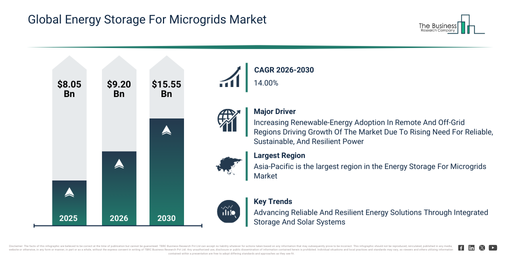
In recent years, the energy storage for the microgrids market size has experienced rapid growth. It will grow from $8.05 billion in 2025 to $9.20 billion in 2026 at a compound annual growth rate (CAGR) of 14.3%. Key drivers behind this historical growth include the broader adoption of lithium-ion batteries, the proliferation of remote microgrids, an enhanced focus on energy security, the expanding integration of renewable energy sources, and a surge in commercial and industrial microgrid installations.
The energy storage for microgrids market is anticipated to experience substantial expansion in the coming years. Projections indicate it will reach $15.55 billion in 2030, exhibiting a compound annual growth rate (CAGR) of 14.0%. This expansion during the forecast period is driven by factors such as the increasing adoption of hybrid energy storage systems, the rising integration of artificial intelligence (AI)-based energy management systems, the growing deployment of smart grid and internet of things (IoT) modules, the proliferation of microgrid-as-a-service models, and a heightened emphasis on decarbonization and sustainability efforts. Key developments expected during this period involve progress in modular and scalable microgrid designs, breakthroughs in power electronics and inverter technology, advancements in second-life and recycling solutions for batteries, ongoing research and development in virtual power plant-enabled microgrids, and increased connectivity with electric vehicle charging infrastructure.
Get A Free Sample Report With In-Depth Market Insights:
Energy Storage For Microgrids Market Growth Factors: What’s Supporting Expansion?
The escalating adoption of renewable energy in remote and off-grid regions is projected to drive the growth of the energy storage for microgrids market. This involves the increasing deployment of solar, wind, and other clean energy sources in areas not connected to central power grids, aimed at improving energy access, reducing reliance on fossil fuels, enhancing sustainability, and supporting local economic development. The surge in renewable energy adoption is due to declining technology costs and supportive government policies, making off-grid solutions more viable. Energy storage for microgrids facilitates renewable energy adoption by storing intermittent energy, providing stable and reliable power, and enhancing grid resilience in these remote regions. For instance, in December 2024, the International Renewable Energy Agency (IRENA), a United Arab Emirates-based intergovernmental organization, reported that global off-grid renewable power capacity reached 11.1 GW, increasing from 10.5 GW in 2023, which signifies a 5.7% rise. Therefore, the increasing renewable energy adoption in remote and off-grid regions is propelling the expansion of the energy storage for microgrids market.
Energy Storage For Microgrids Market Segment Outlook: Which Categories Are Growing Fastest?
The energy storage for microgrids market covered in this report is segmented –
1) By Component: Battery Energy Storage Systems, Hybrid Energy Storage Platforms, Inverters And Power Conversion Systems, Microgrid Controllers, Energy Management Systems, Smart Grid And Internet Of Things (IoT) Communication Modules, Integrated Power Electronics
2) By Microgrid Type: Grid-connected Microgrids, Remote Microgrids, Hybrid Microgrids
3) By Technology: Lithium-Ion Batteries, Flow Batteries, Lead-Acid Batteries
4) By Application: Enhanced Grid Stability, Backup Power And Islanding, Peak Shaving And Demand Response, Improved Renewable Energy Integration
5) By End-use: Residential, Commercial, Industrial, Military
Subsegments:
1) By Battery Energy Storage Systems: Lithium Ion Batteries, Sodium Ion Batteries, Flow Batteries, Lead Acid Batteries, Metal Air Batteries
2) By Hybrid Energy Storage Platforms: Battery And Ultracapacitor Systems, Battery And Flywheel Systems, Battery And Fuel Cell Systems, Multi Technology Energy Storage Systems
3) By Inverters And Power Conversion Systems: Grid Tied Inverters, Off Grid Inverters, Bidirectional Inverters, Hybrid Inverters, Solid State Power Conversion Devices
4) By Microgrid Controllers: Advanced Supervisory Control Systems, Distributed Control Systems, Adaptive Control Systems, Predictive Control Systems, Real Time Control Systems
5) By Energy Management Systems: Home Energy Management Systems, Building Energy Management Systems, Industrial Energy Management Systems, Renewable Energy Management Systems, Utility Energy Management Systems
6) By Smart Grid And Internet Of Things Communication Modules: Wireless Sensor Network Devices, Advanced Metering Infrastructure Modules, Smart Gateway Communication Devices, Internet Protocol Based Communication Modules, Edge Computing Communication Devices
7) By Integrated Power Electronics: Power Conditioning Units, Power Conversion Modules, High Frequency Switches, Thermal Management Modules, Integrated Power Control Units
Energy Storage For Microgrids Market Industry Trends: What’s Reshaping Demand?
Leading companies in the energy storage for microgrids market are concentrating on developing advanced solutions, such as solar-plus long-duration energy storage microgrids, to bolster energy reliability and resilience. These solar-plus long-duration energy storage microgrids are integrated systems combining renewable energy generation with substantial battery storage to deliver continuous, reliable power while optimizing energy usage and reducing carbon emissions. For instance, in September 2024, the Department of Energy (DOE), a US-based government agency, announced a $72.8 million partial loan guarantee to finance the Viejas Microgrid on the Tribal lands of the Viejas Band of the Kumeyaay Indians near Alpine, California. This microgrid integrates a 15 MW photovoltaic solar generation system with a 70 MWh long-duration battery storage system to supply electricity to commercial operations like gaming, hospitality, and retail facilities, with excess energy sold to the utility grid. By merging solar generation with large-scale energy storage, the microgrid ensures reliable power, supports grid stability, and enables efficient energy management. The project is anticipated to lower energy costs, create 250 construction jobs and eight permanent operations positions, and prevent approximately 9,009 metric tons of CO2 emissions annually, providing both economic and environmental benefits for the local community.
Energy Storage For Microgrids Market Key Players Shaping Industry Direction
Major companies operating in the energy storage for microgrids market are Tesla Inc., BYD Company Limited, Siemens Aktiengesellschaft, Hitachi Energy Ltd., Contemporary Amperex Technology Co. Limited, Schneider Electric SE, Honeywell International Inc., General Electric Vernova Inc., Asea Brown Boveri Ltd., LG Energy Solution Ltd., Eaton Corporation plc, Samsung SDI Company Limited, Tata Power Renewable Energy Limited, Zhejiang Narada Power Source Co. Ltd., Saft Groupe S.A., PowerSecure Inc., Alfen N.V., Powin LLC, Alpha Batteries Company Limited, Enchanted Rock LLC, Ampere Hour Energy Private Limited, BoxPower Inc., VRB Energy Inc., ESS Tech Inc., Scale Microgrid Solutions LLC
View The Full Energy Storage For Microgrids Market Report:
Energy Storage For Microgrids Market Regional Analysis: Which Geography Leads On Revenue?
Asia-Pacific was the largest region in the energy storage for microgrids market in 2025, and it is expected to be the fastest-growing region in the forecast period. The regions covered in the energy storage for microgrids market report are Asia-Pacific, South East Asia, Western Europe, Eastern Europe, North America, South America, Middle East, Africa.
Reach Out To Our Team:
The Business Research Company: https://www.thebusinessresearchcompany.com/
Americas: +1 310-496-7795
Asia: +44 7882 955267 & +91 8897263534
Europe: +44 7882 955267
Email us at: marketing@tbrc.info
Follow us on:
LinkedIn: https://in.linkedin.com/company/the-business-research-company
YouTube: https://www.youtube.com/channel/UC24_fI0rV8cR5DxlCpgmyFQ
Global Market Model: https://www.thebusinessresearchcompany.com/global-market-model

Wasay has over a decade of experience in market research, data modelling, and analytics, with prior experience at GlobalData and Decision Tree Consulting Services. At The Business Research Company , he leads research operations across syndicated studies, customized consulting engagements, and the Global Market Model platform. His professional experience includes supporting organizations such as Boston Consulting Group, KPMG, and Ernst & Young. Wasay holds a degree in Electronics and Communications Engineering, postgraduate management qualifications from International Management Institute Belgium and Indian School of Business and Entrepreneurship, and completed the Integrated Program in Business Analytics from Indian Institute of Management Indore.