Backed by market attractiveness analysis, total addressable market sizing, company benchmarking matrices, interactive Excel dashboards, wider supply chain intelligence, emerging startup coverage, and detailed product-level insights, The Business Research Company’s 2026 market reports are designed to offer research that is more actionable and strategically valuable than ever.
Automotive Engine Management System Market Value Analysis: What Growth Lies Ahead Over The Forecast Period?
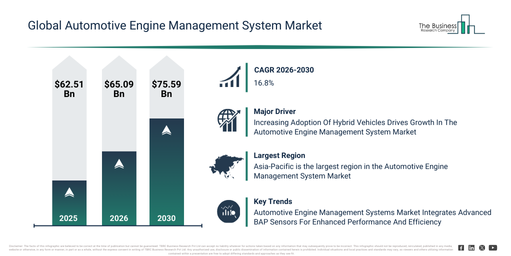
The automotive engine management system market size has grown steadily in recent years. It will grow from $62.51 billion in 2025 to $65.09 billion in 2026 at a compound annual growth rate (CAGR) of 4.1%. The growth in the historic period can be attributed to emission regulation compliance, adoption of electronic fuel injection, engine downsizing trends, growth of passenger car production, demand for improved drivability.
The automotive engine management system market size is expected to see steady growth in the next few years. It will grow to $75.59 billion in 2030 at a compound annual growth rate (CAGR) of 3.8%. The growth in the forecast period can be attributed to hybrid powertrain integration, stricter emission norms, software-driven engine calibration, electrification transition management, demand for intelligent powertrain systems. Major trends in the forecast period include adoption of advanced engine control algorithms, integration of real-time engine sensors, growth of emission control electronics, expansion of ecu-based optimization, demand for fuel efficiency.
Get A Free Sample Report With In-Depth Market Insights:
Automotive Engine Management System Market Industry Drivers: What’s Behind The Revenue Growth?
The increasing adoption of hybrid vehicles is expected to propel the growth of the automotive engine management system market going forward. Hybrid vehicles are vehicles that utilize two or more distinct power sources to propel themselves. The rise in hybrid vehicle adoption is increasing due to environmental worries, fuel savings, and government incentives. Hybrid vehicles require advanced engine management systems to integrate and control the internal combustion engine and the electric motor seamlessly, optimizing performance and efficiency. For instance, in February 2024, according to the European Automobile Manufacturers Association, a UK-based standards group of the automobile industry, sales of new hybrid-electric cars reached 255,511 units in February 2024, marking a 24.7% increase from February 2023. Therefore, the increasing adoption of hybrid vehicles drives growth in the automotive engine management system market.
Automotive Engine Management System Market Driver: The Rising Demand For Fuel-Efficient And Low-Emission Vehicles Driving Growth Of The Automotive Engine Management System Market
The rising demand for fuel-efficient and low-emission vehicles is expected to propel the growth of the automotive engine management system market going forward. Fuel-efficient and low-emission vehicles are automobiles designed to consume less fuel and produce fewer pollutants compared to conventional vehicles. The demand for these vehicles is rising due to stricter environmental regulations and government policies that mandate lower carbon emissions to combat climate change. These vehicles require advanced engine management systems that optimize combustion processes, monitor emission levels, and ensure compliance with environmental standards. For instance, in November 2024, according to the U.S. Environmental Protection Agency, a US-based federal agency responsible for environmental protection, the combined category of battery-electric vehicles, plug-in hybrid electric vehicles, and fuel cell vehicles increased from 6.7% of production in model year 2022 to 11.5% of production in model year 2023. Therefore, rising demand for fuel-efficient and low-emission vehicles is driving the growth of the automotive engine management system market.
Automotive Engine Management System Market Segment Performance And Emerging Opportunities
The automotive engine management system market covered in this report is segmented –
1) By Component: Electronic Control Unit (ECU), Engine Sensors, Other Components
2) By Vehicles: Passenger Cars, Commercial Vehicles
3) By Fuel Type: Diesel, Gasoline
4) By Sales Channel: Original Equipment Manufacturer (OEM), Aftermarket
Subsegments:
1) By Electronic Control Unit (ECU): Engine Control Unit, Powertrain Control Module (PCM)
2) By Engine Sensors: Oxygen Sensors, Temperature Sensors, Pressure Sensors, Knock Sensors, Mass Airflow Sensors
3) By Other Components: Ignition Coils, Fuel Injectors, Throttle Position Sensors, Air-Fuel Ratio Sensors
#Automotive Engine Management System Market Growth Trends: What’s Shaping The Future Outlook?
Major companies operating in the automotive engine management systems market focus on developing advanced technologies such as barometric air pressure (BAP) sensors to enhance engine performance, optimize fuel efficiency, and improve overall vehicle functionality. Barometric air pressure (BAP) sensors detect atmospheric pressure, which fluctuates based on altitude and weather, and are utilized in numerous applications, such as automotive systems, to provide data for optimal performance by calculating air density and adjusting functions as needed. For instance, in June 2023, Infineon Technologies AG, a Germany-based semiconductor manufacturing company, launched XENSIV barometric air pressure (BAP) sensors, which include the KP464 and KP466. The KP464 is designed for engine control management, measuring atmospheric pressure to optimize the air-fuel mixture. The KP466 is intended for seat comfort, enabling advanced pneumatic seat systems with innovative features and clear technical benefits.
Automotive Engine Management System Market Key Players: Which Companies Lead Industry Competition?
Major companies operating in the automotive engine management system market report include Robert Bosch GmbH, DENSO Corporation, Continental AG, Hitachi Astemo Ltd., BorgWarner Inc., Valeo SA, Cummins Inc., Delphi Technologies, Magneti Marelli, Mitsubishi Electric Corporation, Hyundai Mobis, Nidec Corporation, Mahle GmbH, Weifu High-Technology Group, Woodward Inc., Sensata Technologies Inc., NGK Spark Plug Co., Ltd., CTS Corporation, Infineon Technologies AG, NXP Semiconductors, STMicroelectronics, Renesas Electronics Corporation
View The Full Automotive Engine Management System Market Report:
Automotive Engine Management System Market Regional Analysis And Top Geography
Asia-Pacific was the largest region in the automotive engine management systems market in 2025. North America is expected to be the fastest-growing region in the forecast period. The regions covered in the automotive engine management system market report include Asia-Pacific, South East Asia, Western Europe, Eastern Europe, North America, South America, Middle East, Africa.
Reach Out To Our Team:
The Business Research Company: https://www.thebusinessresearchcompany.com/
Americas: +1 310-496-7795
Asia: +44 7882 955267 & +91 8897263534
Europe: +44 7882 955267
Email us at: marketing@tbrc.info
Follow us on:
LinkedIn: https://in.linkedin.com/company/the-business-research-company
YouTube: https://www.youtube.com/channel/UC24_fI0rV8cR5DxlCpgmyFQ
Global Market Model: https://www.thebusinessresearchcompany.com/global-market-model

Wasay has over a decade of experience in market research, data modelling, and analytics, with prior experience at GlobalData and Decision Tree Consulting Services. At The Business Research Company , he leads research operations across syndicated studies, customized consulting engagements, and the Global Market Model platform. His professional experience includes supporting organizations such as Boston Consulting Group, KPMG, and Ernst & Young. Wasay holds a degree in Electronics and Communications Engineering, postgraduate management qualifications from International Management Institute Belgium and Indian School of Business and Entrepreneurship, and completed the Integrated Program in Business Analytics from Indian Institute of Management Indore.