Built to provide research that’s more actionable and strategically valuable, The Business Research Company’s 2026 market reports include market attractiveness analysis, total addressable market sizing, company benchmarking matrices, interactive Excel dashboards, broader supply chain intelligence, emerging startup tracking, and in-depth product insights.
Renewable Power Purchase Agreement Market Size And Revenue Outlook Through 2030
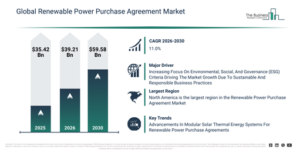
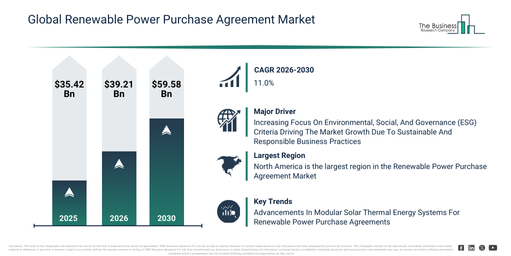
The renewable power purchase agreement market size has witnessed substantial growth in recent years. It is projected to expand from $35.42 billion in 2025 to $39.21 billion in 2026, showcasing a compound annual growth rate (CAGR) of 10.7%. The expansion observed in previous periods can be linked to increasing corporate sustainability commitments, the unpredictable nature of conventional energy prices, the development of utility-scale renewable projects, advantageous renewable energy policies, and a growing involvement of commercial buyers.
The renewable power purchase agreement market size is anticipated to experience substantial expansion over the upcoming years. It is projected to reach $59.58 billion in 2030, growing at a compound annual growth rate (CAGR) of 11.0%. This projected growth during the forecast period is fueled by the increased adoption of net-zero targets, a surging demand for cost-stable clean energy, the broadening of cross-border renewable contracts, greater participation from industrial buyers, and advancements in contract structuring. Prominent trends expected in this period include the widespread adoption of corporate renewable PPAs, a rising inclination towards long-term fixed-price contracts, a growing preference for off-site renewable procurement, the development of hybrid pricing models, and an intensified focus on risk mitigation and ensuring price certainty.
Get A Free Sample Report With In-Depth Market Insights:
Renewable Power Purchase Agreement Market Demand Drivers Opening New Revenue Streams
The rising concentration on environmental, social, and governance (ESG) criteria is anticipated to accelerate the expansion of the renewable power purchase agreement market in the future. Environmental, social, and governance (ESG) criteria signify the escalating importance placed on sustainable, ethical, and transparent operational practices for businesses. The growth in ESG criteria is attributed to sustainable investment, as businesses embrace responsible approaches to attract investors and enhance long-term value. This heightened focus on ESG criteria encourages the adoption of renewable power purchase agreements by prompting organizations to align their energy procurement with sustainability objectives, reduce carbon footprints, meet stakeholder expectations, and demonstrate sound corporate governance. For instance, in September 2025, a report from KPMG, a Netherlands-based professional service company, revealed that 56% of companies employ ESG data dashboards to collect, organize, store, and analyze non-financial data, while 68% indicated using traditional AI or machine learning. Additionally, 63% of leaders foresee ESG assurance improving employee engagement and productivity, in contrast to only 47% of beginners. Therefore, the intensified focus on environmental, social, and governance (ESG) criteria is stimulating the growth of the renewable power purchase agreement market.
Renewable Power Purchase Agreement Market Segmentation: How Does The Market Break Down By Category?
The renewable power purchase agreement market covered in this report is segmented –
1) By Type: Solar Power Purchase Agreements, Wind Power Purchase Agreements, Hydropower Purchase Agreements, Biomass Power Purchase Agreements, Other Types
2) By Contract Duration: Short-Term Power Purchase Agreement (PPA), Medium-Term Power Purchase Agreement (PPA), Long-Term Power Purchase Agreement (PPA)
3) By Pricing Models: Fixed-Price, Index-Based, Hybrid-Price, Other Pricing Models
4) By Application: Renewable Energy Integration, Off-Site Power Procurement, Peak Load Management, Energy Cost Savings, Other Applications
5) By End-User: Commercial, Industrial, Utilities, Government, Other End-Users
Subsegments:
1) By Solar Power Purchase Agreements: Utility Scale Solar Power Purchase Agreements, Commercial Solar Power Purchase Agreements, Industrial Solar Power Purchase Agreements, Residential Solar Power Purchase Agreements
2) By Wind Power Purchase Agreements: Onshore Wind Power Purchase Agreements, Offshore Wind Power Purchase Agreements, Community Wind Power Purchase Agreements
3) By Hydropower Purchase Agreements: Large Hydropower Purchase Agreements, Small Hydropower Purchase Agreements, Micro Hydropower Purchase Agreements
4) By Biomass Power Purchase Agreements: Solid Biomass Power Purchase Agreements, Liquid Biomass Power Purchase Agreements, Biogas Power Purchase Agreements
5) By Other Types: Geothermal Power Purchase Agreements, Tidal Power Purchase Agreements, Wave Power Purchase Agreements, Hybrid Renewable Power Purchase Agreements
Renewable Power Purchase Agreement Market Trends Powering Strategic Industry Growth
Leading companies in the renewable power purchase agreement market are increasingly adopting blockchain and artificial intelligence-based digital platforms, such as modular solar thermal energy systems, to achieve a competitive advantage. These systems are designed to capture and store solar energy as heat in long-duration thermal batteries, providing dispatchable electricity on demand and effectively addressing the intermittency issues common in traditional renewables. For instance, in September 2024, Exowatt, a U.S.-based renewable energy company, unveiled the Exowatt P3, a modular energy solution tailored for data centres and industrial applications. The Exowatt P3 boasts a scalable design, stores energy for up to 24 hours, and operates at an industry-leading cost of under 4 cents per kWh. It facilitates rapid deployment with low maintenance, supports zero carbon emissions, and incorporates domestically sourced materials. This advancement enables the integration of renewable energy with a reliable, cost-effective power supply, thereby reducing energy expenses and significantly cutting CO2 emissions in the market. This transformative technology is profoundly influencing the future of Renewable Power Purchase Agreements by enhancing energy reliability and sustainability.
Renewable Power Purchase Agreement Market Industry Leaders And Competitive Landscape
Major companies operating in the renewable power purchase agreement market are Iberdrola,S.A, Ørsted A/S, RWE AG, Statkraft AS, Vattenfall AB (Vattenfall), EDF Energy, BayWa AG (BayWa r.e. AG), BP (via Lightsource bp), Shell Plc, SSE Renewables, Drax Energy Solutions Limited, TotalEnergies SE, Aker Horizons ASA (Mainstream Renewable Power), Renew Energy Global PLC, Clearway Energy Group, Enel Global Trading SpA, Adani Green Energy (SB Energy), Ameresco Inc., Atlas Renewable Energy, SEC Victoria Pty Ltd.
View The Full Renewable Power Purchase Agreement Market Report:
Renewable Power Purchase Agreement Market Regional Analysis And Leading Geography
North America was the largest region in the renewable power purchase agreement market in 2025. Asia-Pacific is expected to be the fastest-growing region in the forecast period. The regions covered in the renewable power purchase agreement market report are Asia-Pacific, South East Asia, Western Europe, Eastern Europe, North America, South America, Middle East, Africa.
Reach Out To Our Team:
The Business Research Company: https://www.thebusinessresearchcompany.com/
Americas: +1 310-496-7795
Asia: +44 7882 955267 & +91 8897263534
Europe: +44 7882 955267
Email us at: marketing@tbrc.info
Follow us on:
LinkedIn: https://in.linkedin.com/company/the-business-research-company
YouTube: https://www.youtube.com/channel/UC24_fI0rV8cR5DxlCpgmyFQ
Global Market Model: https://www.thebusinessresearchcompany.com/global-market-model

Wasay has over a decade of experience in market research, data modelling, and analytics, with prior experience at GlobalData and Decision Tree Consulting Services. At The Business Research Company , he leads research operations across syndicated studies, customized consulting engagements, and the Global Market Model platform. His professional experience includes supporting organizations such as Boston Consulting Group, KPMG, and Ernst & Young. Wasay holds a degree in Electronics and Communications Engineering, postgraduate management qualifications from International Management Institute Belgium and Indian School of Business and Entrepreneurship, and completed the Integrated Program in Business Analytics from Indian Institute of Management Indore.