Market attractiveness scoring, total addressable market sizing, company benchmarking matrices, interactive Excel dashboards, deeper supply chain intelligence, emerging startup tracking, and granular product-level insights are among the key offerings featured in The Business Research Company’s 2026 market reports, designed to deliver more actionable and strategically valuable research.
Staple Food Market Growth Outlook: How Much Bigger Will The Market Be By 2030?
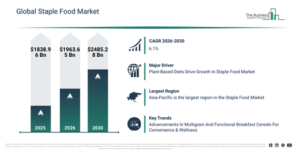
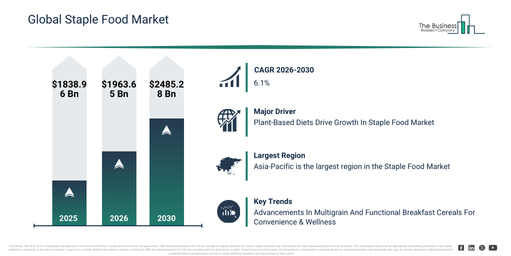
The staple food market size has experienced robust growth in recent years. It is forecast to expand from $1838.96 billion in 2025 to $1963.65 billion in 2026, achieving a compound annual growth rate (CAGR) of 6.8%. The historical expansion can be primarily linked to increased population driving greater staple consumption, the expansion of agricultural production, the establishment of wholesale food distribution networks, the affordability of staple food products, and extensive retail availability.
The staple food market is projected to experience robust expansion over the coming years. By 2030, its size is anticipated to reach $2485.28 billion, progressing at a compound annual growth rate (CAGR) of 6.1%. This growth during the forecast period is primarily driven by factors such as an intensified focus on sustainable agricultural practices, a rising consumer demand for organic and clean-label food products, the expansion of digital platforms for food retail, increased investments in infrastructure for food storage, and reinforced food security initiatives. Key trends identified for this period encompass the wider availability of packaged staple foods, an escalating demand for organic staple items, a heightened emphasis on optimizing supply chain efficiency, the increasing embrace of direct-to-consumer sales channels, and a stronger focus on ensuring food security.
Request A Free Staple Food Market Sample From The Business Research Company:
How Is The Key Growth Driver Influencing The Staple Food Market?
The rising prevalence of plant-based diets is anticipated to boost the expansion of the staple food market in the future. These diets focus on consuming foods sourced from plants, including vegetables, fruits, nuts, seeds, oils, whole grains, legumes, and beans. The growing appeal of plant-based eating patterns stems from heightened understanding of their health advantages, environmental implications, and ethical considerations regarding animal treatment. With plant-based diets, essential foods like grains, legumes, and vegetables become more significant, enhancing nutritional consumption, fostering sustainable farming practices, lessening reliance on resource-heavy animal agriculture, and advancing environmental well-being. For example, in May 2023, the International Food Information Council, a US based health nonprofit organization, reported that the proportion of U.S. adults who stated they had increased their intake of “protein from whole plant sources” in the previous 12 months reached 9% much more + 13% somewhat more = 22%, surpassing the lower net increases recorded in 2022. Consequently, the increasing adoption of plant-based diets propels the staple food market.
Staple Food Market Segmentation By Category: What Does The 2026 Report Cover?
The staple food market covered in this report is segmented –
1) By Product : Cereals, Sugar, Roots And Tuber, Fruit, Vegetables, Oil, Other Products
2) By Nature: Organic, Conventional
3) By Distribution Channel: Wholesale Distributors, Online Retailers, Other Distribution Channels, Direct-to-Consumer (D2C), Retail Stores
Subsegments:
1) By Cereals: Rice, Wheat, Maize, Barley, Oats
2) By Sugar: Refined Sugar, Raw Sugar, Brown Sugar, Molasses
3) By Roots and Tuber: Potatoes, Cassava, Sweet Potatoes, Yams
4) By Fruit: Bananas, Apples, Citrus Fruits, Mangoes
5) By Vegetables: Leafy Greens, Tomatoes, Onions, Carrots
6) By Oil: Vegetable Oils, Palm Oil, Olive Oil, Coconut Oil
7) By Other Products: Legumes, Pulses, Nuts And Seeds
How Are Industry Players Changing The Staple Food Market Landscape?
Leading companies in the staple food market are prioritizing the creation of advanced innovations, such as functional multigrain cereals, to secure a competitive edge. These cereals merge whole grains with vitamins, minerals, and supplementary nutritional benefits, addressing evolving consumer needs for both convenience and wellness. For example, in April 2025, Life, a US-based food company owned by Quaker Oats Company/PepsiCo, introduced Mighty Life, a multigrain cereal. It is offered in flavors like “Strawberry Blueberry Bliss,” which provides vitamins C, D, and zinc for immune support, and “Very Vanilla,” containing vitamin D and calcium for bone health. This cereal delivers 34 g of whole grains per serving and contains no artificial flavors or colors. This launch demonstrates a broader trend towards nutritionally enhanced, ready-to-eat staple foods that promote health while maintaining convenience.
Staple Food Market Global Key Players And Competitive Overview
Major companies operating in the staple food market are Cargill Incorporated, Nestlé S.A., Archer-Daniels-Midland Company, Bunge Limited, Olam Group, Unilever PLC, Wilmar International, Louis Dreyfus Company, CHS Inc., Tereos Group, Danone S.A., Kraft Heinz Company, General Agriculture Products Co., The Kellogg Company, ITC Limited, Adani Wilmar Ltd., General Mills Inc., AGT Foods and Ingredients Inc., Saskcan Pulse Trading, Bharat Cereals Ltd., GrainCorp Limited
Explore Comprehensive Staple Food Market Coverage In The Full Report:
Regional Analysis Of The Staple Food Market: Where Is The Industry Concentrated?
Asia-Pacific was the largest region in the staple food market in 2025. The regions covered in the staple food market report are Asia-Pacific, South East Asia, Western Europe, Eastern Europe, North America, South America, Middle East and Africa.
Reach Out To Our Team:
The Business Research Company: https://www.thebusinessresearchcompany.com/
Americas: +1 310-496-7795
Asia: +44 7882 955267 & +91 8897263534
Europe: +44 7882 955267
Email us at: marketing@tbrc.info
Follow us on:
LinkedIn: https://in.linkedin.com/company/the-business-research-company
YouTube: https://www.youtube.com/channel/UC24_fI0rV8cR5DxlCpgmyFQ
Global Market Model: https://www.thebusinessresearchcompany.com/global-market-model

Wasay has over a decade of experience in market research, data modelling, and analytics, with prior experience at GlobalData and Decision Tree Consulting Services. At The Business Research Company , he leads research operations across syndicated studies, customized consulting engagements, and the Global Market Model platform. His professional experience includes supporting organizations such as Boston Consulting Group, KPMG, and Ernst & Young. Wasay holds a degree in Electronics and Communications Engineering, postgraduate management qualifications from International Management Institute Belgium and Indian School of Business and Entrepreneurship, and completed the Integrated Program in Business Analytics from Indian Institute of Management Indore.