
Featuring market attractiveness scoring, total addressable market sizing, company benchmarking matrices, interactive Excel dashboards, deeper supply chain intelligence, emerging startup tracking, and granular product-level insights, The Business Research Company’s 2026 market reports are built to deliver research that is both more actionable and more strategically valuable.
Virtual Tourism Market Poised To Hit $32.81 Billion By 2030 With A 17.6% CAGR
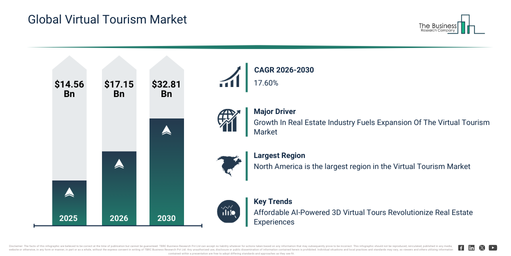
The virtual tourism market has experienced substantial growth in recent years. It is anticipated to expand from $14.56 billion in 2025 to $17.15 billion in 2026, exhibiting a compound annual growth rate (CAGR) of 17.7%. Historically, this market expansion can be attributed to factors such as restricted global travel activities, the early adoption of virtual museum experiences, the increasing digitization of cultural landmarks, broader internet penetration, and the rising use of 360-degree media content.
The virtual tourism market is anticipated to experience substantial growth over the next few years. It is projected to expand to $32.81 billion by 2030, achieving a compound annual growth rate (CAGR) of 17.6%. The expansion during this forecast period can be attributed to factors such as increasing demand for remote travel experiences, the proliferation of metaverse-based tourism platforms, growing investments in immersive content creation, the rising adoption of VR devices, and increased collaboration between tourism boards and tech providers. Key trends for the forecast period include the increasing uptake of immersive virtual reality tours, a rise in the use of high-resolution 3D scanning technologies, the evolving integration of spatial audio and haptic feedback, the expansion of cloud-based virtual tourism platforms, and a sharpened focus on cultural heritage digitization.
Get A Free Sample Report With In-Depth Market Insights:
Virtual Tourism Market Growth Factors Behind Sustained Expansion
The anticipated growth of the real estate sector is projected to propel the virtual tourism market in the future. Real estate firms engage in the acquisition, sale, rental, and administration of residential, commercial, and industrial properties. This industry’s expansion is attributed to factors like increasing urbanization, overall economic progress, and advantageous investment climates. Companies within the real estate domain utilize virtual reality (VR) and augmented reality (AR) innovations to provide engaging property walkthroughs, allowing prospective clients worldwide to explore locations remotely without needing to be physically present. Such practices enhance virtual tourism by drawing in both potential buyers and sightseers with elaborate, interactive presentations of high-end properties. As an illustration, in July 2024, data from the United States Census Bureau, a US-based government administration, indicated that in June 2023, the total privately owned housing units authorized by building permits reached 1,493,000. This figure represents a 3.1 percent increase from the 1,399,000 units sanctioned in May 2023. Consequently, the expansion of the real estate industry is set to be a significant impetus for the virtual tourism market.
Virtual Tourism Market Segment Breakdown: Which Categories Lead On Revenue?
The virtual tourism market covered in this report is segmented –
1) By Type: 360 Virtual Tour, Three-Dimensional (3D) Virtual Tour, Virtual Reality Tour
2) By Deployment Mode: Cloud-Based, Web-Based
3) By Technology: Three-Dimensional (3D) Scanning And Imaging, Photogrammetry, Computer Vision, Haptic Feedback, Spatial Audio, Other Technologies
4) By Direct Suppliers: Hotel Campaigns, Tour Operators, Government Bodies
5) By End-Use: Travelers And Tourists, Hospitality And Accommodation, Cultural And Historical Sites, Entertainment And Recreation, Education And Training, Other End-Uses
Subsegments:
1) By 360 Virtual Tour: Single Location 360 Tours, Multiple Location 360 Tours
2) By Three-Dimensional (3D) Virtual Tour: 3D Static Tours, 3D Interactive Tours
3) By Virtual Reality Tour: Immersive VR Tours, Non-immersive VR Tours
Virtual Tourism Market Industry Trends Fueling Future Revenue Growth
Leading companies in the virtual tourism sector are creating sophisticated AI-driven three-dimensional (3D) virtual tours to transform virtual real estate through cost-effective and swift 3D solutions. These AI-powered 3D virtual tours leverage artificial intelligence to generate immersive, lifelike digital representations of actual places, enabling users to explore and engage with virtual environments in three dimensions, complete with adaptable content and tailored experiences. As an illustration, in January 2024, Planitar Inc., a Canada-based measurement technology provider, introduced iGUIDE Instant. This service provides an economical option at just USD 7.99 per project, empowering real estate photographers to quickly produce premium virtual tours and floor plans, often shortly after collecting property data. It smoothly integrates with social media and web platforms, offering customizable branding for listing agents. Furthermore, iGUIDE Instant supplies analytics reports to monitor online engagement, assisting agents in evaluating listing effectiveness. The system captures high-resolution 360° imagery, allowing prospective buyers to explore properties in exceptional detail and enriching the viewing experience.
Virtual Tourism Market Leading Companies And Competitive Benchmarking
Major companies operating in the virtual tourism market are Google LLC, Intel Corporation, Toshiba Corporation, Ricoh Co. Ltd., Zebra Technologies Corp., Autodesk Inc., Trimble Inc., Zillow Group, Leica Geosystems AG, Cvent Inc., Magic Leap Inc., Vuzix, Real Tour Vision (RTV) Inc., Vieweet, Urbanimmersive Inc., Blippar Group Limited, UNIMERSIV, Kuula Inc., Virtual Pictures Corp., Cupix Inc.
View The Full Virtual Tourism Market Report:
Virtual Tourism Market Largest Region By Revenue And Market Share
North America was the largest region in the virtual tourism market in 2025. The regions covered in the virtual tourism market report are Asia-Pacific, South East Asia, Western Europe, Eastern Europe, North America, South America, Middle East, Africa
Reach Out To Our Team:
The Business Research Company: https://www.thebusinessresearchcompany.com/
Americas: +1 310-496-7795
Asia: +44 7882 955267 & +91 8897263534
Europe: +44 7882 955267
Email us at: marketing@tbrc.info
Follow us on:
LinkedIn: https://in.linkedin.com/company/the-business-research-company
YouTube: https://www.youtube.com/channel/UC24_fI0rV8cR5DxlCpgmyFQ
Global Market Model: https://www.thebusinessresearchcompany.com/global-market-model

Wasay has over a decade of experience in market research, data modelling, and analytics, with prior experience at GlobalData and Decision Tree Consulting Services. At The Business Research Company , he leads research operations across syndicated studies, customized consulting engagements, and the Global Market Model platform. His professional experience includes supporting organizations such as Boston Consulting Group, KPMG, and Ernst & Young. Wasay holds a degree in Electronics and Communications Engineering, postgraduate management qualifications from International Management Institute Belgium and Indian School of Business and Entrepreneurship, and completed the Integrated Program in Business Analytics from Indian Institute of Management Indore.