Featuring market attractiveness scoring, total addressable market sizing, company benchmarking matrices, interactive Excel dashboards, deeper supply chain intelligence, emerging startup tracking, and granular product-level insights, The Business Research Company’s 2026 market reports are built to deliver research that is both more actionable and more strategically valuable.
Photonics-Electronics Convergence Technology Market Growth From $21.84 Billion In 2026 To $48.27 Billion By 2030 At A CAGR Of 21.9%
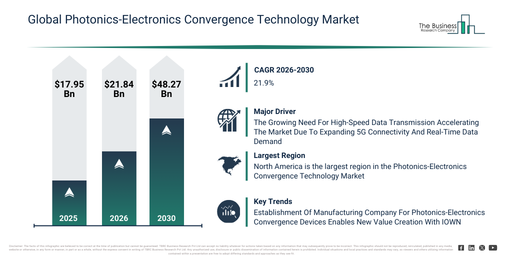
The photonics-electronics convergence technology market has witnessed substantial expansion in recent years. Its value is expected to increase from $17.95 billion in 2025 to $21.84 billion in 2026, demonstrating a compound annual growth rate (CAGR) of 21.7%. The market’s historical growth can be attributed to the rising demand for high-speed data transmission, the growing need for energy-efficient computing, the widespread adoption of optical communication technologies, an increase in data center deployments, and continuous technological advancements in photonic components.
The photonics-electronics convergence technology market is projected to experience substantial growth in the coming years. It is anticipated to reach $48.27 billion in 2030, demonstrating a compound annual growth rate (CAGR) of 21.9%. This expansion during the forecast period is fueled by the increasing adoption of integrated photonics, a rising demand for AI and high-performance computing (HPC) applications, the ongoing expansion of 5G and telecommunication networks, the growing need for low-latency optical interconnects, and the broader application in healthcare and medical imaging. Prominent trends expected in this timeframe include the increasing uptake of photonic-electronic integrated circuits, a heightened demand for high-speed optical interconnects, the growing deployment of energy-efficient computing solutions, the widening scope of ultra-low-latency data transmission applications, and the increasing integration of advanced optical sensing and imaging systems.
Get A Free Sample Report With In-Depth Market Insights:
Photonics-Electronics Convergence Technology Market Industry Drivers: What’s Behind The Revenue Growth?
The rising need for rapid data transfer is anticipated to boost the expansion of the photonics electronics convergence technology market in the future. High-speed data transmission involves the swift movement of extensive digital data across networks with minimal latency, facilitating quicker communication, processing, and real-time connections. The surge in high-speed data transmission, driven by the growing requirement for real-time data processing and ultra-fast connectivity, is prompting the deployment of sophisticated networking infrastructure to accommodate greater bandwidth and reduced latency. Photonics electronics convergence technology supports high-speed data transmission by combining optical and electronic elements to enable extremely fast signal processing, enhanced bandwidth capacity, and significantly shortened transmission delays. For instance, in March 2024, 5G Americas, a US-based wireless industry trade association, indicated that by the end of 2023, there were 1.76 billion 5G connections worldwide, representing an addition of 700 million connections during the year, which was a 66% growth compared to 2022. Global 5G connections are projected to reach 7.9 billion by 2028. Consequently, the increasing demand for high-speed data transmission is fueling the growth of the photonics electronics convergence technology market.
Photonics-Electronics Convergence Technology Market Segment Performance And Emerging Opportunities
The photonics-electronics convergence technology market covered in this report is segmented –
1) By Component: Electronic Integrated Circuits, Optical Interconnects, Transceivers, Other Components
2) By Material: Silicon Photonics, Indium Phosphide, Gallium Arsenide, Lithium Niobate, Other Materials
3) By Application: Data Centers, Telecommunications, High Performance Computing, Consumer Electronics, Healthcare And Medical Devices
4) By End User: Information Technology And Telecommunications, Consumer Electronics, Healthcare, Automotive And Mobility, Military And Defense, Other End Users
Subsegments:
1) By Electronic Integrated Circuits: Photonic Integrated Circuits, High-Speed Analog Integrated Circuits, Digital Signal Processing Integrated Circuits, Radio-Frequency Integrated Circuits, Application-Specific Integrated Circuits
2) By Optical Interconnects: Fiber Optic Cables, Waveguides, Optical Splitters, Optical Multiplexers, Optical Couplers
3) By Transceivers: Optical Transceivers, Coherent Transceivers, Direct-Detection Transceivers, Pluggable Transceivers, Integrated Transceiver Modules
4) By Other Components: Optical Amplifiers, Photodetectors, Laser Diodes, Modulators, Optical Switches
#Photonics-Electronics Convergence Technology Market Growth Trends: What’s Shaping The Future Outlook?
Leading companies in the Photonics Electronics Convergence Technology market are concentrating on creating sophisticated solutions, including advanced communication and computing technology, to cater to the rising demand from data-intensive applications. This advanced communication and computing technology involves next-generation systems that integrate high-speed connectivity, intelligent data processing, and closely intertwined hardware–software platforms to handle large data volumes. For example, in May 2023, NTT Corporation, a Japan-based technology company, moved forward with plans to establish a manufacturing company for photonics-electronics convergence devices, as part of its IOWN vision. The objective of this undertaking is to accelerate the mass production of optical-based devices, enable their seamless integration with electronic circuits, and bolster next-generation computing and network infrastructure. This infrastructure is intended to deliver new value through significantly reduced power consumption, improved processing efficiency, and enhanced data transmission performance.
Photonics-Electronics Convergence Technology Market Competitive Analysis Of Leading Industry Participants
Major companies operating in the photonics electronics convergence technology market are Samsung Electronics Co. Ltd, Hon HAI Precision Industry Co. Ltd, Sony Group Corporation, Panasonic Holdings Corporation, Cisco Systems Incorporated, Intel Corporation, Fujitsu Limited, Toshiba Corporation, Texas Instruments Incorporated, Infineon Technologies AG, STMicroelectronics N V, Corning Incorporated, onsemi Corporation, Lite On Technology Corporation, Coherent Corp, Ciena Corporation, ams OSRAM AG, Vishay Intertechnology Inc, ROHM Co. Ltd, Hamamatsu Photonics K K, IPG Photonics Corporation, and Nichia Corporation.
View The Full Photonics-Electronics Convergence Technology Market Report:
Photonics-Electronics Convergence Technology Market Geographic Spread And Regional Opportunities
North America was the largest region in the photonics electronics convergence technology market in 2025. Asia-Pacific is expected to be the fastest-growing region in the forecast period. The regions covered in the photonics-electronics convergence technology market report are Asia-Pacific, South East Asia, Western Europe, Eastern Europe, North America, South America, Middle East, Africa.
Reach Out To Our Team:
The Business Research Company: https://www.thebusinessresearchcompany.com/
Americas: +1 310-496-7795
Asia: +44 7882 955267 & +91 8897263534
Europe: +44 7882 955267
Email us at: marketing@tbrc.info
Follow us on:
LinkedIn: https://in.linkedin.com/company/the-business-research-company
YouTube: https://www.youtube.com/channel/UC24_fI0rV8cR5DxlCpgmyFQ
Global Market Model: https://www.thebusinessresearchcompany.com/global-market-model

Wasay has over a decade of experience in market research, data modelling, and analytics, with prior experience at GlobalData and Decision Tree Consulting Services. At The Business Research Company , he leads research operations across syndicated studies, customized consulting engagements, and the Global Market Model platform. His professional experience includes supporting organizations such as Boston Consulting Group, KPMG, and Ernst & Young. Wasay holds a degree in Electronics and Communications Engineering, postgraduate management qualifications from International Management Institute Belgium and Indian School of Business and Entrepreneurship, and completed the Integrated Program in Business Analytics from Indian Institute of Management Indore.