Designed to make market research more actionable and strategically valuable, The Business Research Company’s 2026 market reports feature market attractiveness scoring, total addressable market sizing, company benchmarking matrices, interactive Excel dashboards, deeper supply chain intelligence, emerging startup tracking, and granular product-level insights.
Payables Supply Chain Finance Market To Expand At A 9.7% CAGR: Size And Growth Projections Through 2030
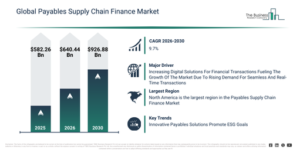
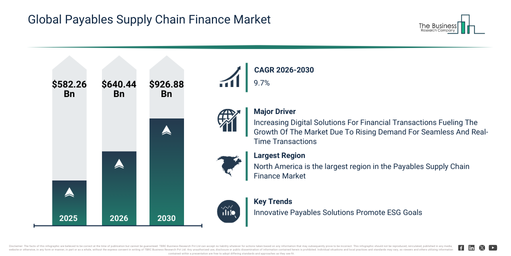
The payables supply chain finance market has experienced significant expansion recently. It is anticipated to increase from $582.26 billion in 2025 to $640.44 billion in 2026, achieving a compound annual growth rate (CAGR) of 10.0%. This historical growth can be attributed to factors such as the expansion of globalized supply chains, increased pressure on supplier cash flows, wider adoption of electronic invoicing, growing participation of banks in scf programs, and the rising use of early payment discounting.
The payables supply chain finance market is anticipated to experience robust growth in the next few years. It is projected to grow to $926.88 billion in 2030, at a compound annual growth rate (CAGR) of 9.7%. This expansion during the forecast period can be attributed to an increased focus on supply chain resilience, a rise in fintech-led scf innovation, the proliferation of cloud-based finance platforms, growing demand from SMEs for liquidity access, and enhanced regulatory clarity around scf structures. Significant trends expected in the forecast period include the increasing adoption of reverse factoring programs, a rising utilization of digital supply chain finance platforms, growing integration of automated invoice processing, an expansion of buyer-led working capital optimization, and an enhanced focus on supplier liquidity management.
Get Your Free Payables Supply Chain Finance Market Report Sample Today:
Which Factor Is Expected To Drive The Payables Supply Chain Finance Market Over The Forecast Period?
The expansion of digital financial transaction solutions is anticipated to boost the payables supply chain finance market’s growth in the future. These solutions encompass technology-based platforms and tools that facilitate the secure, efficient, and smooth completion of financial dealings digitally. The growth of digital solutions is driven by a growing consumer demand for readily available, convenient, and real-time financial services via online channels. Payables supply chain finance aids digital financial solutions through simplified invoice handling and automated early payment capabilities. This improves cash flow effectiveness for both buyers and suppliers, fostering transparency and financial flexibility throughout the supply chain. For example, as reported by the European Central Bank (ECB), a Germany-based supranational public institution, in July 2025, the overall volume of non-cash digital payments within the euro area saw an 8.6% rise, reaching 77.6 billion transactions in the second half of 2024, when contrasted with the corresponding period in 2023. Consequently, the proliferation of digital solutions for financial transactions is propelling the expansion of the payables supply chain finance market.
Payables Supply Chain Finance Market Segmentation Insights: How Is The Industry Categorized?
The payables supply chain finance market covered in this report is segmented –
1) By Type Of Financing: Dynamic Discounting, Reverse Factoring, Invoice Financing, Purchase Order Financing, Supply Chain Financing Platforms
2) By Financing Source: Banks, Non-Bank Financial Institutions, Fintech Companies, Investment Funds, Peer-To-Peer Lending Platforms
3) By Enterprise Size: Small Enterprises (1-50 employees), Medium Enterprises (51-200 employees), Large Enterprises (201+ employees)
4) By Technology Deployment: Cloud-Based Solutions, On-Premises Solutions, Hybrid Solutions
5) By Industry Vertical: Manufacturing, Retail, Healthcare, Information Technology, Construction, Food And Beverage, Telecommunications
Subsegments:
1) By Dynamic Discounting: Buyer-Funded Dynamic Discounting, Third-Party-Funded Dynamic Discounting, Early Payment Programs
2) By Reverse Factoring: Bank-Led Reverse Factoring, Multi-Bank Reverse Factoring, Fintech-Enabled Reverse Factoring
3) By Invoice Financing: Invoice Discounting, Factoring, Selective Invoice Financing
4) By Purchase Order Financing: Pre-Shipment Financing, Post-Shipment Financing, Transaction-Based Financing
5) By Supply Chain Financing Platforms: Cloud-Based Platforms, Application Programming Interface-Integrated Platforms, Blockchain-Enabled Platforms
Payables Supply Chain Finance Market Trends Explained: What Is Changing And Why It Matters
Leading firms in the payables supply chain finance market are concentrating on creating novel solutions, including environmental, social, and governance (ESG)-linked working capital finance. This effort aims to foster sustainable supply chains and satisfy the increasing need for ethical corporate conduct. ESG-linked working capital finance is defined as a financial strategy where a company’s ability to access or the expense of its working capital is connected to reaching particular ESG performance objectives, thereby promoting sustainable and accountable business operations throughout the supply chain. For example, in July 2024, Deutsche Bank AG, an investment banking firm based in Germany, introduced BASF’s first sustainability-linked payables finance program in Asia. This initiative is structured to assist BASF’s suppliers by providing better financing rates upon their achievement of defined sustainability performance metrics. The program aligns with BASF’s wider ESG objectives, motivating suppliers to implement more environmentally friendly practices while enhancing working capital efficiency throughout the supply chain. Through the incorporation of sustainability incentives into payables financing, Deutsche Bank intends to generate a positive environmental impact alongside cultivating enduring business efficiency.
Payables Supply Chain Finance Market Competitor Landscape: Who Are The Major Companies?
Major companies operating in the payables supply chain finance market are JPMorgan Chase & Co., Citibank N.A., Bank of America Corporation, Banco Santander S.A., HSBC Holdings plc., Wells Fargo & Company, Oracle Corporation, Deutsche Bank AG., Standard Chartered plc., FIS Global, Finastra, Infor Nexus, OpenText Business Network, ACI Worldwide Inc., Basware Corporation, Kyriba Corp., Tradeshift Holdings Inc., C2FO, SAP Taulia Inc., PrimeRevenue Inc., Orbian Management Limited, Credlix Technologies Private Limited
See The Full Payables Supply Chain Finance Market Report For Complete Market Sizing And Trends:
Payables Supply Chain Finance Market Regional Demand Analysis And Leading Geography
North America was the largest region in the payables supply chain finance market in 2025. Asia-Pacific is expected to be the fastest-growing region in the forecast period. The regions covered in the payables supply chain finance market report are Asia-Pacific, South East Asia, Western Europe, Eastern Europe, North America, South America, Middle East, Africa.
Reach Out To Our Team:
The Business Research Company: https://www.thebusinessresearchcompany.com/
Americas: +1 310-496-7795
Asia: +44 7882 955267 & +91 8897263534
Europe: +44 7882 955267
Email us at: marketing@tbrc.info
Follow us on:
LinkedIn: https://in.linkedin.com/company/the-business-research-company
YouTube: https://www.youtube.com/channel/UC24_fI0rV8cR5DxlCpgmyFQ
Global Market Model: https://www.thebusinessresearchcompany.com/global-market-model

Wasay has over a decade of experience in market research, data modelling, and analytics, with prior experience at GlobalData and Decision Tree Consulting Services. At The Business Research Company , he leads research operations across syndicated studies, customized consulting engagements, and the Global Market Model platform. His professional experience includes supporting organizations such as Boston Consulting Group, KPMG, and Ernst & Young. Wasay holds a degree in Electronics and Communications Engineering, postgraduate management qualifications from International Management Institute Belgium and Indian School of Business and Entrepreneurship, and completed the Integrated Program in Business Analytics from Indian Institute of Management Indore.