
The Business Research Company’s 2026 market reports combine market attractiveness scoring, total addressable market sizing, company benchmarking matrices, interactive Excel dashboards, deeper supply chain intelligence, emerging startup tracking, and granular product-level insights to deliver research that is more actionable and strategically valuable.
Is The Coatings And Application Technologies For Robotics Market Expanding? Latest Size Estimates And 2030 Projections
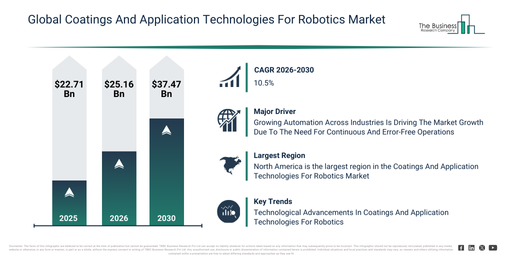
The market size for coatings and application technologies for robotics has demonstrated rapid growth in recent years. It is forecast to expand from $22.71 billion in 2025 to $25.16 billion in 2026, registering a compound annual growth rate (CAGR) of 10.8%. This historical expansion can be linked to several factors, including the surge in industrial automation, the need for durable robotic parts, the implementation of protective coatings, the broadening of manufacturing robotics, and advancements in surface engineering.
The coatings and application technologies for robotics market is projected to experience swift expansion over the coming years. This market is anticipated to reach a valuation of $37.47 billion by 2030, exhibiting a compound annual growth rate (CAGR) of 10.5%. Factors contributing to this growth during the forecast period include the rise of collaborative robots, the proliferation of smart factories, a need for high precision coatings, wider adoption of robotics across various sectors, and advancements in coating materials. Key trends identified for the forecast period encompass an increasing need for wear-resistant robotic coatings, greater implementation of automated coating systems, expanded application of low-friction surface treatments, broadening of precision coating technologies, and an emphasis on safeguarding robotic components from corrosion.
Free Coatings And Application Technologies For Robotics Market Sample: Market Size, Growth Drivers And Competitive Landscape:
Coatings And Application Technologies For Robotics Market Drivers Explained: What Is Supporting A 10.5% CAGR?
The escalating need for automation across diverse sectors is anticipated to fuel the expansion of coatings and application technologies within the robotics market. Automation, defined as the deployment of robotic systems and control mechanisms to execute tasks with minimal human involvement, significantly improves efficiency, accuracy, and scalability. This surging demand for automation stems from the imperative for greater efficiency, reduction in human errors, addressing labor shortages, and improving speed, quality, and cost-effectiveness in various industries. Coatings and application technologies specifically for robotics bolster automation by ensuring reliable robotic operation in tasks requiring high precision and facilitate high-speed functions by mitigating thermal accumulation and mechanical friction. A notable example is the projection by the International Federation of Robotics, a Germany-based professional non-profit organization, which indicated in September 2023 that the industrial robot market is expected to expand by 7% to exceed 590,000 units globally in 2023. Consequently, the rising demand for automation across numerous industries is a key driver for the growth of coatings and application technologies in the robotics market.
Coatings And Application Technologies For Robotics Market Segment Guide: Main Divisions And Subsegments
The coatings and application technologies for robotics market covered in this report is segmented –
1) By Coating Technology Type: Powder, Ultra Violet Cure, Water Borne, Solvent Borne
2) By Resin Type: Acrylics, Polyurethanes, Polyester, Epoxy
3) By Coating Layer Type: Primer, Top Coat, Base Coat
4) By End-User Industry: Healthcare, Agriculture, Mining, Manufacturing, Other End-User Industries
Subsegments:
1) By Powder: Electrostatic Spray, Fluidized Bed, Fusion Bonded Powder
2) By Ultra Violet Cure: Free Radical Ultra Violet Cure, Cationic Ultra Violet Cure, Dual Cure Ultra Violet Systems
3) By Water Borne: Single Component Waterborne, Two Component Waterborne, High Solids Waterborne
4) By Solvent Borne: One Component Solvent Borne, Two Component Solvent Borne, High Solids Solvent Borne
Coatings And Application Technologies For Robotics Market Trends And Opportunities For 2026–2030
Leading companies in the coatings and application technologies for robotics market are concentrating on developing sophisticated solutions, such as advanced arc technology, to enhance coating efficiency and sustainability in the protection of robotic components. This advanced arc technology is a cutting-edge physical vapor deposition (PVD) innovation designed to improve arc control, facilitate multi-material coatings, and boost coating consistency for advanced applications like robotics. For instance, in September 2024, Oerlikon Balzers, a Liechtenstein-based surface technology company, launched the INVENTA PVD Coating System, which uses advanced arc technology (AAT) to allow quick magnetic field adjustments, employ multi-material targets, and achieve nanolayer coating precision. This system provides up to 50% higher deposition rates, 60% better material utilization, and smoother coatings, making it perfectly suited for protecting high-tech robotic parts while simultaneously lowering energy consumption and ownership costs. Additionally, the system features a new chamber design, remote access capability, and smart monitoring tools to ensure operational efficiency and scalability for future coating innovations.
Which Major Players Are Active In The Coatings And Application Technologies For Robotics Market?
Major companies operating in the coatings and application technologies for robotics market are BASF SE, Henkel AG & Co. KGaA, The Sherwin-Williams Company, Dürr Aktiengesellschaft, Nordson Corporation, Graco Inc., Tikkurila Oyj, Carlisle Fluid Technologies Inc., Rösler Oberflächentechnik GmbH, Sames Kremlin S.A.S., Hentzen Coatings Inc., Novaria Group, General Magnaplate Corporation, The Armoloy Corporation, A&A Company Inc., Praxair Surface Technologies Inc., PPG Industries, Inc., Akzo Nobel N.V., Hempel A/S, Jotun Group, Kansai Paint Co., Ltd., Nippon Paint Holdings Co., Ltd.
Unlock The Complete Coatings And Application Technologies For Robotics Market Report With Company Benchmarking:
Coatings And Application Technologies For Robotics Market World Regions Compared: Which Leads In Revenue?
North America was the largest region in the coatings and application technologies for robotics market in 2025. The regions covered in the coatings and application technologies for robotics market report are Asia-Pacific, South East Asia, Western Europe, Eastern Europe, North America, South America, Middle East, Africa
Reach Out To Our Team:
The Business Research Company: https://www.thebusinessresearchcompany.com/
Americas: +1 310-496-7795
Asia: +44 7882 955267 & +91 8897263534
Europe: +44 7882 955267
Email us at: marketing@tbrc.info
Follow us on:
LinkedIn: https://in.linkedin.com/company/the-business-research-company
YouTube: https://www.youtube.com/channel/UC24_fI0rV8cR5DxlCpgmyFQ
Global Market Model: https://www.thebusinessresearchcompany.com/global-market-model

Wasay has over a decade of experience in market research, data modelling, and analytics, with prior experience at GlobalData and Decision Tree Consulting Services. At The Business Research Company , he leads research operations across syndicated studies, customized consulting engagements, and the Global Market Model platform. His professional experience includes supporting organizations such as Boston Consulting Group, KPMG, and Ernst & Young. Wasay holds a degree in Electronics and Communications Engineering, postgraduate management qualifications from International Management Institute Belgium and Indian School of Business and Entrepreneurship, and completed the Integrated Program in Business Analytics from Indian Institute of Management Indore.

