The Business Research Company’s 2026 market reports combine market attractiveness scoring, total addressable market sizing, company benchmarking matrices, interactive Excel dashboards, deeper supply chain intelligence, emerging startup tracking, and granular product-level insights to deliver research that is more actionable and strategically valuable.
Cosmic Infrastructure Maintenance Market Size Review: What Shaped Past Growth And What Will Drive Future Expansion?
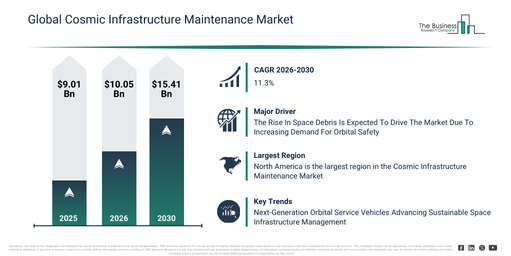
The cosmic infrastructure maintenance market has experienced significant expansion in its size over recent years. It is projected to grow from $9.01 billion in 2025 to $10.05 billion in 2026, at a compound annual growth rate (CAGR) of 11.5%. This historical growth can be attributed to an increase in satellite launches, rising space asset replacement costs, growing orbital congestion, the expansion of government space programs, and advancements in robotics technology.
The market for cosmic infrastructure maintenance is projected to experience swift expansion over the coming years. This market is forecast to reach $15.41 billion by 2030, demonstrating a compound annual growth rate (CAGR) of 11.3%. Factors driving this growth during the forecast period include the development of commercial space stations, the expansion of satellite mega constellations, a need for cost-effective space missions, advancements in robotic servicing technologies, and rising private sector investments in space. Key trends anticipated in this period encompass the increasing deployment of autonomous in-orbit servicing robots, a heightened emphasis on extending satellite operational lives, the proliferation of active space debris management solutions, the wider adoption of AI-powered predictive maintenance systems, and an elevated requirement for in-orbit inspection and diagnostics.
Access Free Sample Pages From The Cosmic Infrastructure Maintenance Market Report 2026:
Understanding The Main Driver Of The Cosmic Infrastructure Maintenance Market
The increasing amount of space debris is projected to fuel the expansion of the cosmic infrastructure maintenance market in the future. Orbital debris, also known as space debris, denotes obsolete human-made artifacts in Earth’s orbit, encompassing non-operational satellites, used rocket sections, and pieces from impact or breakup incidents. The surge in space debris primarily stems from the rapid increase in satellite launches, especially in low Earth orbit, coupled with inadequate compliance with end-of-mission disposal guidelines and a growing number of in-orbit collisions. Cosmic infrastructure maintenance is crucial for addressing this problem by facilitating active tracking of debris, providing in-orbit services, and removing satellites at the end of their operational lives, thus improving orbital safety and ensuring the sustainability of space endeavors. As an illustration, data from the European Space Agency (ESA), a France-based intergovernmental organization, indicated in July 2024 that orbiting space debris is escalating quickly, with 35,000 objects presently monitored. Among these, 26,000 are debris exceeding 10 cm, and 9,100 are operational payloads. Furthermore, 2023 recorded an unprecedented number of satellite launches, largely contributing to dense commercial constellations, resulting in more than 6,000 active satellites now clustered between 500 and 600 km altitude. Consequently, the increase in space debris is propelling the expansion of the cosmic infrastructure maintenance market.
Cosmic Infrastructure Maintenance Market Segment Mapping For 2026 And Beyond
The cosmic infrastructure maintenance market covered in this report is segmented –
1) By Service Type: Structural Repairs, System Upgrades, Debris Management, Other Service Types
2) By Technology: Robotics, AI And Machine Learning, Remote Sensing, Other Technologies
3) By Application: Satellites, Space Stations, Spacecraft, Other Applications
4) By End-User: Government, Commercial, Defense, Other End-Users
Subsegments:
1) By Structural Repairs: In-Orbit Component Replacement, Surface Micrometeoroid Damage Repair, Thermal Protection System Restoration, Hull Reinforcement And Sealing, Joint And Hinge Reconditioning
2) By System Upgrades: Power System Enhancement, Propulsion Retrofitting, Communication System Modernization, Software Patch Deployment, Sensor Suite Augmentation
3) By Debris Management: Active Debris Removal, Collision Avoidance Maneuvering, Debris Tracking And Cataloging, End-Of-Life Deorbiting Services, Tethered Capture Systems
4) By Other Service Types: Refueling And Resource Replenishment, Inspection And Diagnostics, Orbital Repositioning And Towing, Life-Extension Servicing, Environmental Monitoring For Maintenance Support
What Key Trend Is Expected To Shape The Cosmic Infrastructure Maintenance Market Over The Forecast Period?
Major companies operating in the cosmic infrastructure maintenance market are prioritizing the development of advanced solutions, such as orbital service vehicles, to support long-term sustainability in orbit. An orbital service vehicle is a type of spacecraft designed to carry out a variety of in-orbit support functions, including satellite upkeep, refueling, repositioning, and managing end-of-life procedures, all aimed at sustaining and extending the operational life of space infrastructure. As an illustration, in February 2024, Space Machines Company, an Australia-based space logistics enterprise, successfully launched Optimus, an innovative orbital servicing vehicle. Optimus is built to provide on-demand services like satellite repair, fuel replenishment, and system upgrades, promoting more efficient and sustainable management of assets in space. It incorporates a space-grade digital fiber-optic gyroscope-based inertial navigation system, which enables the precise maneuvers critical for secure docking and complex orbital operations.
Cosmic Infrastructure Maintenance Market Major Players And Industry Competition Overview
Major companies operating in the cosmic infrastructure maintenance market are RTX Corporation, The Boeing Company, Airbus SE, Mitsubishi Electric Corporation, Northrop Grumman Corporation, Honeywell Aerospace, BAE Systems plc, Safran S.A., Thales Group, Leonardo S.p.A., Space Exploration Technologies Corp., Sierra Nevada Corporation, OHB SE, Maxar Technologies Inc. (Advent International), Momentus Inc., ClearSpace SA, Orbit Fab Inc., Astroscale Holdings Inc., Kurs Orbital, Rogue Space Systems Corporation.
Full Cosmic Infrastructure Maintenance Market Report: Market Size, Trends, Segments And Key Players:
Cosmic Infrastructure Maintenance Market Geographic Segmentation: Regions Covered In The Report
North America was the largest region in the cosmic infrastructure maintenance market in 2025, and it is expected to be the fastest-growing region in the forecast period. The regions covered in the cosmic infrastructure maintenance market report are Asia-Pacific, South East Asia, Western Europe, Eastern Europe, North America, South America, Middle East, Africa
Reach Out To Our Team:
The Business Research Company: https://www.thebusinessresearchcompany.com/
Americas: +1 310-496-7795
Asia: +44 7882 955267 & +91 8897263534
Europe: +44 7882 955267
Email us at: marketing@tbrc.info
Follow us on:
LinkedIn: https://in.linkedin.com/company/the-business-research-company
YouTube: https://www.youtube.com/channel/UC24_fI0rV8cR5DxlCpgmyFQ
Global Market Model: https://www.thebusinessresearchcompany.com/global-market-model

Wasay has over a decade of experience in market research, data modelling, and analytics, with prior experience at GlobalData and Decision Tree Consulting Services. At The Business Research Company , he leads research operations across syndicated studies, customized consulting engagements, and the Global Market Model platform. His professional experience includes supporting organizations such as Boston Consulting Group, KPMG, and Ernst & Young. Wasay holds a degree in Electronics and Communications Engineering, postgraduate management qualifications from International Management Institute Belgium and Indian School of Business and Entrepreneurship, and completed the Integrated Program in Business Analytics from Indian Institute of Management Indore.