
The Business Research Company’s 2026 market reports combine market attractiveness scoring, total addressable market sizing, company benchmarking matrices, interactive Excel dashboards, deeper supply chain intelligence, emerging startup tracking, and granular product-level insights to deliver research that is more actionable and strategically valuable.
Plant-Based Protein Market Value Projected To Grow At A 17.1% Compound Annual Growth Rate Through 2030
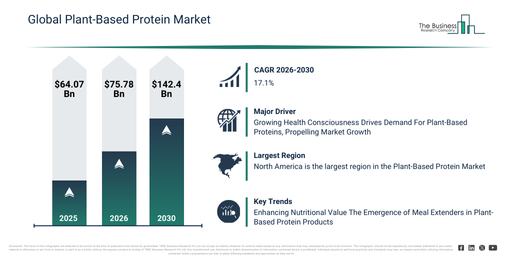
The plant-based protein market size has expanded quickly in recent years. It is anticipated to grow from $64.07 billion in 2025 to $75.78 billion in 2026, achieving a compound annual growth rate (CAGR) of 18.3%. The market’s historic growth can be attributed to heightened awareness of the benefits of plant-based nutrition, the broadened utilization of soy and pea proteins, an increasing demand for meat substitutes, greater availability of plant protein ingredients, and the adoption of plant proteins in animal feed.
The plant-based protein market is anticipated to experience substantial growth in the coming years, with projections indicating it will reach $142.4 billion by 2030, exhibiting a compound annual growth rate (CAGR) of 17.1%. This expansion during the forecast period is primarily driven by an escalating demand for sustainable nutrition solutions, advancements in plant protein formulations, the broadening scope of personalized nutrition trends, increased incorporation of plant proteins in sports nutrition, and an enhanced regulatory focus on sustainable food systems. Prominent trends expected over this period include a rise in the consumption of plant-based protein products, a growing preference for clean and natural protein sources, wider adoption of flexitarian diets, expanded application of plant proteins in fortified foods, and a greater emphasis on optimizing nutritional profiles.
Evaluate The Plant-Based Protein Market Report Before You Buy With A Free Sample:
Plant-Based Protein Market Growth Driver Analysis For The 2026–2030 Forecast Period
The growing focus on health and well-being is projected to drive the plant-based protein market’s expansion. This awareness signifies consumers’ increasing commitment to nutritious eating, active living, and proactive healthcare for enhanced overall well-being. The emphasis on wellness is intensifying as a greater number of people opt for healthier food selections. The plant-based protein market aids health and wellness by providing protein choices that are rich in nutrients, low in fat, and high in fiber, aligning with preventive health objectives. This strong correlation between what consumers prioritize for wellness and the nutritional advantages of plant-based proteins boosts the market’s importance and uptake. For example, data from Health Affairs, a US health policy journal, indicated in December 2024 that US healthcare expenditures rose by 7.5% in 2023, an increase from 4.6% in 2022. Consequently, the heightened consciousness regarding health and wellness is fueling the expansion of the plant-based protein market.
Plant-Based Protein Market Segmentation Breakdown: Primary And Secondary Categories
The plant-based protein market covered in this report is segmented –
1) By Type: Isolates, Concentrates, Textured
2) By Source: Soy, Wheat, Pea, Other Sources
3) By Form: Dry, Liquid
4) By Application: Feed, Food, Other Applications
Subsegments:
1) By Isolates: Soy Protein Isolate, Pea Protein Isolate, Rice Protein Isolate, Wheat Protein Isolate
2) By Concentrates: Soy Protein Concentrate, Pea Protein Concentrate, Rice Protein Concentrate, Hemp Protein Concentrate
3) By Textured: Textured Soy Protein (TSP), Textured Pea Protein, Textured Wheat Protein, Textured Rice Protein
Plant-Based Protein Market Industry Trends: New Developments From Leading Companies
Key players within the plant-based protein market are concentrating on creating novel offerings, including Meal Extenders, to boost the nutritional content and elevate the taste and texture of meat substitutes. A meal extender is defined as an additive that expands the quantity or mass of a meal without considerably affecting its taste. Often incorporated into diverse culinary traditions, these extenders can consist of components such as grains, vegetables, or legumes, thereby assisting in cost reduction and the enlargement of serving portions. As an illustration, in July 2024, Nestle, a Switzerland-based food company, introduced Maggi Rindecarne, designed to enrich dishes when mixed with conventional minced meat. Maggi Rindecarne functions as a plant-based meat extender that improves meals when blended with traditional minced meat, delivering roughly 5.2 g of protein per serving while maintaining a reduced fat level. This economical option enables families to double their meal portions, presenting an affordable alternative for consumers mindful of their budget.
Who Are The Top Competitors In The Plant-Based Protein Market?
Major companies operating in the plant-based protein market are Archer-Daniels-Midland Company, DuPont Nutrition & Biosciences, Axiom Foods Inc., Cargill Inc., Kerry Group, Ingredion Inc., Roquette Freres SA, Wilmar International Ltd., Glanbia plc, Cosucra Groupe Warcoing SA, Sotexpro SAS, Emsland Group, Puris Proteins LLC., Beyond Meat Inc., BENEO GmbH, Tate & Lyle plc, Shandong Jianyuan group, Proeon Foods, Australian Plant Proteins Pty Ltd., Impossible Foods Inc., Nestle SA, Kellogg Company, Conagra Brands Inc., Tyson Foods Inc., Turtle Island Foods, Lightlife Foods Inc., Field Roast Grain Meat Co. Inc., Quorn Foods Ltd.
Access The Plant-Based Protein Market Report For Complete Segment-Level Analysis:
Which Region Leads The Plant-Based Protein Market, And Which Regions Are Covered?
North America was the largest region in the plant-based protein market in 2025. Asia-Pacific is expected to be the fastest-growing region in the forecast period. The regions covered in the plant-based protein market report are Asia-Pacific, South East Asia, Western Europe, Eastern Europe, North America, South America, Middle East and Africa.
Reach Out To Our Team:
The Business Research Company: https://www.thebusinessresearchcompany.com/
Americas: +1 310-496-7795
Asia: +44 7882 955267 & +91 8897263534
Europe: +44 7882 955267
Email us at: marketing@tbrc.info
Follow us on:
LinkedIn: https://in.linkedin.com/company/the-business-research-company
YouTube: https://www.youtube.com/channel/UC24_fI0rV8cR5DxlCpgmyFQ
Global Market Model: https://www.thebusinessresearchcompany.com/global-market-model

Wasay has over a decade of experience in market research, data modelling, and analytics, with prior experience at GlobalData and Decision Tree Consulting Services. At The Business Research Company , he leads research operations across syndicated studies, customized consulting engagements, and the Global Market Model platform. His professional experience includes supporting organizations such as Boston Consulting Group, KPMG, and Ernst & Young. Wasay holds a degree in Electronics and Communications Engineering, postgraduate management qualifications from International Management Institute Belgium and Indian School of Business and Entrepreneurship, and completed the Integrated Program in Business Analytics from Indian Institute of Management Indore.

