Designed to make market research more actionable and strategically valuable, The Business Research Company’s 2026 market reports feature market attractiveness scoring, total addressable market sizing, company benchmarking matrices, interactive Excel dashboards, deeper supply chain intelligence, emerging startup tracking, and granular product-level insights.
Dimethyl Ether (DME) Synthesis From Carbon Dioxide (CO2) Market To Expand At A 15.9% CAGR: Size And Growth Projections Through 2030
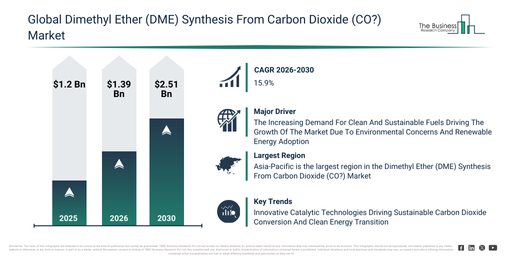
The dimethyl ether (DME) synthesis from carbon dioxide (CO2) market has experienced rapid expansion in recent years. This market is projected to grow from $1.2 billion in 2025 to $1.39 billion in 2026, achieving a compound annual growth rate (CAGR) of 16.2%. The historical growth can be attributed to factors such as fossil fuel dependence, fuel emission regulations, the establishment of methanol-to-DME pathways, energy diversification initiatives, and advancements in catalytic process development.
The dimethyl ether (dme) synthesis from carbon dioxide (co2) market size is projected to experience swift expansion over the coming years. It is anticipated to reach $2.51 billion by 2030, demonstrating a compound annual growth rate (CAGR) of 15.9%. This growth during the forecast period is primarily driven by clean fuel mandates, the expansion of the hydrogen economy, the integration of renewable energy sources, incentives for carbon utilization, and the decarbonization of transportation fuels. Major trends foreseen for the forecast horizon include a heightened interest in alternative clean fuels, the increasing use of dme as a diesel substitute, the broadening of co2 hydrogenation technologies, an amplified focus on energy security, and the development of integrated ccu systems.
Get Your Free Dimethyl Ether (DME) Synthesis From Carbon Dioxide (CO2) Market Report Sample Today:
Which Factor Is Expected To Drive The Dimethyl Ether (DME) Synthesis From Carbon Dioxide (CO2) Market Over The Forecast Period?
The escalating requirement for clean and sustainable fuels is anticipated to propel the growth of the dimethyl ether (DME) synthesis from carbon dioxide (CO2) market in the coming period. These fuels are energy sources characterized by minimal environmental pollution, derived from renewable or low-carbon resources, thereby ensuring their long-term availability without depleting natural resources. The heightened demand for these fuels arises from increasing environmental concerns, as both industries and consumers aim to reduce greenhouse gas emissions, combat climate change, and lessen the ecological impact of traditional fossil fuels. Dimethyl ether (DME) synthesis from carbon dioxide (CO2) contributes to the category of clean and sustainable fuels by converting waste CO2 into a low-emission, renewable fuel alternative that diminishes reliance on fossil fuels and mitigates greenhouse gas emissions. For example, in September 2023, the U.S. Energy Information Administration, a US-based federal agency, reported that the nationwide biofuels production capacity, encompassing renewable diesel, biodiesel, ethanol, and other biofuels, stood at 23 billion gallons per year (gal/y), signifying a 6% increase in total capacity compared to January 2022. Consequently, the increasing demand for clean and sustainable fuels is driving the dimethyl ether (DME) synthesis from carbon dioxide (CO2) market.
Dimethyl Ether (DME) Synthesis From Carbon Dioxide (CO2) Market Segmentation Insights: How Is The Industry Categorized?
The dimethyl ether (dme) synthesis from carbon dioxide (co2) market covered in this report is segmented –
1) By Technology: Direct Synthesis, Indirect Synthesis
2) By Feedstock: Carbon Dioxide With Hydrogen, Carbon Dioxide With Syngas
3) By Application: Fuel, Aerosol Propellant, Refrigerant, Chemical Intermediate, Other Applications
4) By End-User: Automotive, Power Generation, Chemical Industry, Other End-Users
Subsegments:
1) By Direct Synthesis: Catalytic Hydrogenation, Methanol Dehydration, Single-Step Conversion, Hybrid Conversion
2) By Indirect Synthesis: Methanol Route, Syngas Route, CO2 Hydrogenation Followed By Dehydration, Two-Step Conversion
Dimethyl Ether (DME) Synthesis From Carbon Dioxide (CO2) Market Trends Explained: What Is Changing And Why It Matters
Leading firms within the dimethyl ether (DME) synthesis from carbon dioxide (CO2) market are prioritizing the creation of novel technologies, including sophisticated catalytic conversion methods, to boost conversion effectiveness and lower carbon output. These advanced catalytic conversion technologies involve state-of-the-art procedures employing highly effective catalysts to speed up chemical reactions, facilitating the transformation of carbon dioxide (CO2) into useful fuels or chemicals like dimethyl ether (DME) with enhanced efficiency and reduced energy expenditure. As an illustration, during November 2025, Godavari Biorefineries Limited, an India-based bio-based manufacturing company, collaborated with the Institute of Chemical Technology (ICT), an India-based deemed university, to initiate a groundbreaking pilot project focused on directly transforming industrial CO2 emissions into Dimethyl Ether (DME), which serves as a clean-burning, low-emission energy carrier. This sustainable fuel provides an environmentally friendly substitute for LPG and diesel, simultaneously acting as a adaptable chemical raw material for various industrial applications. This endeavor helps in lowering greenhouse gas emissions, supports a circular economy through the reuse of waste CO2, and corresponds with India’s wider objectives for energy transition and rural advancement.
Dimethyl Ether (DME) Synthesis From Carbon Dioxide (CO2) Market Competitor Landscape: Who Are The Major Companies?
Major companies operating in the dimethyl ether (dme) synthesis from carbon dioxide (co2) market are Sinopec Limited, BASF SE, Linde plc, Air Liquide S.A., Johnson Matthey plc, Air Products and Chemicals Inc., Toyo Engineering Corporation, Nippon Gases Co. Ltd., Haldor Topsoe A/S, TNO, Proman AG, Mitsubishi Gas Chemical Company Inc., Oberon Fuels Inc., Real Carbon Technology Private Limited, Winspiration Energy and Engineering Pvt. Ltd., Dimeta B.V., Grillo-Werke AG, Carbon Recycling International hf, Thyssenkrupp Uhde (Uhde GmbH), Liquid Wind AB, Eni S.p.A., TotalEnergies SE
See The Full Dimethyl Ether (DME) Synthesis From Carbon Dioxide (CO2) Market Report For Complete Market Sizing And Trends:
Dimethyl Ether (DME) Synthesis From Carbon Dioxide (CO2) Market Regional Demand Analysis And Leading Geography
Asia-Pacific was the largest region in the market in 2025. Europe is expected to be the fastest-growing region in the forecast period. The regions covered in the dimethyl ether (dme) synthesis from carbon dioxide (co2) market report are Asia-Pacific, South East Asia, Western Europe, Eastern Europe, North America, South America, Middle East, Africa
Reach Out To Our Team:
The Business Research Company: https://www.thebusinessresearchcompany.com/
Americas: +1 310-496-7795
Asia: +44 7882 955267 & +91 8897263534
Europe: +44 7882 955267
Email us at: marketing@tbrc.info
Follow us on:
LinkedIn: https://in.linkedin.com/company/the-business-research-company
YouTube: https://www.youtube.com/channel/UC24_fI0rV8cR5DxlCpgmyFQ
Global Market Model: https://www.thebusinessresearchcompany.com/global-market-model

Wasay has over a decade of experience in market research, data modelling, and analytics, with prior experience at GlobalData and Decision Tree Consulting Services. At The Business Research Company , he leads research operations across syndicated studies, customized consulting engagements, and the Global Market Model platform. His professional experience includes supporting organizations such as Boston Consulting Group, KPMG, and Ernst & Young. Wasay holds a degree in Electronics and Communications Engineering, postgraduate management qualifications from International Management Institute Belgium and Indian School of Business and Entrepreneurship, and completed the Integrated Program in Business Analytics from Indian Institute of Management Indore.