The Business Research Company’s 2026 market reports are designed to deliver research that is more actionable and strategically valuable. Key offerings include market attractiveness scoring, total addressable market sizing, company benchmarking matrices, interactive Excel dashboards, deeper supply chain intelligence, emerging startup tracking, and granular product-level insights.
Exoplanet Exploration Market Size 2026: Valuation, Growth Rate And Forecast To 2030
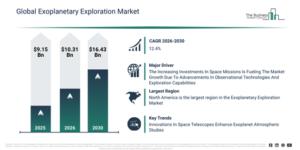
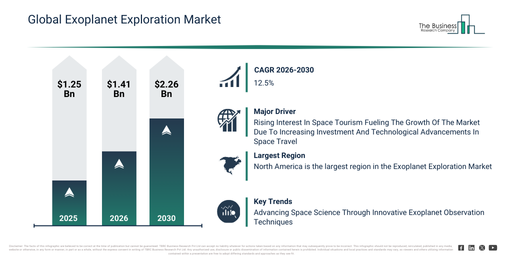
The exoplanet exploration market has shown rapid expansion in its size over recent years. Its value is expected to rise from $1.25 billion in 2025 to $1.41 billion in 2026, achieving a compound annual growth rate (CAGR) of 12.8%. This past expansion is largely due to improvements in telescope technology, increased funding for astrophysics research, the initial identification of exoplanets, the development of more space observatories, and better data processing abilities.
The exoplanet exploration market size is anticipated to experience substantial growth in the upcoming years, with projections indicating it will reach $2.26 billion in 2030, expanding at a compound annual growth rate (CAGR) of 12.5%. This expected growth during the forecast period stems from factors such as next generation space telescope missions, increasing interest in extraterrestrial life research, the proliferation of private space exploration companies, advancements in deep space imaging, and a rise in interdisciplinary scientific collaborations. Significant trends for the forecast period include the increasing deployment of space-based telescopes, the growing adoption of AI-driven data analysis for exoplanet detection, the expansion of spectroscopy-based atmospheric analysis, rising collaboration between public and private space institutions, and a higher focus on habitable zone planet discovery.
Get A Free Sample Of The Exoplanet Exploration Market Report 2026:
What Is Driving The Growth Of The Exoplanet Exploration Market?
The increasing appeal of space tourism is projected to boost the expansion of the exoplanet exploration market in the future. Space tourism involves individuals traveling commercially into space for recreation or adventure. The growing public captivation with venturing into space is fueling this interest, as more individuals desire to experience the excitement of journeys beyond our planet and explore what was once an inaccessible domain. Exoplanet exploration is vital for the development of space tourism, as it identifies worlds outside our solar system that could potentially sustain life or host human visitors. For instance, in May 2025, PatentPC, a US-based full-service law firm, projected that between 250 and 400 people would travel to space in 2025. Consequently, the rising fascination with space tourism is fostering the growth of the exoplanet exploration market. The increasing fascination with space exploration is expected to stimulate the expansion of the exoplanet exploration market in the forthcoming years. Space exploration involves investigating and uncovering elements of outer space using astronomical methods, advanced space technologies, and missions extending beyond Earth’s atmosphere. This heightened interest stems from advancements in technology, which render space missions more viable, streamlined, and economical, thereby encouraging participation from both governmental bodies and private enterprises. This surging interest in space exploration substantially aids exoplanet research by attracting financial support, encouraging international partnerships, and spurring technological breakthroughs. Such enthusiasm expedites missions focused on locating and analyzing exoplanets, bringing humanity closer to discovering Earth-like environments and comprehending our position in the cosmos. For instance, in March 2025, according to the House of Commons Library, a UK-based library and information resource of the lower house of the British Parliament, the UK government announced that contracts worth a total of $1,150.03 million (£844 million) were awarded to the country between 2022 and 2024 via the European Space Agency (ESA). Consequently, the deepening interest in space exploration is set to accelerate the growth of the exoplanet exploration market.
How Is The Exoplanet Exploration Market Segmented?
The exoplanet exploration market covered in this report is segmented –
1) By Technology: Space Telescopes, Ground-Based Telescopes, Spectroscopy Instruments, Other Technologies
2) By Application: Scientific Research, Commercial, Other Applications
3) By End-User: Government Agencies, Academic Institutions, Other End Users
Subsegments:
1) By Space Telescopes: Optical Space Telescopes, Infrared Space Telescopes, Ultraviolet Space Telescopes, X-ray Space Telescopes
2) By Ground-Based Telescopes: Optical Ground Telescopes, Radio Telescopes, Adaptive Optics Telescopes, Very Large Telescopes (VLTs)
3) By Spectroscopy Instruments: Transit Spectrometers, Radial Velocity Spectrometers, Direct Imaging Spectrometers, Atmospheric Characterization Spectrometers
4) By Other Technologies: Coronagraphs, Starshades, Interferometers, Photometric Detectors
What Are The Latest Trends In The Exoplanet Exploration Market?
Leading companies within the exoplanet exploration market are concentrating on creating exoplanet missions to offer crucial understanding regarding how planetary systems throughout the galaxy form and evolve. These exoplanet missions represent scientific initiatives conducted from space, primarily dedicated to identifying and examining planets located outside our solar system. For example, in February 2025, the US government agency NASA chose SpaceX, a US-based aerospace manufacturer, for the launch of Pandora. This 716-pound (325-kilogram) satellite is engineered to assist scientists in acquiring more profound knowledge about how changes in parent stars affect the atmospheres of exoplanets. Pandora will operate in low Earth orbit, with its primary objective being the observation of a minimum of 20 transiting exoplanets—planets that pass in front of their stars as seen from the satellite. Each of these planets will undergo scrutiny 10 times, with observations continuing uninterrupted for 24-hour periods. The satellite incorporates a 17-inch-wide all-aluminum telescope capable of capturing both visible and near-infrared light, in addition to near-infrared spectra emanating from the planets.
Who Are The Key Players In The Exoplanet Exploration Market?
Major companies operating in the exoplanet exploration market are Raytheon Technologies, Lockheed Martin Corp., Airbus SE, Northrop Grumman Corp., Mitsubishi Electric Corp., Honeywell International Inc., National Aeronautics And Space Administration (NASA), Thales Alenia Space, L3Harris Technologies Inc., Leidos Holdings Inc., CACI International Inc., Teledyne Technologies Inc., Bruker Corp., General Atomics, DLR, Ball Aerospace and Technologies, OHB System AG, Sierra Nevada Corporation, JAXA
Read The Complete Exoplanet Exploration Market Report 2026:
Which Region Is The Largest In The Exoplanet Exploration Market?
North America was the largest region in the exoplanet exploration market in 2025. The regions covered in the exoplanet exploration market report are Asia-Pacific, South East Asia, Western Europe, Eastern Europe, North America, South America, Middle East, Africa
Reach Out To Our Team:
The Business Research Company: https://www.thebusinessresearchcompany.com/
Americas: +1 310-496-7795
Asia: +44 7882 955267 & +91 8897263534
Europe: +44 7882 955267
Email us at: marketing@tbrc.info
Follow us on:
LinkedIn: https://in.linkedin.com/company/the-business-research-company
YouTube: https://www.youtube.com/channel/UC24_fI0rV8cR5DxlCpgmyFQ
Global Market Model: https://www.thebusinessresearchcompany.com/global-market-model

Wasay has over a decade of experience in market research, data modelling, and analytics, with prior experience at GlobalData and Decision Tree Consulting Services. At The Business Research Company , he leads research operations across syndicated studies, customized consulting engagements, and the Global Market Model platform. His professional experience includes supporting organizations such as Boston Consulting Group, KPMG, and Ernst & Young. Wasay holds a degree in Electronics and Communications Engineering, postgraduate management qualifications from International Management Institute Belgium and Indian School of Business and Entrepreneurship, and completed the Integrated Program in Business Analytics from Indian Institute of Management Indore.