With a focus on actionable insights and strategic value, The Business Research Company’s 2026 market reports include market attractiveness scoring, total addressable market sizing, company benchmarking matrices, interactive Excel dashboards, deeper supply chain intelligence, emerging startup tracking, and granular product-level insights.
Charge Card Market Size Analysis: Historical Growth And Future Revenue Projections
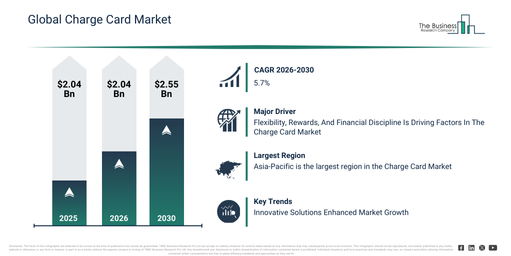
The charge card market size has shown slight expansion in recent times. The market is forecast to expand to $2.04 billion in 2025 and maintain this valuation in 2026, demonstrating a compound annual growth rate (CAGR) of 0.0%. During the historical period, the growth was driven by factors such as the increasing reach of electronic payment systems, evolving corporate expense management requirements, a rise in cashless transaction uptake, broadening global travel and business expenditures, and enhancements in banking infrastructure.
The charge card market is anticipated to exhibit robust expansion over the forthcoming years. It is predicted to reach $2.55 billion in 2030, progressing at a compound annual growth rate (CAGR) of 5.7%. This expansion during the forecast period is fueled by several factors, including the increasing incorporation of AI-driven risk assessment, a surging demand for real-time expense analytics, the broadening of embedded finance solutions, a growing inclination for contactless and virtual cards, and a heightened focus on regulatory compliance and data security. Noteworthy trends for this forecast timeframe encompass a rising adoption of corporate charge cards, an escalating need for spend control and transparency, a stronger preference for rewards-based charge cards, the proliferation of digital-first charge card platforms, and an elevated emphasis on fraud prevention and security.
Preview The Charge Card Market Report With A Free Sample:
Charge Card Market Drivers: What Is Fueling Demand Through 2030?
The expansion of the charge card market has been fueled by the absence of a pre-determined spending limit and enhanced financial maneuverability. Charge cards provide financial adaptability, offering increased purchasing power due to their lack of a pre-set spending cap on purchases. Furthermore, these cards deliver premium rewards, optimize reward points according to spending habits, and include various travel and purchase safeguards. For example, American Express provides benefits such as complimentary airport lounge access, hotel room upgrades, and travel insurance. Responsible use of charge cards and consistent, timely payments can help customers enhance their credit scores. A charge card also facilitates the arrangement of personal events, including dining and golf reservations, as well as movie and theatre ticket bookings, alongside providing exclusive rates and discounts with major airlines. These elements stimulated the demand for charge card services, thereby propelling the charge card market. Nevertheless, the absence of a pre-set spending limit does not imply boundless spending. A customer’s purchasing capacity is adapted based on card usage, payment history, credit record, financial resources, and other considerations, fostering financial discipline within the charge card market.
Charge Card Market Driver: Consumer Spending Habits A Catalyst For Charged Card Market Growth
The anticipated expansion of the charged card market is significantly driven by evolving consumer spending habits. These habits, which encompass how individuals and households allocate their financial resources for goods and services, directly influence their preferred payment methods. Many consumers gravitate towards charged cards for the majority of their purchases due to the convenience they offer, along with rewards or cashback incentives, while others might opt for cash or debit cards. For instance, data from October 2024 by the U.S. Bureau of Economic Analysis (BEA), a U.S. government agency, indicated that Personal consumption expenditures (PCE) in US rose across all 50 states and the District of Columbia in 2023. The percentage increase varied from 8.1 percent in Florida to 4.7 percent in Iowa. On a national scale, current-dollar PCE saw a 6.4 percent rise in 2023. Consequently, the rising trend in consumer spending is poised to accelerate the growth of the charged card market.
Charge Card Market Segmentation Analysis: Core Categories And Subcategories
The charge card market covered in this report is segmented –
1) By Type: Gold Card, Platinum Card, Plum Card, Business Gold Card, Business Platinum Card, Other Types
2) By Institution Type: Banking Institutions, Non-Banking Institutions
3) By End User: Retail, Corporate, Government Or Public Sector
Subsegments:
1) By Gold Card: Standard Gold Card, Premium Gold Card
2) By Platinum Card: Standard Platinum Card, Premium Platinum Card
3) By Plum Card: Standard Plum Card, Business Plum Card
4) By Business Gold Card: Small Business Gold Card, Corporate Business Gold Card
5) By Business Platinum Card: Small Business Platinum Card, Corporate Business Platinum Card
6) By Other Types: Secured Charge Card, Travel Charge Card, Rewards Charge Card
Which Trends Will Define The Charge Card Market Through 2030?
Leading companies operating within the charge card market are focusing on developing charge cards for e-commerce, which feature an optimized user experience. An e-commerce charge card is a financial solution specifically designed for online businesses, allowing them to make purchases and manage expenses with flexible payment terms, often contingent on the company’s performance, and without a preset spending limit. For instance, in March 2023, Parker, a US-based financial technology company, unveiled the first charge card tailored for e-commerce, announcing $157 million in total funding, including $31.1 million in Series A venture funding led by Valar Ventures. The company achieved over $300 million in transaction volume at its launch, with major brands such as Amour Vert, Italic, and SpikeBall adopting the service. Parker’s distinctive underwriting approach enables flexible financing terms customized to the needs of e-commerce businesses, and the funding is earmarked to support expansion in product development, engineering, and market reach throughout 2023.
Charge Card Market Major Companies And Industry Participants
Major companies operating in the charge card market are American Express, Diners Club International, Coutts and Co., Chase Bank, Barclays plc, JCB Co Ltd, The Hongkong and Shanghai Banking Corporation Limited, HDFC Bank Ltd, ICICI Bank Limited, SBI Cards and Payment Services Limited, Axis Bank Limited, UBS Group AG, Deutsche Bank AG, BNP Paribas, Santander Group, Royal Bank of Canada, Sumitomo Mitsui Card Company, China UnionPay, HSBC Holdings plc, Standard Chartered, TD Bank, National Australia Bank, Société Générale, ANZ
Buy The Full Charge Card Global Market Report 2026:
Charge Card Market Geographic Analysis: Which Region Accounts For The Biggest Share?
Asia-Pacific was the largest region in the charge card market in 2025. Western Europe was the second largest region in the charge card market. The regions covered in the charge card market report are Asia-Pacific, South East Asia, Western Europe, Eastern Europe, North America, South America, Middle East, Africa.
Reach Out To Our Team:
The Business Research Company: https://www.thebusinessresearchcompany.com/
Americas: +1 310-496-7795
Asia: +44 7882 955267 & +91 8897263534
Europe: +44 7882 955267
Email us at: marketing@tbrc.info
Follow us on:
LinkedIn: https://in.linkedin.com/company/the-business-research-company
YouTube: https://www.youtube.com/channel/UC24_fI0rV8cR5DxlCpgmyFQ
Global Market Model: https://www.thebusinessresearchcompany.com/global-market-model

Wasay has over a decade of experience in market research, data modelling, and analytics, with prior experience at GlobalData and Decision Tree Consulting Services. At The Business Research Company , he leads research operations across syndicated studies, customized consulting engagements, and the Global Market Model platform. His professional experience includes supporting organizations such as Boston Consulting Group, KPMG, and Ernst & Young. Wasay holds a degree in Electronics and Communications Engineering, postgraduate management qualifications from International Management Institute Belgium and Indian School of Business and Entrepreneurship, and completed the Integrated Program in Business Analytics from Indian Institute of Management Indore.