
The Business Research Company’s 2026 market reports combine market attractiveness scoring, total addressable market sizing, company benchmarking matrices, interactive Excel dashboards, deeper supply chain intelligence, emerging startup tracking, and granular product-level insights to deliver research that is more actionable and strategically valuable.
Chemical Auxiliary Agents Market Size Review: What Shaped Past Growth And What Will Drive Future Expansion?
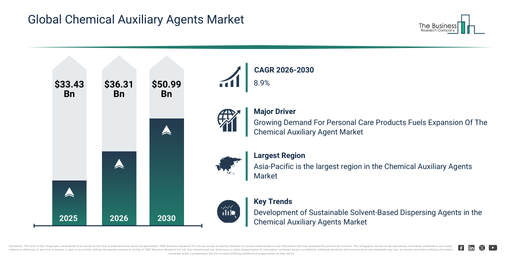
The market for chemical auxiliary agents has experienced strong growth in recent years. It is projected to expand from $33.43 billion in 2025 to $36.31 billion in 2026, achieving a compound annual growth rate (CAGR) of 8.6%. Historically, this growth can be attributed to the expansion of textile manufacturing, the increase in paint and coating production, the rising use of specialty chemicals, the industrialization of construction materials, and the availability of diverse auxiliary formulations.
The chemical auxiliary agents market is projected to experience substantial growth in the upcoming years, reaching a size of $50.99 billion by 2030, exhibiting a compound annual growth rate (CAGR) of 8.9%. This expansion during the forecast period is driven by increasing demand for sustainable chemical solutions, a rising adoption of water-based auxiliaries, the broadening scope of high-performance industrial chemicals, an intensified regulatory emphasis on chemical safety, and greater investment in specialty chemical innovation. Significant trends expected in this period encompass the increasing use of performance-enhancing additives, growing demand from the textile and paint industries, the expansion of eco-friendly auxiliary chemicals, increasing integration into construction materials, and improved process efficiency in chemical formulations.
Access Free Sample Pages From The Chemical Auxiliary Agents Market Report 2026:
Understanding The Main Driver Of The Chemical Auxiliary Agents Market
The increasing consumer need for personal care items is projected to boost the expansion of the chemical auxiliary agent market. Personal care products encompass various self-care goods utilized for personal hygiene, cleansing, and grooming purposes. Chemical auxiliary agents are incorporated into these products to inhibit microbial growth and extend their shelf life. For example, data from the Bureau of Labor Statistics, a US government body, released in December 2024, indicated that in 2023, spending on personal care products and services increased by 9.7%, alongside a 9.3% rise in expenditure on personal insurance and pensions. Consequently, the growing preference for personal care products is fueling the growth of the chemical auxiliary agent market.
Chemical Auxiliary Agents Market Segment Mapping For 2026 And Beyond
The chemical auxiliary agents market covered in this report is segmented –
1) By Type: Dispersing Agents, Emulsifying Agents, Wetting Agents, Stabilizing Agents, Thickening And Rheology Modifiers, Binding Agents, Defoaming And Antifoaming Agents, Sequestering And Chelating Agents, Lubricating Agents, Finishing And Performance Enhancement Agents
2) By Application: Technical Textiles, Home Furnishings, Apparel
3) By Industry: Paint, Paper, Textile, Other Industries
Subsegments:
1) By Dispersing Agents: Anionic Dispersing Agents, Cationic Dispersing Agents, Non-Ionic Dispersing Agents, Amphoteric Dispersing Agents
2) By Emulsifying Agents: Anionic Emulsifiers, Cationic Emulsifiers, Non-Ionic Emulsifiers, Amphoteric Emulsifiers
3) By Wetting Agents: Anionic Wetting Agents, Non-Ionic Wetting Agents, Cationic Wetting Agents, Silicone-Based Wetting Agents
4) By Stabilizing Agents: Thermal Stabilizers, Light And UV Stabilizers, Oxidation Stabilizers, pH Stabilizers
5) By Thickening And Rheology Modifiers: Cellulosic Thickeners, Synthetic Polymer Thickeners, Natural Gum Thickeners, Inorganic Rheology Modifiers
6) By Binding Agents: Polymer-Based Binders, Natural Binders, Synthetic Resin Binders, Latex-Based Binders
7) By Defoaming And Antifoaming Agents: Silicone-Based Defoamers, Oil-Based Defoamers, Water-Based Defoamers, Powder Defoamers
8) By Sequestering And Chelating Agents: Aminopolycarboxylate Chelating Agents, Phosphonate-Based Sequestering Agents, Organic Acid Chelating Agents, Biodegradable Chelating Agents
9) By Lubricating Agents: Mineral Oil-Based Lubricants, Synthetic Lubricants, Fatty Acid-Based Lubricants, Silicone-Based Lubricants
10) By Finishing And Performance Enhancement Agents: Softening Agents, Anti-Wrinkle And Crease-Resistant Agents, Water And Oil Repellents, Flame-Retardant Finishing Agents, Antimicrobial Finishing Agents
What Key Trend Is Expected To Shape The Chemical Auxiliary Agents Market Over The Forecast Period?
Major companies in the chemical auxiliary agents market are concentrating on developing sustainable auxiliaries, such as solvent-based dispersing agents, to enhance formulation performance and improve compatibility with various resin systems. A solvent-based dispersing agent refers to a chemical additive utilized in formulations to improve the dispersion of pigments and fillers within solvent-based systems, thereby enhancing product stability, color consistency, and overall effectiveness. For instance, in April 2024, BASF SE, a Germany-based chemicals company, launched Efka PX 4360. BASF’s Efka PX 4360 is a solvent-based dispersing agent crafted for industrial coatings, employing Controlled Free Radical Polymerization (CFRP) technology for superior performance and storage stability. It provides excellent compatibility with various solvent-based resin systems, enabling the formulation of tin- and aromatic-free solutions that meet modern performance and sustainability requirements.
Chemical Auxiliary Agents Market Major Players And Industry Competition Overview
Major companies operating in the chemical auxiliary agents market are BASF SE, Dow Inc., Arkema S.A., Solvay S.A., Clariant AG, Evonik Industries AG, LANXESS AG, Huntsman Corporation, Akzo Nobel N.V., Archroma Management GmbH, Croda International Plc, Ashland Global Holdings Inc., Kemira Oyj, Nouryon Chemicals Holding B.V., Wacker Chemie AG, Eastman Chemical Company, Elementis plc, Allnex Group GmbH, Kiri Industries Limited, Atul Limited
Full Chemical Auxiliary Agents Market Report: Market Size, Trends, Segments And Key Players:
Chemical Auxiliary Agents Market Geographic Segmentation: Regions Covered In The Report
Asia-Pacific was the largest region in the chemical auxiliary agents market in 2025. The regions covered in the chemical auxiliary agents market report are Asia-Pacific, South East Asia, Western Europe, Eastern Europe, North America, South America, Middle East, Africa
Reach Out To Our Team:
The Business Research Company: https://www.thebusinessresearchcompany.com/
Americas: +1 310-496-7795
Asia: +44 7882 955267 & +91 8897263534
Europe: +44 7882 955267
Email us at: marketing@tbrc.info
Follow us on:
LinkedIn: https://in.linkedin.com/company/the-business-research-company
YouTube: https://www.youtube.com/channel/UC24_fI0rV8cR5DxlCpgmyFQ
Global Market Model: https://www.thebusinessresearchcompany.com/global-market-model

Wasay has over a decade of experience in market research, data modelling, and analytics, with prior experience at GlobalData and Decision Tree Consulting Services. At The Business Research Company , he leads research operations across syndicated studies, customized consulting engagements, and the Global Market Model platform. His professional experience includes supporting organizations such as Boston Consulting Group, KPMG, and Ernst & Young. Wasay holds a degree in Electronics and Communications Engineering, postgraduate management qualifications from International Management Institute Belgium and Indian School of Business and Entrepreneurship, and completed the Integrated Program in Business Analytics from Indian Institute of Management Indore.

