
With a focus on actionable insights and strategic value, The Business Research Company’s 2026 market reports include market attractiveness scoring, total addressable market sizing, company benchmarking matrices, interactive Excel dashboards, deeper supply chain intelligence, emerging startup tracking, and granular product-level insights.
How Large Could The Chemical Blue Hydrogen Market Become By 2030 At A 24.4% CAGR?
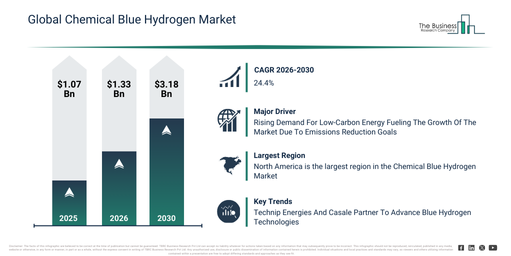
The chemical blue hydrogen market size has expanded significantly over recent years. It is projected to increase from $1.07 billion in 2025 to $1.33 billion in 2026, exhibiting a compound annual growth rate (CAGR) of 24.7%. This historic growth can be attributed to several factors including natural gas availability, the need for gray hydrogen replacement, early CCS pilot projects, high demand from the chemical industry, and energy security concerns.
The market for chemical blue hydrogen is projected to expand significantly in the coming years. By 2030, this market is anticipated to reach a valuation of $3.18 billion, exhibiting a compound annual growth rate (CAGR) of 24.4%. Driving this expansion over the forecast period are factors such as net zero targets, investments in the hydrogen economy, mandates for industrial decarbonization, advancements in CCS technology, and various hydrogen policy incentives. Key trends expected during this period involve the increasing uptake in low-carbon chemical production, the proliferation of CCS-integrated hydrogen facilities, an expanding role in the synthesis of ammonia and methanol, greater investment in hydrogen infrastructure, and an emphasis on transitional hydrogen pathways.
Get A Free Chemical Blue Hydrogen Market Sample With 2030 Forecast Insights:
Chemical Blue Hydrogen Market Outlook: Key Driver Supporting Long-Term Growth
The chemical blue hydrogen market is expected to experience growth due to an escalating need for low-carbon energy solutions. Low-carbon energy is characterized by sources that generate substantially less carbon dioxide (CO2) and other greenhouse gases compared to fossil fuels. The demand for such energy solutions is rapidly expanding as governments, businesses, and consumers strive to reduce greenhouse gas emissions and combat global warming. Chemical blue hydrogen supports these low-carbon energy efforts by offering a cleaner fuel alternative, as its production process involves capturing and storing CO2 emissions, thereby decreasing the carbon footprint of industries reliant on hydrogen. For instance, a report published in March 2025 by the Department of Energy Security & Net Zero, a UK-based government department, revealed that low-carbon sources accounted for 65.0% of total electricity generation in 2024, setting a new record and marking an increase of 4.7 percentage points compared to 2023. Consequently, the rising demand for low-carbon energy solutions is propelling the growth of the chemical blue hydrogen market.
Segmentation Of The Chemical Blue Hydrogen Market: Key Categories Explained
The chemical blue hydrogen market covered in this report is segmented –
1) By Production Method: Steam Reforming, Autothermal Reforming (ATR), Partial Oxidation (POX)
2) By Infrastructure: Production Facilities, Transportation Networks, Storage Systems, Distribution Channels
3) By End-Use Industry: Chemical Manufacturing, Industrial Feedstock & Processing, Power & Utilities
Subsegments:
1) By Steam Reforming (SMR): Conventional Steam Methane Reforming (SMR) with CCS, Advanced High-Efficiency SMR with CCS, Integrated SMR with Pre-Combustion Carbon Capture, Integrated SMR with Post-Combustion Carbon Capture
2) By Autothermal Reforming (ATR): Natural Gas-Based ATR with CCS, Oxygen-Blown ATR Systems, ATR with High CO2 Capture Rate (>90%), ATR Integrated with Blue Ammonia or Methanol Production
3) By Partial Oxidation (POX): Non-Catalytic Partial Oxidation (NCPOX) with CCS, Catalytic Partial Oxidation (CPOX) with CCS, POX Integrated with Refinery & Petrochemical Operations, POX for High-Pressure Syngas Production
Chemical Blue Hydrogen Market Evolving Trends: What Businesses Should Know
Companies operating within the chemical blue hydrogen market are actively concentrating on advancing blue hydrogen technologies through autothermal reforming (ATR) and partial oxidation (POx) processes. ATR and POx represent industrial methods for generating blue hydrogen, which is hydrogen produced from fossil fuels integrated with carbon capture and storage (CCS) to lessen greenhouse gas emissions. For example, in April 2023, Technip Energies NV, a France-based provider of engineering and technology services mainly for the energy sector, collaborated with Casale Holding SA, a Switzerland-based chemical manufacturing firm. Their joint effort is dedicated to developing and licensing advanced blue hydrogen technologies, specifically emphasizing ATR and POx processes. This alliance aims to offer scalable, low-carbon hydrogen production with carbon capture rates reaching up to 99%, thus enabling the creation of large-scale, cost-effective blue hydrogen plants. The collaborating companies are providing a complete suite of services, encompassing process design, proprietary equipment, and full plant solutions, which contributes to accelerating the global energy transition and supporting clients’ decarbonization ambitions.
Who Competes In The Chemical Blue Hydrogen Market? Major Companies Listed
Major companies operating in the chemical blue hydrogen market are Exxon Mobil Corporation, Shell plc, Uniper SE, TotalEnergies SE, BP p.l.c., Equinor ASA, Eni S.p.A., ENGIE SA, Iberdrola S.A., Suncor Energy Inc., thyssenkrupp AG, Linde plc, Mitsubishi Heavy Industries Ltd., Johnson Matthey Plc, Technip Energies N.V., Aker Solutions ASA, Petrofac Limited, Topsoe A/S, Aquaterra Energy Limited, Dastur Energy Private Limited
Read The Complete Chemical Blue Hydrogen Market Forecast Report Through 2030:
Chemical Blue Hydrogen Market Regional Ranking: Which Geography Comes First?
North America was the largest region in the chemical blue hydrogen market in 2025. Asia-Pacific is expected to be the fastest-growing region in the forecast period. The regions covered in the chemical blue hydrogen market report are Asia-Pacific, South East Asia, Western Europe, Eastern Europe, North America, South America, Middle East, Africa
Reach Out To Our Team:
The Business Research Company: https://www.thebusinessresearchcompany.com/
Americas: +1 310-496-7795
Asia: +44 7882 955267 & +91 8897263534
Europe: +44 7882 955267
Email us at: marketing@tbrc.info
Follow us on:
LinkedIn: https://in.linkedin.com/company/the-business-research-company
YouTube: https://www.youtube.com/channel/UC24_fI0rV8cR5DxlCpgmyFQ
Global Market Model: https://www.thebusinessresearchcompany.com/global-market-model

Wasay has over a decade of experience in market research, data modelling, and analytics, with prior experience at GlobalData and Decision Tree Consulting Services. At The Business Research Company , he leads research operations across syndicated studies, customized consulting engagements, and the Global Market Model platform. His professional experience includes supporting organizations such as Boston Consulting Group, KPMG, and Ernst & Young. Wasay holds a degree in Electronics and Communications Engineering, postgraduate management qualifications from International Management Institute Belgium and Indian School of Business and Entrepreneurship, and completed the Integrated Program in Business Analytics from Indian Institute of Management Indore.

