
Featuring market attractiveness scoring, total addressable market sizing, company benchmarking matrices, interactive Excel dashboards, deeper supply chain intelligence, emerging startup tracking, and granular product-level insights, The Business Research Company’s 2026 market reports are built to deliver research that is both more actionable and more strategically valuable.
Language Localization Artificial Intelligence (AI) Market Revenue Growth On Track For A 22.7% CAGR Through 2030
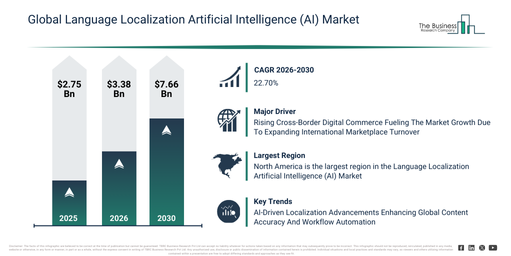
The language localization artificial intelligence (AI) market has experienced rapid expansion in its size over recent years. Projections indicate it will expand from $2.75 billion in 2025 to $3.38 billion in 2026, demonstrating a compound annual growth rate (CAGR) of 23.0%. Historically, this growth has stemmed from factors such as the proliferation of digital content creation, the rise in cross-border business communication, a heightened need for multilingual customer assistance, the broadening of global e-commerce operations, and the greater uptake of artificial intelligence (AI)-powered translation tools.
The language localization artificial intelligence (AI) market is projected to experience substantial expansion in the coming years, reaching a valuation of $7.66 billion by 2030, driven by a compound annual growth rate (CAGR) of 22.7%. This expansion during the forecast period is primarily fueled by the increasing requirement for real-time multilingual interaction, the greater integration of artificial intelligence (AI) into enterprise communication, the rising need for scalable localization solutions, the broader application of localized content in global marketing efforts, and the expanding embrace of artificial intelligence (AI)-powered language tools within developing markets. Significant developments anticipated during this period encompass progress in neural machine translation, breakthroughs in multimodal language processing, the evolution of context-aware artificial intelligence (AI) localization, heightened research and development in generative artificial intelligence (AI) for various language tasks, and enhancements in automated quality assurance specifically for localization.
Get A Free Sample Report With In-Depth Market Insights:
Language Localization Artificial Intelligence (AI) Market Development Factors: What’s Supporting Demand?
The expansion of cross-border digital commerce is expected to fuel the language localization AI market moving forward. Cross-border digital commerce involves online transactions where consumers purchase goods from merchants situated in other countries, demanding seamless communication across different languages. With digital payment systems becoming more secure and widely adopted, consumers feel increased confidence in buying from international online retailers, thereby driving the growth of cross-border digital commerce. Language localization AI supports this by automatically translating product information, customer support, and marketing content into various local languages, enabling international shoppers to clearly comprehend offerings and complete purchases with greater confidence and simplicity. For instance, in October 2024, data from Cross-Border Commerce Europe, a knowledge platform based in Belgium, revealed that European cross-border e-commerce sales reached a notable $380 billion (€326 billion) in 2023/2024. Within this total, online marketplaces contributed $262 billion (€225 billion), accounting for around 69%. Additionally, the top 100 cross-border marketplaces recorded $230 billion (€197.01 billion) in revenue, demonstrating a robust year-on-year growth of 39.29%. Thus, the increasing cross-border digital commerce is a key driver for the language localization AI market.
Language Localization Artificial Intelligence (AI) Market Segment Analysis: What Are The Core Market Categories?
The language localization artificial intelligence (AI) market covered in this report is segmented –
1) By Component: Software, Services
2) By Deployment Mode: Cloud, On-Premises
3) By Organization Size: Small and Medium Enterprises, Large Enterprises
4) By Application: Website Localization, App Localization, Document Translation, Customer Support, E-commerce, Gaming, Other Applications
5) By End-User: Information Technology (IT) and Telecommunications, Media and Entertainment, E-commerce, Healthcare, Education, Banking, Financial Services, and Insurance (BFSI), Other End-Users
Subsegments:
1) By Software: Machine Learning Localization Tools, Neural Machine Translation Platforms, Automated Content Adaptation Software, Speech Processing Software, Text Processing Software, Multilingual Quality Assurance Software, Generative Language Modeling Software
2) By Services: Artificial Intelligence Powered Translation Services, Automated Content Localization Services, Real Time Multilingual Communication Services, Speech To Text Conversion Services, Text To Speech Conversion Services, Cultural Adaptation Services, Language Quality Assurance Services
Language Localization Artificial Intelligence (AI) Market Transformation Trends: What Innovations Are Driving Change?
Major companies operating in the language localization AI market are concentrating on technological innovations, such as AI-powered localization software, to automate multilingual content adaptation, reduce translation turnaround times, and ensure cultural and contextual accuracy across global markets. This AI-driven localization software refers to intelligent language technologies that utilize artificial intelligence to automatically translate and culturally adapt content for various regions, ensuring accurate and context-appropriate communication across global markets. For instance, in September 2023, Phrase, an AI-powered localization platform based in the Czech Republic, launched AI-driven capabilities to advance next-generation localization software. Core features encompass Bring Your Own Engine (BYOE) for integrating custom MT/AI models with full data governance; a re-engineered Phrase Orchestrator enabling up to 50x faster hyperautomation of enterprise workflows; and seamless unified flows across Phrase Studio, Portal, TMS, and Strings for multimedia, marketing, and software content. It also introduces authentic AI dubbing with emotion/pronunciation controls, in addition to integrations like Figma Buzz and Storyblok to boost ecosystem connectivity and eliminate inefficiencies.
Language Localization Artificial Intelligence (AI) Market Key Participants And Competitive Landscape
Major companies operating in the language localization artificial intelligence (AI) market are Google LLC, Microsoft Corporation, Meta Platforms Inc., Amazon Web Services Inc., TELUS International AI Inc., RWS Group plc, DeepL SE, Smartling Inc., Phrase GmbH, Lokalise Inc., Unbabel Inc., Lilt Inc., Crowdin LLC, Gengo Inc., Transifex U.S. Inc., Smartcat Platform Inc., OneSkyApp Inc., TextShuttle AG, Localazy s.r.o., Linguana.com
View The Full Language Localization Artificial Intelligence (AI) Market Report:
Language Localization Artificial Intelligence (AI) Market Geographic Analysis: Where Is Demand Rising Fastest?
North America was the largest region in the language localization artificial intelligence (AI) market in 2025. Asia-Pacific is expected to be the fastest-growing region in the forecast period. The regions covered in the language localization artificial intelligence (AI) market report are Asia-Pacific, South East Asia, Western Europe, Eastern Europe, North America, South America, Middle East, Africa.
Reach Out To Our Team:
The Business Research Company: https://www.thebusinessresearchcompany.com/
Americas: +1 310-496-7795
Asia: +44 7882 955267 & +91 8897263534
Europe: +44 7882 955267
Email us at: marketing@tbrc.info
Follow us on:
LinkedIn: https://in.linkedin.com/company/the-business-research-company
YouTube: https://www.youtube.com/channel/UC24_fI0rV8cR5DxlCpgmyFQ
Global Market Model: https://www.thebusinessresearchcompany.com/global-market-model

Wasay has over a decade of experience in market research, data modelling, and analytics, with prior experience at GlobalData and Decision Tree Consulting Services. At The Business Research Company , he leads research operations across syndicated studies, customized consulting engagements, and the Global Market Model platform. His professional experience includes supporting organizations such as Boston Consulting Group, KPMG, and Ernst & Young. Wasay holds a degree in Electronics and Communications Engineering, postgraduate management qualifications from International Management Institute Belgium and Indian School of Business and Entrepreneurship, and completed the Integrated Program in Business Analytics from Indian Institute of Management Indore.
