The Business Research Company’s 2026 market reports combine market attractiveness scoring, total addressable market sizing, company benchmarking matrices, interactive Excel dashboards, deeper supply chain intelligence, emerging startup tracking, and granular product-level insights to deliver research that is more actionable and strategically valuable.
Snack Food Packaging Market Size Review: What Shaped Past Growth And What Will Drive Future Expansion?
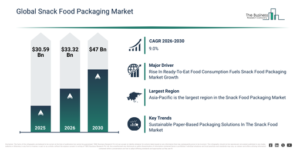
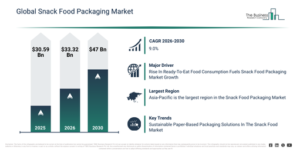
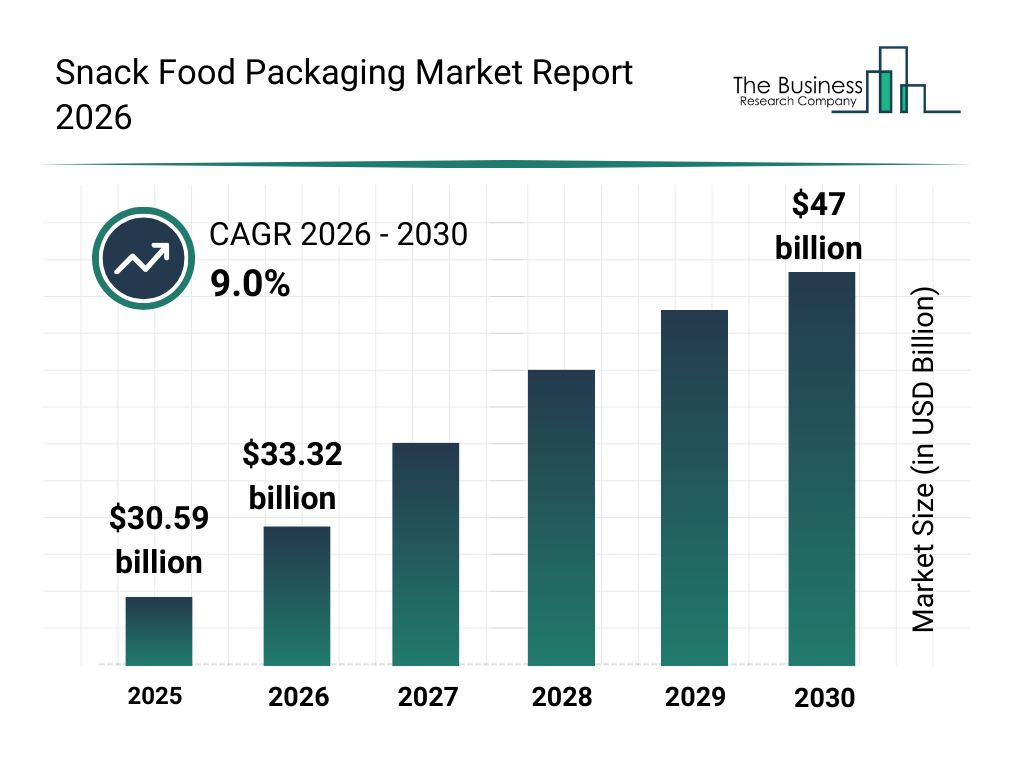
The snack food packaging market has demonstrated strong growth over recent years. It is projected to expand from $30.59 billion in 2025 to $33.32 billion in 2026, exhibiting a compound annual growth rate (CAGR) of 8.9%. The market’s historical expansion is attributable to several factors, including the increased consumption of packaged snacks, a growing requirement for extended product freshness, the expansion of organized food retailing, a rising demand for convenient packaging formats, and advancements in packaging material technology.
The snack food packaging market is projected to experience substantial expansion over the upcoming years. This market is forecast to reach a value of $47 billion by 2030, exhibiting a compound annual growth rate (CAGR) of 9.0%. This anticipated growth is driven by several factors, including increasing regulatory demands to reduce plastic, a greater shift towards recyclable and biodegradable packaging materials, increased investment in smart packaging technologies, the expanding demand for packaging fueled by e-commerce, and an emphasis on lightweight and cost-effective packaging options. Key trends foreseen during this period encompass the wider use of sustainable packaging, a surge in demand for flexible packaging, increased application of high-barrier solutions, the proliferation of smart and trackable packaging, and a heightened emphasis on extending product shelf-life.
Access Free Sample Pages From The Snack Food Packaging Market Report 2026:
Understanding The Main Driver Of The Snack Food Packaging Market
The growing intake of ready-to-eat food products is set to drive the expansion of the snack food packaging market in the coming years. Ready-to-eat meals are regarded as the most convenient choice over traditional food items, given their instant availability for consumption. Such ready-to-eat offerings utilize snack food packaging and only need a short heating period prior to serving. As an illustration, the United States Department of Agriculture, a US-based federal agency, reported that in 2023, the total export value of US processed food products reached $36.59 billion, marking a 1.7% increase compared to preceding years. Consequently, the heightened consumption of ready-to-eat food products is anticipated to propel the snack food packaging market.
Snack Food Packaging Market Segment Mapping For 2026 And Beyond
The snack food packaging market covered in this report is segmented –
1) By Packaging Type: Flexible Packaging, Rigid Packaging
2) By Material: Plastic, Paper, Metal, Other Materials
3) By Application: Bakery Snacks, Savory Snacks, Nuts, Dried Fruits, Other Applications
Subsegments:
1) By Flexible Packaging: Bags, Wraps, Pouches, Films, Rollstock
2) By Rigid Packaging: Boxes, Containers, Tins, Trays, Clamshell Packaging
What Key Trend Is Expected To Shape The Snack Food Packaging Market Over The Forecast Period?
Major companies operating in the snack food packaging market are focusing on innovative items, such as paper-based products, to improve sustainability, lower environmental impact, and fulfill consumer demand for eco-friendly packaging. A paper-based product is a packaging material crafted from paper or cardboard, often valued for its recyclability and sustainability. For instance, in June 2024, Saica, a Spain-based packaging company, and subsequently Mondelez, a US-based snack and confectionery company, introduced a novel paper-based packaging solution. This new packaging is engineered for complete recyclability within the paper waste stream, conforming to contemporary sustainability standards. This marks an important advancement in reducing the reliance on virgin plastic in the food industry.
Snack Food Packaging Market Major Players And Industry Competition Overview
Major companies operating in the snack food packaging market are Amcor Plc, Smurfit Kappa Group plc, Sonoco Products Company, Huhtamaki Oyj, Sealed Air Corporation, Berry Global Group Inc., Constantia Flexibles Group GmbH, Mondi Plc, Coveris Holdings S.A., Clondalkin Group Holdings B.V., Reynolds Group Holdings Limited, ProAmpac LLC, Guala Pack S.p.A., Detpak Group, UFlex Limited, TC Transcontinental Packaging, Winpak Ltd., Novolex Holdings LLC, Greiner Packaging International GmbH, Plastipak Packaging Inc., Graphic Packaging International LLC
Full Snack Food Packaging Market Report: Market Size, Trends, Segments And Key Players:
Snack Food Packaging Market Geographic Segmentation: Regions Covered In The Report
Asia-Pacific was the largest region in the snack food packaging market in 2025. The regions covered in the snack food packaging market report are Asia-Pacific, South East Asia, Western Europe, Eastern Europe, North America, South America, Middle East and Africa.
Reach Out To Our Team:
The Business Research Company: https://www.thebusinessresearchcompany.com/
Americas: +1 310-496-7795
Asia: +44 7882 955267 & +91 8897263534
Europe: +44 7882 955267
Email us at: marketing@tbrc.info
Follow us on:
LinkedIn: https://in.linkedin.com/company/the-business-research-company
YouTube: https://www.youtube.com/channel/UC24_fI0rV8cR5DxlCpgmyFQ
Global Market Model: https://www.thebusinessresearchcompany.com/global-market-model

Wasay has over a decade of experience in market research, data modelling, and analytics, with prior experience at GlobalData and Decision Tree Consulting Services. At The Business Research Company , he leads research operations across syndicated studies, customized consulting engagements, and the Global Market Model platform. His professional experience includes supporting organizations such as Boston Consulting Group, KPMG, and Ernst & Young. Wasay holds a degree in Electronics and Communications Engineering, postgraduate management qualifications from International Management Institute Belgium and Indian School of Business and Entrepreneurship, and completed the Integrated Program in Business Analytics from Indian Institute of Management Indore.