Backed by market attractiveness analysis, total addressable market sizing, company benchmarking matrices, interactive Excel dashboards, wider supply chain intelligence, emerging startup coverage, and detailed product-level insights, The Business Research Company’s 2026 market reports are designed to offer research that is more actionable and strategically valuable than ever.
Multi-Access Edge Computing Market Size, Value And Growth Trajectory Through 2030
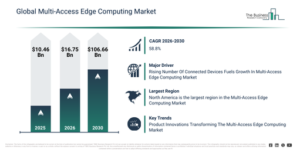
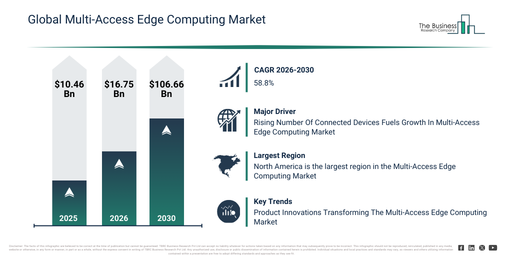
The multi-access edge computing market has experienced significant expansion in recent years. It is projected to increase from $10.46 billion in 2025 to $16.75 billion in 2026, at a compound annual growth rate (CAGR) of 60.2%. This historical growth can be attributed to several factors, including rising mobile data traffic volumes, the widespread adoption of cloud-native applications, the initial deployment of 5G infrastructure, a growing need for reduced network latency, and the increasing use of IoT-enabled devices.
The multi-access edge computing market is projected to experience substantial expansion in the coming years, with its value anticipated to reach $106.66 billion by 2030, demonstrating a compound annual growth rate (CAGR) of 58.8%. This growth over the projected period can be attributed to several factors, including greater investments in 5G and edge infrastructure, a rise in the use of real-time analytics applications, broader deployment of smart cities, an increasing need for immersive digital experiences, and a heightened emphasis on distributed cloud architectures. Key trends expected during this forecast span involve a surge in the deployment of edge computing nodes, increased uptake of low-latency application architectures, deeper integration of MEC with 5G networks, an expansion of real-time data processing capabilities, and a stronger focus on localized data management.
Get A Free Sample Report With In-Depth Market Insights:
Multi-Access Edge Computing Market Industry Drivers: What’s Behind The Revenue Growth?
The multi-access edge computing market is experiencing growth due to the rising number of connected devices. These devices encompass computing hardware, laptops, desktops, and mobile devices, all of which connect through diverse wired and wireless networks to the internet and to one another. They are capable of accommodating a broad spectrum of latency and bandwidth requirements. Consequently, multi-access edge computing (MEC) is utilized, providing ultra-low latency and high bandwidth, simultaneously enabling applications to leverage real-time radio network data. For example, data from the British Broadcasting Corporation, a UK-based broadcasting network, indicated in April 2024 that the proportion of children aged five to seven using messaging services rose from 59% to 65%. Furthermore, social media usage among this age group saw an increase from 30% to 38%, and livestream engagement expanded from 39% to 50%. Moreover, online gaming participation was reported by just over 40%, an increase from 34% in the preceding year. Hence, the expanding volume of connected devices is anticipated to foster the development of the multi-access edge computing industry in the future.
Multi-Access Edge Computing Market Segmentation And Category Overview
The multi-access edge computing market covered in this report is segmented –
1) By Component Type: Hardware, Software, Service
2) By Organization Size: Small And Medium Enterprise, Large Enterprise
3) By Technology: Augmented Reality, Data Caching, Internet Of Things, Real Time Video Analytics, Virtual Reality
4) By End-User: IT And Telecom, Smart Cities, Smart Homes, And Smart Buildings, Datacenters, Energy And Utilities, Automotive And Government, Other End Users
Subsegments:
1) By Hardware: Edge Servers, Gateways, Network Devices, Storage Devices
2) By Software: Edge Application Development Platforms, Edge Management Software, Security Software, Analytics And Monitoring Software
3) By Service: Consulting Services, Integration Services, Support And Maintenance Services, Managed Services
#Multi-Access Edge Computing Market Growth Trends: What’s Shaping The Future Outlook?
Key companies operating within the multi-access edge computing market are developing advanced products for enterprises to secure a competitive advantage. These product innovations include improvements in edge computing hardware and software solutions, providing faster processing, low latency, and enhanced functionality, which addresses the diverse demands of IoT applications and 5G networks. For instance, in July 2023, M1 Limited, a Singapore-based telecommunications company, launched Pinnacle, a multi-access edge computing (MEC) platform, collaborating with ST Engineering, a Singaporean multinational technology and engineering group. Powered by M1’s dedicated 5G network and ST Engineering’s AGIL Edge Platform for 5G, Pinnacle is designed to empower enterprises with new digital capabilities. It delivers real-time data processing, low latency, and high-performance services, enabling businesses to streamline operations and exploit the potential of technologies like augmented reality, virtual reality, live video analytics, and industrial IoT. Pinnacle also offers 5G connectivity, scalable industry solutions, and end-to-end servicing to simplify digital transformation for enterprises.
Multi-Access Edge Computing Market Competitive Analysis Of Leading Industry Participants
Major companies operating in the multi-access edge computing market are ADLINK Technology Inc.; Advantech Co. Ltd.; Nokia Corporation; Cisco Systems Inc.; International Business Machines Corporation; Huawei Technologies Co. Ltd.; Juniper Networks Inc.; Saguna Networks Ltd.; SpiderCloud Wireless Inc.; Vapor IO Inc.; FogHorn Systems Inc.; ZTE Corporation; Microsoft Corporation; Intel Corporation; Hewlett Packard Enterprise Development LP; Dell Technologies Inc.; Ericsson AB; Fujitsu Limited; NEC Corporation; Lenovo Group Limited; PacketFabric LLC; EdgeConneX Inc.; AlefEdge Inc.; MobiledgeX Inc.; AkamAI Technologies Inc.; ClearBlade Inc.; Adapdix Corporation; Azion Technologies LLC; Rigado LLC; Equinix Inc.; ADVA Optical Networking SE; Aruba Networks Inc.; Avassa Inc.; Amazon Web Services Inc.; Cloudera Inc.; Section.io Inc.; AT&T Inc.; Verizon Communications Inc.; Deutsche Telekom AG; Orange S.A.; Vodafone Group Plc; Telefonica S.A.; China Mobile Communications Corporation; SK Telecom Co. Ltd.; KT Corporation; LG Uplus Corp.
View The Full Multi-Access Edge Computing Market Report:
Multi-Access Edge Computing Market Geographic Spread And Regional Opportunities
North America was the largest region in the multi-access edge computing market in 2025.Asia-Pacific is expected to be the fastest-growing region in the forecast period. The regions covered in the multi-access edge computing market report are Asia-Pacific, South East Asia, Western Europe, Eastern Europe, North America, South America, Middle East, Africa.
Reach Out To Our Team:
The Business Research Company: https://www.thebusinessresearchcompany.com/
Americas: +1 310-496-7795
Asia: +44 7882 955267 & +91 8897263534
Europe: +44 7882 955267
Email us at: marketing@tbrc.info
Follow us on:
LinkedIn: https://in.linkedin.com/company/the-business-research-company
YouTube: https://www.youtube.com/channel/UC24_fI0rV8cR5DxlCpgmyFQ
Global Market Model: https://www.thebusinessresearchcompany.com/global-market-model

Wasay has over a decade of experience in market research, data modelling, and analytics, with prior experience at GlobalData and Decision Tree Consulting Services. At The Business Research Company , he leads research operations across syndicated studies, customized consulting engagements, and the Global Market Model platform. His professional experience includes supporting organizations such as Boston Consulting Group, KPMG, and Ernst & Young. Wasay holds a degree in Electronics and Communications Engineering, postgraduate management qualifications from International Management Institute Belgium and Indian School of Business and Entrepreneurship, and completed the Integrated Program in Business Analytics from Indian Institute of Management Indore.