Featuring market attractiveness scoring, total addressable market sizing, company benchmarking matrices, interactive Excel dashboards, deeper supply chain intelligence, emerging startup tracking, and granular product-level insights, The Business Research Company’s 2026 market reports are built to deliver research that is both more actionable and more strategically valuable.
Environmental Sensor Market Forecast: What Value Will The Market Reach By 2030?
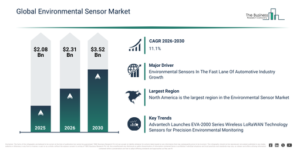
The environmental sensor market size has shown swift expansion in recent years. It is anticipated to increase from $2.08 billion in 2025 to $2.31 billion in 2026, exhibiting a compound annual growth rate (CAGR) of 10.9%. Historically, this growth can be attributed to factors such as environmental regulation enforcement, the growth of industrial automation, the expansion of smart city projects, the demand for pollution monitoring, and increased climate change awareness.
The environmental sensor market is anticipated to undergo substantial expansion in the coming years, with projections indicating it will reach $3.52 billion by 2030, exhibiting a compound annual growth rate (CAGR) of 11.1%. This growth during the forecast period is fueled by several factors, including government initiatives focused on sustainability, the increasing integration of IoT, the expansion of smart infrastructure, a heightened demand for climate monitoring, and ongoing advancements in sensor technology. Notable trends expected in this period include real-time environmental monitoring, the deployment of smart city sensors, the integration of multi-parameter sensors, the rise of wireless sensor networks, and the development of predictive environmental analytics.
Get A Free Sample Report With In-Depth Market Insights:
Environmental Sensor Market Growth Factors: What’s Supporting Expansion?
Future expansion of the environmental sensor market is anticipated, driven by the escalating demand within the automotive industry. This sector encompasses the design, development, production, promotion, and sale of motor vehicles. Within vehicles, environmental sensors enhance safety, efficiency, and comfort by supplying crucial data to various systems and functionalities. An example of this trend is observed in August 2023, when the Board of Governors of the Federal Reserve System, a US government agency, reported that total vehicle production in the United States rose to 11.77 million units in July 2023, an increase from 10.91 million units in June 2023. Consequently, the heightened demand in the automotive industry is fueling the expansion of the environmental sensor market.
Environmental Sensor Market Segment Outlook: Which Categories Are Growing Fastest?
The environmental sensor market covered in this report is segmented –
1) By Type: Temperature, Humidity, Air Quality, Water Quality, Integrated, Gas, Chemicals, Smoke, Ultraviolet (UV), Soil Moisture
2) By Application: Smart Home Automation, Factory Automation, Smart Cities, Automotive Powertrain System, Energy Harvesting, Other Applications
3) By End User: Industrial, Residential, Commercial, Automotive, Government And Public Utilities, Other End-Users
Subsegments:
1) By Temperature: Thermocouples, Thermistors, Infrared Sensors
2) By Humidity: Capacitive Humidity Sensors, Resistive Humidity Sensors
3) By Air Quality: Particulate Matter Sensors, VOC Sensors, CO2 Sensors
4) By Water Quality: pH Sensors, Turbidity Sensors, Conductivity Sensors
5) By Integrated: Multi-parameter Sensors
6) By Gas: Carbon Monoxide Sensors, Methane Sensors, Hydrogen Sensors
7) By Chemicals: Ion-selective Electrodes, Optical Sensors
8) By Smoke: Ionization Smoke Detectors, Photoelectric Smoke Detectors
9) By Ultraviolet (UV): UV Index Sensors, UV Light Intensity Sensors
10) By Soil Moisture: Capacitive Soil Moisture Sensors, Resistive Soil Moisture Sensors
Environmental Sensor Market Transformation Trends: What Innovations Are Driving Change?
Major companies operating in the environmental sensor market are prioritizing the development of technological advancements, such as advanced sensing devices, to improve real-time monitoring and data accuracy for enhanced environmental management and decision-making. These sophisticated instruments, known as advanced sensing devices, are engineered to detect and quantify environmental parameters including temperature, humidity, and air quality. By integrating technologies like microelectromechanical systems (MEMS) and artificial intelligence, these devices provide precise, real-time data for better oversight and analysis. For instance, in April 2024, Advantech Co., Ltd., a China-based computer manufacturing company, introduced its EVA-2000 Series Wireless LoRaWAN Technology Sensors. These sensors offer considerable benefits for precision environmental monitoring. They utilize low-power, long-range LoRaWAN technology, which enables efficient data transmission over extensive distances while ensuring exceptional battery life due to their double 3.6V Li-ion batteries. This series not only simplifies integration into existing systems but also supports scalable deployments, making it a cost-effective solution for a variety of industrial applications.
Environmental Sensor Market Leading Companies And Competitive Benchmarking
Major companies operating in the environmental sensor market are Siemens AG; Schneider Electric SE; Honeywell International Inc.; ABB Ltd.; Texas Instruments Incorporated; Emerson Electric Co.; TE Connectivity; Microelectronics N.V.; Infineon Technologies AG; Amphenol Corporation; Renesas Electronics Corporation; Omron Corporation; Ams OSRAM AG; Horiba Group; Sick AG; Sensirion AG; RioT Technology Corp.; Figaro Engineering Inc.; Omega Engineering Inc.; Bosch Sensortec GmbH; Eurotech SpA.; Raritan; Eko Instruments BV; Breeze Technologies; Elichens; NuWave Sensor; Nesa Srl.; Apogee Instruments Inc.; Aeroqual Ltd.
View The Full Environmental Sensor Market Report:
Environmental Sensor Market Regional Analysis: Which Geography Leads On Revenue?
North America was the largest region in the environmental sensor market in 2025. Asia-Pacific is expected to be the fastest-growing region in the forecast period. The regions covered in the environmental sensor market report are Asia-Pacific, South East Asia, Western Europe, Eastern Europe, North America, South America, Middle East, Africa.
Reach Out To Our Team:
The Business Research Company: https://www.thebusinessresearchcompany.com/
Americas: +1 310-496-7795
Asia: +44 7882 955267 & +91 8897263534
Europe: +44 7882 955267
Email us at: marketing@tbrc.info
Follow us on:
LinkedIn: https://in.linkedin.com/company/the-business-research-company
YouTube: https://www.youtube.com/channel/UC24_fI0rV8cR5DxlCpgmyFQ
Global Market Model: https://www.thebusinessresearchcompany.com/global-market-model

Wasay has over a decade of experience in market research, data modelling, and analytics, with prior experience at GlobalData and Decision Tree Consulting Services. At The Business Research Company , he leads research operations across syndicated studies, customized consulting engagements, and the Global Market Model platform. His professional experience includes supporting organizations such as Boston Consulting Group, KPMG, and Ernst & Young. Wasay holds a degree in Electronics and Communications Engineering, postgraduate management qualifications from International Management Institute Belgium and Indian School of Business and Entrepreneurship, and completed the Integrated Program in Business Analytics from Indian Institute of Management Indore.