With a focus on actionable insights and strategic value, The Business Research Company’s 2026 market reports include market attractiveness scoring, total addressable market sizing, company benchmarking matrices, interactive Excel dashboards, deeper supply chain intelligence, emerging startup tracking, and granular product-level insights.
Construction Software-As-A-Service Market Size Snapshot: 2026 Valuation, 2030 Projection And Key Growth Factors
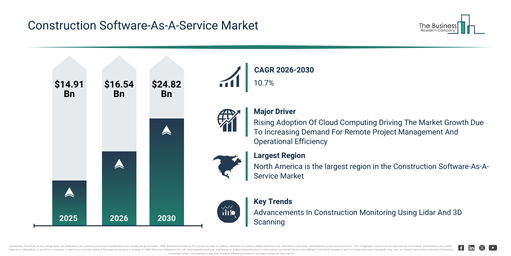
The construction software-as-a-service market size has experienced rapid expansion in recent years. This market is projected to expand from $14.91 billion in 2025 to $16.54 billion in 2026, demonstrating a compound annual growth rate (CAGR) of 11.0%. Historical growth in this sector is primarily due to factors such as the increasing acceptance of cloud solutions in construction, a heightened requirement for real-time project oversight, the expanding utilization of digital document management, broader coordination of remote workforces, and a rising need for integrated construction software.
The construction software-as-a-service market size is anticipated to experience substantial growth over the next few years. It is projected to expand to $24.82 billion in 2030, demonstrating a compound annual growth rate (CAGR) of 10.7%. This expansion during the forecast period is propelled by factors such as an increasing preference for subscription-based construction tools, the rising application of AI-driven project analytics, the broadening of hybrid cloud deployments, a greater reliance on mobile-first construction platforms, and the development of advanced collaborative construction ecosystems. Key trends expected in the forecast period include the integration of AI-driven construction management tools, the expansion of cloud-native SaaS platforms, advancements in automated project workflows, the adoption of IoT-connected construction software, and the implementation of blockchain-based contract management.
Get A No-Cost Sample Of The Construction Software-As-A-Service Market Study:
Major Factor Fueling The Construction Software-As-A-Service Market Through 2030
The increasing integration of cloud computing is anticipated to boost the expansion of the construction software-as-a-service market in the future. Cloud computing involves providing computational services like servers, storage solutions, databases, network infrastructure, and software applications via the internet. This growing embrace of cloud computing stems mainly from the escalating demand for digital infrastructure that is scalable, economical, and accessible remotely, facilitating real-time teamwork and data handling across various sectors. The uptake of cloud computing is propelling the construction software-as-a-service market by allowing for immediate collaboration, distant access to project information, and flexible implementation across numerous construction locations. For example, in September 2025, the IT Desk (UK) Limited, an IT service management firm based in the UK, reported that approximately 70% of businesses are forecast to implement a cloud-native approach for all their digital projects in 2025. Consequently, the expanding use of cloud computing is fueling the growth of the construction software-as-a-service market.
Construction Software-As-A-Service Market Segment Landscape: Main Categories And Subcategories Covered
The construction software-as-a-service market covered in this report is segmented –
1) By Type Of Software: Project Management, Field Service Management, Estimating And Bidding, Enterprise Resource Planning (Erp), Construction Management, Other Type Of Software
2) By Deployment Model: Public Cloud, Private Cloud, Hybrid Cloud
3) By Application: Residential Construction, Commercial Construction, Infrastructure Projects
4) By End-User: General Contractors, Subcontractors, Engineers And Architects, Builders And Developers
Subsegments:
1) By Project Management: Scheduling And Task Management, Document Management, Budgeting And Cost Tracking, Collaboration And Communication Tools
2) By Field Service Management: Work Order Management, Mobile Workforce Management, Time Tracking And Dispatch, Field Reporting And Analytics
3) By Estimating And Bidding: Cost Estimation Tools, Digital Takeoff Tools, Bid Management Systems, Proposal Generation
4) By Enterprise Resource Planning (ERP): Accounting And Financial Management, Human Resource Management, Procurement And Inventory Control, Project Lifecycle Management
5) By Construction Management: Construction Scheduling, Change Order Management, Quality And Safety Compliance, Progress Monitoring And Reporting
6) By Other Type Of Software: Building Information Modeling (BIM), Customer Relationship Management (CRM), Contract Management, Equipment And Asset Tracking
How Are Emerging Trends Influencing The Construction Software-As-A-Service Market’s Growth Path?
Leading companies in the construction software-as-a-service market are prioritizing the development of innovative solutions, such as cloud-based platforms integrated with BIM, to enhance project collaboration, improve accuracy, and streamline construction workflows. Cloud-based platforms that incorporate building information modeling (BIM) are digital solutions used to store, manage, and share BIM data over the cloud, enabling real-time access and cooperative efforts among project stakeholders. These platforms help improve coordination, minimize errors, and accelerate decision-making by allowing teams to view and update models from any location. For instance, in June 2024, Neilsoft, an India-based consulting company, partnered with Fujita Corporation, a Japan-based construction company, to launch ConstructMonitor, a cloud-based BIM-integrated SaaS solution for monitoring construction quality and progress. The platform utilizes LiDAR-enabled devices and 3D laser scanners to capture real-time site data, which is then compared against BIM models using advanced algorithms. This aids in identifying design deviations, structural errors, and missing components early in the construction process.
Construction Software-As-A-Service Market Leading Players And Key Industry Participants In 2026
Major companies operating in the construction software-as-a-service market are Oracle Corporation, Hilti AG, Autodesk Inc., Trimble Inc., Bentley Systems Incorporated, Nemetschek SE, Procore Technologies Inc., Mango Technologies Inc., Higharc Inc., Buildots Ltd., Revizto SA, Tenna LLC, Raken Inc., Buildxact Software Ltd., ZippMat Technology Private Limited, Siteflow SAS, Capmo GmbH, VIKTOR B.V., FreightTrain LLC, Contractor Foreman Inc.
Check Out The Full Construction Software-As-A-Service Market Report 2026:
Construction Software-As-A-Service Market By Geography: Revenue Leaders Among Global Regions
North America was the largest region in the construction software-as-a-service market in 2025. Asia-Pacific is expected to be the fastest-growing region in the forecast period. The regions covered in the construction software-as-a-service market report are Asia-Pacific, South East Asia, Western Europe, Eastern Europe, North America, South America, Middle East, Africa.
Reach Out To Our Team:
The Business Research Company: https://www.thebusinessresearchcompany.com/
Americas: +1 310-496-7795
Asia: +44 7882 955267 & +91 8897263534
Europe: +44 7882 955267
Email us at: marketing@tbrc.info
Follow us on:
LinkedIn: https://in.linkedin.com/company/the-business-research-company
YouTube: https://www.youtube.com/channel/UC24_fI0rV8cR5DxlCpgmyFQ
Global Market Model: https://www.thebusinessresearchcompany.com/global-market-model

Wasay has over a decade of experience in market research, data modelling, and analytics, with prior experience at GlobalData and Decision Tree Consulting Services. At The Business Research Company , he leads research operations across syndicated studies, customized consulting engagements, and the Global Market Model platform. His professional experience includes supporting organizations such as Boston Consulting Group, KPMG, and Ernst & Young. Wasay holds a degree in Electronics and Communications Engineering, postgraduate management qualifications from International Management Institute Belgium and Indian School of Business and Entrepreneurship, and completed the Integrated Program in Business Analytics from Indian Institute of Management Indore.