The Business Research Company’s 2026 market reports combine market attractiveness scoring, total addressable market sizing, company benchmarking matrices, interactive Excel dashboards, deeper supply chain intelligence, emerging startup tracking, and granular product-level insights to deliver research that is more actionable and strategically valuable.
Neuromorphic Chips Market Size Trajectory: Key Numbers Every Industry Stakeholder Should Know
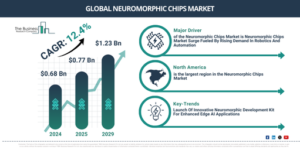
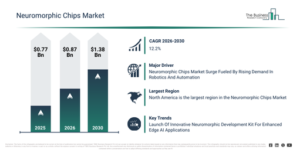
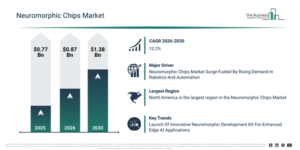
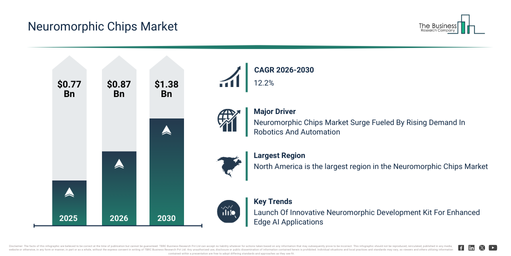
The neuromorphic chips market has expanded quickly over recent years. Its valuation is anticipated to climb from $0.77 billion in 2025 to $0.87 billion in 2026, achieving a compound annual growth rate (CAGR) of 12.5%. This market’s past growth can be attributed to the rise of early neuromorphic research initiatives, advancements in semiconductor miniaturization, increased integration of AI within embedded systems, the development of low-power processing architectures, and the initial commercialization of neuromorphic processors.
The neuromorphic chips market is projected to experience substantial expansion over the coming years. It will grow to $1.38 billion in 2030 at a compound annual growth rate (CAGR) of 12.2%. This anticipated growth during the forecast period stems from factors such as increasing demand for hardware capable of autonomous decision-making, the broadening of edge AI applications, a rise in the implementation of smart robotics, greater investments in neuromorphic research and development, and the incorporation of neuromorphic chips into consumer electronics. Key developments expected in this period encompass the enhanced integration of neuromorphic chips within edge AI systems, a growing embrace of brain-inspired computing designs, increased utilization of neuromorphic chips for autonomous decision-making, a significant rise in the use of neuromorphic hardware for industrial automation, broader application of neuromorphic technology in smart mobility, innovations in spiking neural network architectures, an escalating need for processors offering ultra-low power consumption and high efficiency, greater implementation of memristor-based neuromorphic hardware, increasing deployment of neuromorphic systems for real-time pattern recognition, and the expansion of neuromorphic computing into robotics and automation.
Looking For Reliable Neuromorphic Chips Market Data? Request A Free Sample:
What Is Behind The Rising Demand In The Neuromorphic Chips Market?
The increasing demand for robotics and automation is anticipated to propel the growth of the neuromorphic chips market going forward. Robotics and automation specifically refer to the utilization of computers, control systems, and information technology for managing industrial processes and machinery. These fields employ neuromorphic chips to leverage brain-inspired computing concepts, thereby enhancing the capabilities of automated systems and robots. For instance, in September 2024, data from the International Federation of Robotics, a Germany-based non-profit organization, indicated that industrial robot installations in Europe surged by 9% in 2023, reaching an unprecedented 92,393 units. Out of this total, 80% were deployed within the European Union, accounting for 73,534 units, a 2% increase from the preceding year. Consequently, the escalating demand for robotics and automation is a primary driver behind the expansion of the neuromorphic chips market.
Neuromorphic Chips Market Segment Coverage And Subsegment Analysis
The neuromorphic chips market covered in this report is segmented –
1) By Components: Software, Hardware
2) By Function: Signal Processing, Data Processing, Image Recognition, Process optimization
3) By End Use Industry: Aerospace And Defense, Automotive, Healthcare, Industrial, Consumer Electronics, Other End User Industries
Subsegments:
1) By Software: Neuromorphic Programming Environments, Simulation And Modeling Tools, Machine Learning Algorithms For Neuromorphic Systems, Data Processing And Analytics Software, Development And Debugging Tools
2) By Hardware: Neuromorphic Processors, Neuromorphic Sensors, Specialized Integrated Circuits (Ics), Field-Programmable Gate Arrays (Fpgas) For Neuromorphic Applications, Neuromorphic Chip Systems And Platforms
Neuromorphic Chips Market Future Trends: Where Is The Industry Heading?
Leading companies operating within the neuromorphic chips market are concentrating on developing innovative solutions, such as neuromorphic development kits, for smart wearables and industrial monitoring devices. A neuromorphic development kit functions as a tool crafted for building and testing AI systems that mimic the brain’s neural processing, enabling efficient, low-power sensory data processing in applications like robotics and IoT. For instance, in September 2023, SynSense AG, a Switzerland-based firm specializing in neuromorphic intelligence and application solutions, launched the Xylo IMU HDK, which is a neuromorphic development kit. The Xylo IMU HDK is a neuromorphic development kit featuring a specialized chip designed for ultra-low-power motion processing applications, facilitating human movement analysis, industrial monitoring, and human-computer interaction. It incorporates a 3-axis accelerometer, configurable SNN processing, and a flexible power-efficient design appropriate for various wearables and monitoring devices.
Neuromorphic Chips Market Top Players List For 2026
Major companies operating in the neuromorphic chips market are Samsung Electronics Limited, Lockheed Martin Corporation, Intel Corp., International Business Machine Corporation, IBM Corporation, SK Hynix Inc., Qualcomm, Hewlett Packard Enterprise, Cadence Design Systems Inc., Nepes Corp., Nepes Corporation, CEA Leti, HRL Laboratories LLC, Altium LLC, SynSense AG, Innatera, Brain Corporation, Vicarious FPC Inc., GrAI Matter Labs, Gyrfalcon Technology Inc, Ceryx Medical, Brain chip Holdings Ltd., Numenta, Inc., Koniku, Applied Brain Research, Inc., General Vision Inc., Knowm Inc.
Order Your Copy Of The Neuromorphic Chips Market Report 2026:
How Does The Neuromorphic Chips Market Vary By Region?
North America was the largest region in the neuromorphic chips market in 2025. Asia-Pacific is expected to be the fastest-growing region in the forecast period. The regions covered in the neuromorphic chips market report are Asia-Pacific, South East Asia, Western Europe, Eastern Europe, North America, South America, Middle East, Africa.
Reach Out To Our Team:
The Business Research Company: https://www.thebusinessresearchcompany.com/
Americas: +1 310-496-7795
Asia: +44 7882 955267 & +91 8897263534
Europe: +44 7882 955267
Email us at: marketing@tbrc.info
Follow us on:
LinkedIn: https://in.linkedin.com/company/the-business-research-company
YouTube: https://www.youtube.com/channel/UC24_fI0rV8cR5DxlCpgmyFQ
Global Market Model: https://www.thebusinessresearchcompany.com/global-market-model

Wasay has over a decade of experience in market research, data modelling, and analytics, with prior experience at GlobalData and Decision Tree Consulting Services. At The Business Research Company , he leads research operations across syndicated studies, customized consulting engagements, and the Global Market Model platform. His professional experience includes supporting organizations such as Boston Consulting Group, KPMG, and Ernst & Young. Wasay holds a degree in Electronics and Communications Engineering, postgraduate management qualifications from International Management Institute Belgium and Indian School of Business and Entrepreneurship, and completed the Integrated Program in Business Analytics from Indian Institute of Management Indore.