Built to provide research that’s more actionable and strategically valuable, The Business Research Company’s 2026 market reports include market attractiveness analysis, total addressable market sizing, company benchmarking matrices, interactive Excel dashboards, broader supply chain intelligence, emerging startup tracking, and in-depth product insights.
Business Continuity Market Expansion Outlook: What Revenue Opportunities Are Ahead?
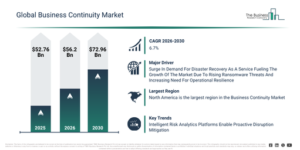
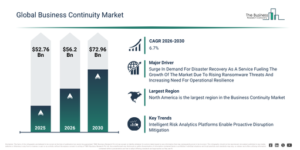
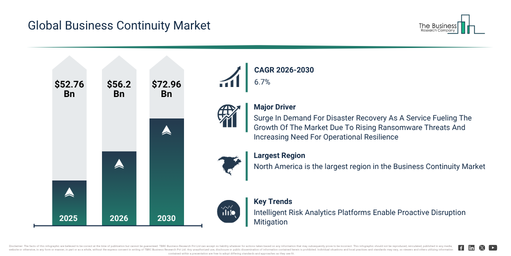
The business continuity market size has experienced robust expansion in recent years. It is anticipated to increase from $52.76 billion in 2025 to $56.2 billion in 2026, registering a compound annual growth rate (CAGR) of 6.5%. The historic growth in this market can be linked to an increase in natural disaster occurrences, rising cybersecurity threats, the expansion of enterprise IT infrastructure, regulatory compliance requirements, and the broader expansion of global business operations.
The business continuity market size is projected to experience robust growth over the next few years. It will grow to $72.96 billion by 2030 at a compound annual growth rate (CAGR) of 6.7%. This expansion during the forecast period can be attributed to the increasing reliance on digital infrastructure, the rising frequency of cyberattacks, the growing adoption of cloud-based recovery solutions, the demand for real-time risk monitoring, and the proliferation of remote and hybrid work environments. Key trends anticipated in the forecast period include a heightened focus on enterprise-wide risk assessment and business impact analysis, the broader embrace of integrated continuity planning frameworks, an escalating need for real-time incident response and recovery solutions, a strengthened emphasis on regulatory compliance and governance requirements, and the increasing significance of resilience testing and simulation exercises.
Get A Free Sample Report With In-Depth Market Insights:
Business Continuity Market Development Factors: What’s Supporting Demand?
The increasing requirement for disaster recovery as a service is projected to stimulate expansion within the business continuity market moving forward. Disaster recovery as a service describes a cloud-based offering that duplicates and restores an organization’s information, software applications, and IT infrastructure, ensuring swift recovery and ongoing operations in the aftermath of disruptions like cyberattacks, system malfunctions, or environmental calamities. This rising need for disaster recovery as a service stems from the increasing frequency of ransomware occurrences and cyber threats, as businesses aim to facilitate quick data restoration, reduce operational interruptions, and sustain constant operations. Business continuity mandates additionally strengthen the uptake of disaster recovery as a service by highlighting the necessity for robust IT infrastructure, continuous operational capabilities, and effective recovery strategies. For example, in 2023, as per America’s Cyber Defense Agency, a US-based government department, over 1,200 pre-ransomware alerts were disseminated across various sectors, including healthcare, education, government, and critical infrastructure, alongside 294 notifications shared with 27 international partners to address early-stage ransomware threats. Consequently, the escalating demand for disaster recovery as a service is propelling the growth of the business continuity market.
Business Continuity Market Segment Outlook: Which Categories Are Growing Fastest?
The business continuity market covered in this report is segmented –
1) By Component: Solutions, Services, Platforms
2) By Deployment Mode: Cloud Based, On Premises, Hybrid
3) By Application: Business Continuity Planning, Disaster Recovery Management, Risk Management And Assessment, Data Backup And Recovery, Incident Management
4) By Organization Size: Small And Medium Enterprises, Large Enterprises, Startups
5) By End Use Industry: Banking Financial Services And Insurance, Information Technology And Telecommunications, Healthcare And Life Sciences, Retail And E Commerce, Manufacturing Industry
Subsegments:
1) By Solutions: Business Impact Analysis Solutions, Risk Assessment Solutions, Disaster Recovery Solutions, Crisis Management Solutions, Compliance Management Solutions
2) By Services: Consulting Services, Implementation Services, Training And Education Services, Managed Services, Support And Maintenance Services
3) By Platforms: Cloud Based Platforms, On Premise Platforms, Hybrid Platforms, Integrated Risk Management Platforms, Continuity Planning Platforms
Business Continuity Market Transformation Trends: What Innovations Are Driving Change?
Leading companies within the business continuity market are dedicated to developing advanced solutions, such as artificial intelligence (AI)-driven operational risk intelligence platforms, to bolster resilience, sharpen real-time risk visibility, and ensure continuous business operations across complex IT landscapes. These AI-driven operational risk intelligence platforms represent integrated solutions that merge analytics, automation, and artificial intelligence to continuously monitor application ecosystems, identify potential vulnerabilities, and prioritize risks that could impact business continuity. For instance, in June 2025, International Business Machines Corporation, a US-based technology company, launched IBM Concert, an AI-powered solution designed to deliver comprehensive insights into operational health and risk throughout the application lifecycle. The platform aggregates data from source code repositories, operational environments, and system components to map application topology and detect risks related to vulnerabilities, compliance gaps, expiring certificates, and software dependencies. It empowers organizations to proactively mitigate potential disruptions, strengthen governance frameworks, and enhance their overall business continuity strategies.
Business Continuity Market Competitive Landscape: Who Leads The Industry?
Major companies operating in the business continuity market are Google LLC; Microsoft Corporation; Amazon Web Services Inc.; Dell Technologies Inc.; International Business Machines Corporation; Oracle Corporation; HCL Technologies Limited; Tata Communications Limited; Veeam Software Group GmbH; Cohesity Inc.; Commvault Systems Inc.; Flexential Corp.; Acronis International GmbH; Druva Inc.; CtrlS Datacenters Limited; TierPoint LLC; InterVision Systems LLC; Arcserve LLC; Expedient Holdings USA LLC; Unitrends Inc.; Recovery Point Systems Inc.; Cyfuture India Private Limited; phoenixNAP Global IT Services; Evolve IP LLC
View The Full Business Continuity Market Report:
Business Continuity Market Geographic Landscape: Which Region Leads Industry Growth?
North America was the largest region in the business continuity market in 2025) Asia-Pacific is expected to be the fastest-growing region in the forecast period. The regions covered in the business continuity market report are Asia-Pacific, South East Asia, Western Europe, Eastern Europe, North America, South America, Middle East, Africa.
Reach Out To Our Team:
The Business Research Company: https://www.thebusinessresearchcompany.com/
Americas: +1 310-496-7795
Asia: +44 7882 955267 & +91 8897263534
Europe: +44 7882 955267
Email us at: marketing@tbrc.info
Follow us on:
LinkedIn: https://in.linkedin.com/company/the-business-research-company
YouTube: https://www.youtube.com/channel/UC24_fI0rV8cR5DxlCpgmyFQ
Global Market Model: https://www.thebusinessresearchcompany.com/global-market-model

Wasay has over a decade of experience in market research, data modelling, and analytics, with prior experience at GlobalData and Decision Tree Consulting Services. At The Business Research Company , he leads research operations across syndicated studies, customized consulting engagements, and the Global Market Model platform. His professional experience includes supporting organizations such as Boston Consulting Group, KPMG, and Ernst & Young. Wasay holds a degree in Electronics and Communications Engineering, postgraduate management qualifications from International Management Institute Belgium and Indian School of Business and Entrepreneurship, and completed the Integrated Program in Business Analytics from Indian Institute of Management Indore.