
Featuring market attractiveness scoring, total addressable market sizing, company benchmarking matrices, interactive Excel dashboards, deeper supply chain intelligence, emerging startup tracking, and granular product-level insights, The Business Research Company’s 2026 market reports are built to deliver research that is both more actionable and more strategically valuable.
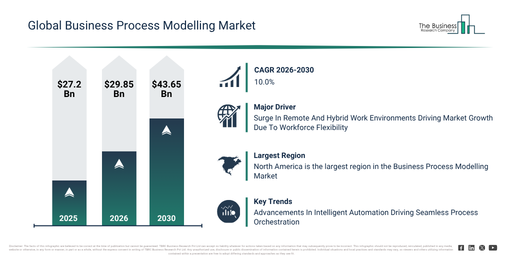
Business Process Modelling Market Growth From $29.85 Billion In 2026 To $43.65 Billion By 2030 At A CAGR Of 10%
The business process modelling market has experienced substantial expansion in recent years. Its valuation is projected to increase from $27.2 billion in 2025 to $29.85 billion in 2026, demonstrating a compound annual growth rate (CAGR) of 9.7%. This historical growth is largely due to factors such as manual workflow documentation methods, various enterprise digital transformation efforts, the increasing adoption of BPM software, a rising requirement for process standardization, and the growing imperative for improving operational efficiency.
The business process modelling market is anticipated to experience substantial expansion over the coming years. By 2030, its valuation is projected to reach $43.65 billion, demonstrating a compound annual growth rate (CAGR) of 10.0%. This projected growth during the forecast period is primarily driven by factors such as the proliferation of AI-powered process intelligence tools, the growing embrace of hyperautomation strategies, an escalating need for real-time process optimization, the emergence of cloud-native BPM platforms, and a heightened corporate emphasis on agility and scalability. Key trends anticipated during this period encompass AI-driven process discovery and modeling, the rise of low-code and no-code process modeling platforms, the implementation of digital twin-based business process simulation, hyperautomation-enabled workflow orchestration, and the increasing use of cloud-based collaborative process modeling tools.
Get A Free Sample Report With In-Depth Market Insights:
Business Process Modelling Market Expansion Drivers: What’s Shaping Future Growth?
The increasing requirement for remote and hybrid work setups is anticipated to propel the business process modeling market forward. These work arrangements involve employees performing their duties remotely or combining remote and in-office work through digital platforms. The expansion of remote and hybrid work models is driven by a greater need for flexibility, enabling employees to balance their professional and personal lives while sustaining productivity. Business process modeling assists remote and hybrid work environments by allowing organizations to design, standardize, and automate workflows, thereby ensuring seamless collaboration, transparency, and efficiency among distributed teams. For instance, in December 2025, data from the Australian Bureau of Statistics, an Australian-based government organization, indicated that approximately 36% of employed individuals in 2025 reported usually working from home, highlighting a notable increase in the adoption of remote and hybrid work models compared to previous years. Consequently, the rising demand for remote and hybrid work environments is a primary factor driving the growth of the business process modeling market.
Business Process Modelling Market Segmentation And Category Overview
The business process modelling market covered in this report is segmented –
1) By Component: Software, Services
2) By Deployment Mode: Cloud-Based, On-Premises, Hybrid
3) By Organization Size: Small And Medium Enterprises (SMEs), Large Enterprises
4) By Application: Process Design And Mapping, Workflow Modelling, Business Process Analysis, Process Simulation And Optimization, Process Automation And Orchestration, Process Governance And Compliance, Enterprise Architecture Modelling
5) By End-User Industry: Banking, Financial Services, And Insurance (BFSI), Information Technology And Telecom, Healthcare And Life Sciences, Manufacturing, Retail And E-Commerce, Government And Public Sector, Energy And Utilities, Transportation And Logistics
Subsegments:
1) By Software: Process Design And Modelling Software, Workflow Modelling Software, Business Process Analysis Software, Process Simulation Software, Process Optimization Software, Process Automation Software, Process Orchestration Software, Process Governance Software, Enterprise Architecture Modelling Software, Collaboration And Documentation Software
2) By Services: Consulting Services, Implementation Services, Integration Services, Customization Services, Support And Maintenance Services, Managed Services, Training And Education Services, Process Assessment Services, Migration Services
Business Process Modelling Market Strategic Trends: What Defines The Next Growth Phase?
Leading companies in the business process modeling market are increasingly concentrating on innovations in AI-driven process modeling and intelligent automation, specifically AI-powered process orchestration platforms. This focus aims to boost workflow efficiency, facilitate real-time decision-making, and provide comprehensive end-to-end visibility across intricate enterprise operations. AI-powered process orchestration platforms are software solutions that utilize artificial intelligence to automate, coordinate, and optimize complete business processes across various systems, thereby enabling prompt decision-making and seamless workflow integration. For example, in May 2024, Camunda Services GmbH, a Germany-based software company, unveiled a suite of AI-powered features for its process orchestration platform, including tools like Copilot, AI-assisted modeling, and AI connectors. These additions are designed to help enterprises integrate artificial intelligence directly into their operational processes. Such capabilities empower organizations to transition from fragmented, isolated automation to unified end-to-end workflow orchestration, making processes more intelligent, efficient, and simpler to design and implement with minimal effort.
Business Process Modelling Market Competitive Landscape: Which Companies Lead The Industry?
Major companies operating in the business process modelling market are Microsoft Corporation; International Business Machines Corporation; Oracle Corporation; Pegasystems Inc.; Software AG; Appian Corporation; Camunda Services GmbH; Bizagi Group Limited; Kissflow Inc.; Creatio Ltd.; MEGA International S.A.; Orbus Software Limited; BOC Group; iGrafx LLC; ProcessMaker Inc.; Bonitasoft S.A.; Trisotech Inc.; QPR Software Plc; GBTEC Software AG; Lucid Software Inc.
View The Full Business Process Modelling Market Report:
Business Process Modelling Market Regional Outlook: Where Is Opportunity Concentrated?
North America was the largest region in the business process modelling market in 2025. Asia-Pacific is expected to be the fastest-growing region in the forecast period. The regions covered in the business process modelling market report are Asia-Pacific, South East Asia, Western Europe, Eastern Europe, North America, South America, Middle East, Africa.
Reach Out To Our Team:
The Business Research Company: https://www.thebusinessresearchcompany.com/
Americas: +1 310-496-7795
Asia: +44 7882 955267 & +91 8897263534
Europe: +44 7882 955267
Email us at: marketing@tbrc.info
Follow us on:
LinkedIn: https://in.linkedin.com/company/the-business-research-company
YouTube: https://www.youtube.com/channel/UC24_fI0rV8cR5DxlCpgmyFQ
Global Market Model: https://www.thebusinessresearchcompany.com/global-market-model

Wasay has over a decade of experience in market research, data modelling, and analytics, with prior experience at GlobalData and Decision Tree Consulting Services. At The Business Research Company , he leads research operations across syndicated studies, customized consulting engagements, and the Global Market Model platform. His professional experience includes supporting organizations such as Boston Consulting Group, KPMG, and Ernst & Young. Wasay holds a degree in Electronics and Communications Engineering, postgraduate management qualifications from International Management Institute Belgium and Indian School of Business and Entrepreneurship, and completed the Integrated Program in Business Analytics from Indian Institute of Management Indore.

