The Business Research Company’s 2026 market reports combine market attractiveness scoring, total addressable market sizing, company benchmarking matrices, interactive Excel dashboards, deeper supply chain intelligence, emerging startup tracking, and granular product-level insights to deliver research that is more actionable and strategically valuable.
What Is The Third-Party Banking Software Market Growth Rate? A 8.7% CAGR Outlook Through 2030
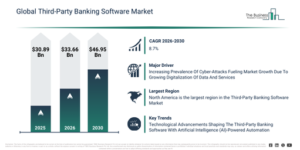
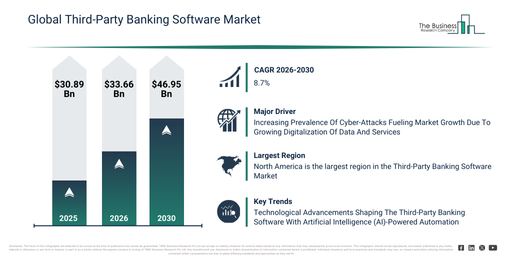
The third-party banking software market has experienced substantial expansion recently. This market is projected to expand from $30.89 billion in 2025 to $33.66 billion in 2026, demonstrating a compound annual growth rate (CAGR) of 9.0%. Historically, this increase has been driven by several factors, including the rising adoption of digital transformation initiatives within financial institutions, a heightened need for scalable banking solutions, stricter regulatory compliance demands, the wider use of online and mobile banking, and an uptick in the outsourcing of banking technology development.
The market for third-party banking software is projected to experience substantial expansion over the upcoming years. This market is anticipated to reach $46.95 billion in 2030, exhibiting a compound annual growth rate (CAGR) of 8.7%. This growth during the forecast period is propelled by several factors, including the rising adoption of AI-powered banking solutions, increased investment in cybersecurity platforms, the expanding open banking ecosystems, a growing need for real-time data analytics, and an accelerated migration to cloud-based banking infrastructure. Key trends anticipated in the same period involve the increasing embrace of cloud-native core banking systems, greater integration of advanced fraud detection tools, the expanding utilization of omnichannel banking platforms, the development of data-driven risk management solutions, and a heightened emphasis on modular banking architectures.
Access A Free Sample Of The Latest Third-Party Banking Software Market Analysis:
Why Is The Third-Party Banking Software Market Growing? The Key Demand Driver Explained
The rising occurrence of cyberattacks is anticipated to propel the expansion of the third-party banking software market in the future. A cyberattack involves a deliberate attempt by an individual or group to breach an information system, aiming to disrupt or gain unauthorized access to computer systems. This increasing prevalence of cyberattacks is fueled by the growing digitalization of data and services, which expands the potential attack surface and creates more opportunities for cybercriminals to exploit vulnerabilities. Third-party banking software assists in preventing cyberattacks by enabling banks to access advanced security technologies, providing continuous monitoring and enhanced protection, and ensuring quick responses to emerging threats. For instance, in June 2025, a report from the UK’s Department for Science, Innovation and Technology indicated a significant rise in ransomware affecting businesses, with the share impacted increasing from less than 0.5% in 2024 to 1% in 2025. Therefore, the growing incidence of cyberattacks is driving the growth of the third-party banking software market.
What Are The Main Segments Of The Third-Party Banking Software Market?
The third-party banking software market covered in this report is segmented –
1) By Product Type: Core Banking Software, Omnichannel Banking Software, Business Intelligence Software, Wealth Management Software, Other Product Types
2) By Deployment: On-Premise, Cloud
3) By Size Of Financial Institution: Small-Sized Financial Institutions, Medium-Sized Financial Institutions, Large Financial Institutions
4) By Application: Risk Management, Information Security, Business Intelligence, Training And Consulting Solutions, Other Applications
5) By End-User: Retail Banks, Commercial Banks, Investment Banks, Other End-Users
Subsegments:
1) By Core Banking Software: Account Management, Loan Management, Deposit Management, Transaction Processing, Compliance Management
2) By Omnichannel Banking Software: Mobile Banking, Internet Banking, Automated Teller Machine Banking, Branch Banking, Call Center Banking
3) By Business Intelligence Software: Data Analytics, Performance Management, Risk Management, Regulatory Reporting, Customer Insights
4) By Wealth Management Software: Portfolio Management, Financial Planning, Investment Management, Retirement Planning, Tax Optimization
5) By Other Product Types: Payment Processing, Customer Relationship Management, Fraud Detection, Treasury Management, Core Integration Tools
Third-Party Banking Software Market Trend Analysis: Where Leading Companies Are Focusing
Major companies operating in the third-party banking software market are increasingly focusing on technological advancements such as artificial intelligence (AI)-powered automation in banking. This strategy aims to enhance decision-making processes and elevate customer experiences, fundamentally redefining operational efficiency within financial institutions. Artificial intelligence (AI)-powered banking integrates AI and automation technologies into banking systems to foster smarter decision-making, enabling banks to provide personalized customer experiences with reduced manual effort. As an illustration, in January 2025, Black Dragon Capital LLC, a US-based technology company, introduced Open Banking Solutions (OBS). This cloud-native and digital banking platform empowers community-based financial institutions to accelerate their digital transformation and improve customer interactions. Open banking solutions (OBS) offer distinct features that enhance both customer experience and financial innovation. These solutions are underpinned by API-driven integration, facilitating secure and standardized data sharing between banks and third-party providers. Customers maintain complete control over their financial data via robust consent management systems, ensuring transparency and trust. Furthermore, it provides real-time access to banking information, enabling faster credit decisions and customized financial services.
Which Companies Are Major Players In The Third-Party Banking Software Market?
Major companies operating in the third-party banking software market are International Business Machines Corporation (IBM), Oracle Corporation, SAP SE, Salesforce Inc., Tata Consultancy Services Limited (TCS), NEC Corporation, Infosys Limited, Fiserv Inc., DXC Technology Company, Fidelity National Information Services Inc. (FIS), Jack Henry & Associates Inc., Finastra Group Holdings Limited, Temenos AG, Misys International Banking Systems Limited , Sopra Banking Software SA, nCino Inc., Intellect Design Arena Limited, Silverlake Axis Ltd., Mambu B.V., Profile Software S.A.
Get The Complete Third-Party Banking Software Market Analysis Here:
Which Region Held The Largest Share Of The Third-Party Banking Software Market In 2025?
North America was the largest region in the third-party banking software market in 2025. Asia-Pacific is expected to be the fastest-growing region in the forecast period. The regions covered in the third-party banking software market report are Asia-Pacific, South East Asia, Western Europe, Eastern Europe, North America, South America, Middle East, Africa.
Reach Out To Our Team:
The Business Research Company: https://www.thebusinessresearchcompany.com/
Americas: +1 310-496-7795
Asia: +44 7882 955267 & +91 8897263534
Europe: +44 7882 955267
Email us at: marketing@tbrc.info
Follow us on:
LinkedIn: https://in.linkedin.com/company/the-business-research-company
YouTube: https://www.youtube.com/channel/UC24_fI0rV8cR5DxlCpgmyFQ
Global Market Model: https://www.thebusinessresearchcompany.com/global-market-model

Wasay has over a decade of experience in market research, data modelling, and analytics, with prior experience at GlobalData and Decision Tree Consulting Services. At The Business Research Company , he leads research operations across syndicated studies, customized consulting engagements, and the Global Market Model platform. His professional experience includes supporting organizations such as Boston Consulting Group, KPMG, and Ernst & Young. Wasay holds a degree in Electronics and Communications Engineering, postgraduate management qualifications from International Management Institute Belgium and Indian School of Business and Entrepreneurship, and completed the Integrated Program in Business Analytics from Indian Institute of Management Indore.