The Business Research Company’s 2026 market reports are designed to deliver research that is more actionable and strategically valuable. Key offerings include market attractiveness scoring, total addressable market sizing, company benchmarking matrices, interactive Excel dashboards, deeper supply chain intelligence, emerging startup tracking, and granular product-level insights.
Which Factors Will Shape The Virtual Card Market Size Through 2030?
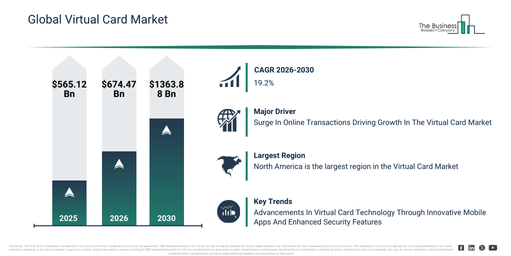
The virtual card market has experienced rapid expansion in recent years. Its size is forecast to grow from $565.12 billion in 2025 to $674.47 billion in 2026, demonstrating a compound annual growth rate (CAGR) of 19.3%. The market’s historical growth is attributable to the proliferation of e-commerce transactions, heightened usage of digital payment platforms, increased acceptance of contactless payments, the expansion of mobile banking applications, and advancements in digital identity verification.
The virtual card market size is anticipated to undergo substantial growth in the upcoming years, projected to expand to $1363.88 billion by 2030, demonstrating a compound annual growth rate (CAGR) of 19.2%. This expansion during the forecast period is fueled by factors such as increasing demand for secure online payments, the broadening of subscription-based payment models, a rise in the adoption of B2B digital payments, growing integration with digital wallets, and ongoing advancements in real-time payment systems. Noteworthy trends expected during this period encompass the increasing use of virtual cards for online transactions, a rising reliance on tokenized payment credentials, surging demand for corporate expense virtual cards, wider integration with mobile wallets, and an intensified focus on fraud prevention.
Request A Free Virtual Card Market Sample To Support Your Strategic Planning:
What Is Propelling The Virtual Card Market Toward $1363.88 Billion By 2030?
Rising online transactions are anticipated to drive the expansion of the virtual card market in the future. These transactions encompass financial exchanges conducted via the Internet, including purchasing goods and services, transferring funds, and settling bills. Their increasing popularity stems from factors such as convenience and accessibility, faster payment options, an expanded customer base, and enhanced security. Virtual cards improve online transactions by providing additional security through unique, temporary card numbers and simplifying payment processes with seamless digital integration. For instance, in May 2024, according to FedPayments Improvement, a US-based product of Federal Reserve Banks, in 2023, digital wallets and mobile apps were adopted by 62% of businesses, a notable increase from 47% in 2022. Therefore, increased online transactions act as a driver for the virtual card market.
What Are The Key Segments And Subsegments In The Virtual Card Market?
The virtual card market covered in this report is segmented –
1) By Type: Business-To-Business (B2B) Virtual Cards, Business-To-Consumer (B2C) Remote Payment Virtual Cards, Business-To-Consumer (B2C) Point Of Sale (POS) Virtual Cards
2) By Card Type: Credit Card, Debit Card
3) By Application: Consumer Use, Business Use, Other Applications
4) By End User: Businesses, Individuals
Subsegments:
1) By Business-To-Business (B2B) Virtual Cards: Corporate Expense Management Cards, Supplier Payments Cards, Employee Reimbursement Cards
2) By Business-To-Consumer (B2C) Remote Payment Virtual Cards: Online Shopping Virtual Cards, Digital Wallet Virtual Cards, Peer-To-Peer Payment Virtual Cards
3) By Business-To-Consumer (B2C) Point Of Sale (POS) Virtual Cards: In-Store Payment Virtual Cards, Mobile Payment Virtual Cards, Contactless Payment Virtual Cards
Virtual Card Market Trends Behind The 19.2% CAGR Forecast
Leading businesses within the virtual card sector are introducing cutting-edge technological innovations, specifically mobile virtual card applications, designed to boost user ease of use, strengthen security protocols, simplify financial operations, and ensure smooth integration with digital wallets and financial management platforms. These mobile virtual card applications are intended to offer financial organizations increased adaptability in providing secure and enduring contactless payment options, which are progressively in demand by businesses. As an illustration, in April 2024, Mastercard, a US-based provider of payment card services, released a Mastercard mobile virtual card app, enabling the straightforward addition of virtual commercial cards into digital wallets. This application leverages Mastercard’s existing virtual card and tokenization infrastructures, delivering sophisticated data and robust spending governance via an intuitive interface. It guarantees a frictionless experience when using Mastercard mobile virtual cards, letting users rapidly benefit from tap-to-pay convenience. Such virtual cards are applicable across a diverse range of organizations and sectors, such as healthcare, insurance, fleet management, higher education, and corporate travel.
Major Companies Profiled In The Virtual Card Market Report
Major companies operating in the virtual card market are JPMorgan Chase & Co., Citigroup Inc., American Express, Visa Inc., Mastercard, Standard Chartered Bank, DBS Bank Ltd, Stripe Inc., Adyen AS, Huntington Bancshares, WEX Inc., Wise Payments Limited, Revolut Ltd, Marqeta Inc., Emburse LLC, Billtrust Inc., Qonto, Skrill Ltd, MineralTree Inc., Cryptopay Ltd, Bento Technologies Inc., Weel Holdings Pty Ltd
Explore The Business Research Company’s Complete Virtual Card Market Report:
Where Does The Virtual Card Market Generate The Most Revenue?
North America was the largest region in the virtual card market in 2025. Asia-Pacific is expected to be the fastest-growing region in the forecast period. The regions covered in the virtual card market report are Asia-Pacific, South East Asia, Western Europe, Eastern Europe, North America, South America, Middle East, Africa.
Reach Out To Our Team:
The Business Research Company: https://www.thebusinessresearchcompany.com/
Americas: +1 310-496-7795
Asia: +44 7882 955267 & +91 8897263534
Europe: +44 7882 955267
Email us at: marketing@tbrc.info
Follow us on:
LinkedIn: https://in.linkedin.com/company/the-business-research-company
YouTube: https://www.youtube.com/channel/UC24_fI0rV8cR5DxlCpgmyFQ
Global Market Model: https://www.thebusinessresearchcompany.com/global-market-model

Wasay has over a decade of experience in market research, data modelling, and analytics, with prior experience at GlobalData and Decision Tree Consulting Services. At The Business Research Company , he leads research operations across syndicated studies, customized consulting engagements, and the Global Market Model platform. His professional experience includes supporting organizations such as Boston Consulting Group, KPMG, and Ernst & Young. Wasay holds a degree in Electronics and Communications Engineering, postgraduate management qualifications from International Management Institute Belgium and Indian School of Business and Entrepreneurship, and completed the Integrated Program in Business Analytics from Indian Institute of Management Indore.