Market attractiveness scoring, total addressable market sizing, company benchmarking matrices, interactive Excel dashboards, deeper supply chain intelligence, emerging startup tracking, and granular product-level insights are among the key offerings featured in The Business Research Company’s 2026 market reports, designed to deliver more actionable and strategically valuable research.
Forestry Lubricants Market Valued At $5.19 Billion In 2026, Projected To Reach $6.13 Billion By 2030
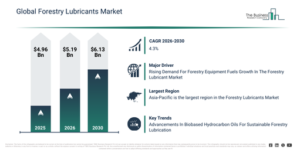
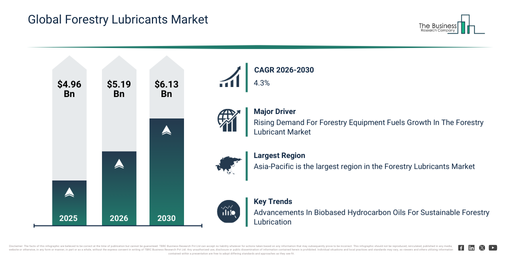
The forestry lubricants market has experienced consistent expansion in recent years. Projections indicate it will expand from $4.96 billion in 2025 to $5.19 billion in 2026, achieving a compound annual growth rate (CAGR) of 4.6%. This historical expansion was driven by factors such as increased forestry mechanization, requirements for equipment maintenance, the use of mineral oil, a rise in logging activities, and the need for machinery protection.
The forestry lubricants market is projected to experience consistent expansion over the upcoming years. Its value is forecast to reach $6.13 billion by 2030, exhibiting a compound annual growth rate (CAGR) of 4.3%. This anticipated growth throughout the forecast period stems from factors such as sustainability mandates, the increasing adoption of bio lubricants, automation within the forestry sector, initiatives for equipment efficiency optimization, and stricter environmental norms. Furthermore, major trends in the same period include the rising use of bio-based forestry lubricants, a growing demand for heavy-duty equipment oils, the expansion of mechanized logging operations, an intensified focus on equipment longevity, and the integration of environmentally friendly lubricants.
Request A Complimentary Forestry Lubricants Market Research Sample:
Key Factor Propelling The Forestry Lubricants Market Forward
The anticipated rise in the need for forestry equipment is projected to fuel the expansion of the forestry lubricant market moving forward. Forestry equipment encompasses the various tools and machinery essential for managing, harvesting, processing, and transporting products derived from forests. This demand for forestry equipment stems from factors like timber consumption, the adoption of sustainable forestry practices, and overall economic growth. Forestry lubricants play a crucial role by minimizing friction and offering protection against corrosion, which in turn extends the operational life of machinery, reduces maintenance expenditures, and enhances both fuel efficiency and productivity, especially in arduous environments. For illustration, a report released by Forest Research, a UK-based government research agency, in September 2025 stated that around 3.9 billion cubic meters (under-bark) of wood was extracted from global forests during 2023. Thus, the escalating demand for forestry equipment is a significant catalyst for the growth of the forestry lubricant market.
Forestry Lubricants Market Segments And Subsegments Explained
The forestry lubricants market covered in this report is segmented –
1) By Product Type: Synthetic, Synthetic Blend, Bio-Based, Mineral, Other Types
2) By Application: Engine, Transmission And Gears, Hydraulics, Greasing, Chain Oils Or Saw Guide Oils, Other Applications
3) By End-User: Sawmills, Wood Products Manufacturing, Biomass Pellet Mills, Pulp Mills, Harvesting Or Logging, Other End-Users
Subsegments:
1) By Synthetic Lubricants: Polyalphaolefin (PAO), Esters, Polyalkylene Glycol (PAG)
2) By Synthetic Blend Lubricants: PAO + Mineral Oil Blend, Ester + Mineral Oil Blend, PAO + Bio-Based Blend, Synthetic Hydrocarbons + Additives
3) By Bio-Based Lubricants: Vegetable Oil-based, Bio-esters, High Oleic Oils, Hydro-treated Vegetable Oils (HVO)
4) By Mineral Lubricants: Paraffinic Oils, Naphthenic Oils, Group I Base Oils, Group II Base Oils, Group III Base Oils
5) By Other Types: Semi-synthetic Lubricants, Re-refined Lubricants, Grease-based Lubricants
Emerging Trends Transforming The Forestry Lubricants Market
Companies operating within the forestry lubricants market are concentrating on developing advanced products, such as biobased hydrocarbon oils, to mitigate environmental impact and enhance sustainability while maintaining excellent performance in challenging forestry environments. Biobased hydrocarbon oils are lubricants derived from renewable biological sources, offering an ecologically responsible method to decrease the carbon footprint and environmental effects of lubricant consumption. For example, in February 2024, Kraton Corporation, a US-based chemical company, introduced SYLVASOLV, a lubricant crafted from crude tall oil (CTO), which is a byproduct of the Kraft pulp industry. This CTO is sourced from ethically managed trees to ensure it does not compete with food crops and helps lower the carbon footprint. The adaptable SYLVASOLV product line serves various industries, including fertilizer coatings and crop protection. SYLVASOLV 1000 is particularly effective for improving dust control and anti-caking properties. These oils deliver high solvency power, reduced viscosity, and excellent performance at low temperatures, contributing to greater flexibility and safety in formulations.
Forestry Lubricants Market Key Players: Major Companies In The 2026 Report
Major companies operating in the forestry lubricants market are Exxon Mobil Corporation, Shell plc, Chevron Corporation, Repsol SA, The Lubrizol Corporation, FUCHS PETROLUB SE, Quaker Chemical Corporation, LIQUI MOLY GmbH, Petro-Canada Lubricants Inc., Gulf Oil International Ltd., Penrite Oil Co Pty Ltd., Cortec Corporation, ADDINOL Lube Oil GmbH, RSC Bio Solutions, Ravensberger Schmierstoffvertrieb GmbH, Exol Lubricants Limited, TotalEnergies New Zealand Limited, BioBlend Renewable Resources LLC, KLONDIKE Lubricants Corporation, Tetrosyl Ltd.
Explore The Full Forestry Lubricants Market Report With Forecasts To 2030:
Forestry Lubricants Market By Region: Where Is Demand Strongest?
Asia-Pacific was the largest region in the forestry lubricants market in 2025. North America is expected to be the fastest-growing region in the forecast period. The regions covered in the forestry lubricants market report are Asia-Pacific, South East Asia, Western Europe, Eastern Europe, North America, South America, Middle East, Africa
Reach Out To Our Team:
The Business Research Company: https://www.thebusinessresearchcompany.com/
Americas: +1 310-496-7795
Asia: +44 7882 955267 & +91 8897263534
Europe: +44 7882 955267
Email us at: marketing@tbrc.info
Follow us on:
LinkedIn: https://in.linkedin.com/company/the-business-research-company
YouTube: https://www.youtube.com/channel/UC24_fI0rV8cR5DxlCpgmyFQ
Global Market Model: https://www.thebusinessresearchcompany.com/global-market-model

Wasay has over a decade of experience in market research, data modelling, and analytics, with prior experience at GlobalData and Decision Tree Consulting Services. At The Business Research Company , he leads research operations across syndicated studies, customized consulting engagements, and the Global Market Model platform. His professional experience includes supporting organizations such as Boston Consulting Group, KPMG, and Ernst & Young. Wasay holds a degree in Electronics and Communications Engineering, postgraduate management qualifications from International Management Institute Belgium and Indian School of Business and Entrepreneurship, and completed the Integrated Program in Business Analytics from Indian Institute of Management Indore.