With a focus on actionable insights and strategic value, The Business Research Company’s 2026 market reports include market attractiveness scoring, total addressable market sizing, company benchmarking matrices, interactive Excel dashboards, deeper supply chain intelligence, emerging startup tracking, and granular product-level insights.
How Large Could The Food Service Market Become By 2030 At A 10.4% CAGR?
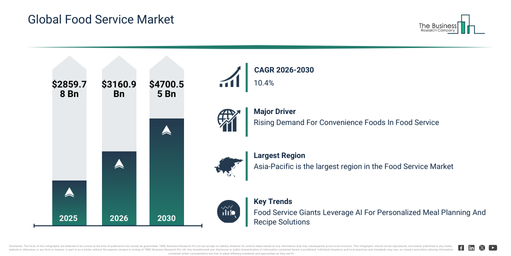
The food service market has seen rapid growth in its size over recent years. Projections indicate it will expand from $2859.78 billion in 2025 to $3160.9 billion in 2026, demonstrating a compound annual growth rate (CAGR) of 10.5%. Historically, this expansion has been driven by factors such as urbanization and lifestyle changes, the increasing popularity of dining out, the proliferation of restaurant chains, rising disposable income, and the globalization of various cuisines.
The food service market size is anticipated to undergo significant expansion over the next few years. It is forecast to grow to $4700.55 billion in 2030 at a compound annual growth rate (CAGR) of 10.4%. This projected growth in the upcoming period is attributable to the continued development of food delivery platforms, an increasing number of health-conscious consumers, the adoption of digital ordering systems, a demand for sustainable sourcing, and the expansion of organized foodservice operations. Noteworthy trends for the forecast period include the rise of online food ordering platforms, an increasing preference for sustainable food practices, the proliferation of cloud and ghost kitchens, a heightened focus on food safety and hygiene, and the personalization of menus and dining experiences.
Get A Free Food Service Market Sample With 2030 Forecast Insights:
Food Service Market Outlook: Key Driver Supporting Long-Term Growth
The food service market is anticipated to expand, driven by the rising demand for convenience foods. These foods, either pre-packaged or pre-prepared, are tailored for rapid, effortless consumption with little to no preparation, often being ready-to-eat or needing just basic steps like heating or mixing, thus suiting hectic routines. Factors contributing to this increasing demand include demanding lifestyles, limited cooking time, and the preference for fast, uncomplicated meal options. Food service providers meet these needs by supplying quick, ready-to-eat meals via effective takeout and delivery, thereby simplifying access to quality food and saving time. An illustrative example is from August 2024, where the U.S. Department of Agriculture (USDA), Economic Research Service (ERS), a U.S.-based government economic analysis source, reported that U.S. consumer spending on food away from home rose by 12.0% in 2023, climbing from $4,004 per person in 2022 to $4,485 per person. This surge indicates a heightened preference for convenience and prepared food alternatives. Consequently, the escalating demand for convenience foods propels the food service market.
Segmentation Of The Food Service Market: Key Categories Explained
The food service market covered in this report is segmented –
1) By Type: Full Service Restaurants, Quick Service Restaurants, Institutes, Other Types
2) By Systems: Conventional Foodservice System, Centralized Foodservice System, Ready Prepared Foodservice System, Assembly-Serve Foodservice System
3) By Sector: Commercial, Non-Commercial
Subsegments:
1) By Full Service Restaurants (FSR): Fine Dining Restaurants, Casual Dining Restaurants, Family Dining Restaurants, Theme-Based Restaurants, Ethnic / Specialty Cuisine Restaurants, Luxury & Premium Restaurants, Hotel-Based Restaurants, Bistro & Brasserie-Style Restaurants
2) By Quick Service Restaurants (QSR): Fast Food Chains, Fast Casual Restaurants, Cafés & Coffee Shops, Bakery-Cafés, Food Courts, Drive-Through Restaurants, Takeaway / Take-out Outlets, Kiosks & Food Stalls
3) By Institutes: Educational Institutions: Corporate Offices & Business Parks, Hospitals & Healthcare Facilities, Military & Defense Establishments, Government Institutions, Correctional Facilities, Elderly Care & Assisted Living Facilities, Research & Training Institutes
4) By Other Types: Catering Services, Cloud Kitchens, Food Trucks & Mobile Food Units, Vending Machine Food Services, Event & Outdoor Food Services, Airline, Railway & Cruise Food Services, Leisure & Entertainment Venues
Food Service Market Evolving Trends: What Businesses Should Know
Leading companies operating in the food service market are developing sophisticated solutions, such as AI-driven, customized food and recipe options, tailored to individual preferences and dietary needs, which also streamline meal planning and preparation processes. These AI-powered, personalized food and recipe solutions aim to enhance the healthiness and enjoyment of meal planning, cooking, and eating by utilizing technology to address specific individual requirements and tastes. For instance, in August 2023, Samsung Electronics, an electronics company based in South Korea, introduced a new AI-powered, personalized food service and recipe platform. It utilizes advanced Food AI to propose meals based on user preferences and food seasonality. Offering over 160,000 recipes, it functions as a personalized assistant, helping users uncover new dishes, formulate tailored meal plans, and order ingredients online. The application can further customize recipes to match users’ dietary requirements, nutritional targets, and available ingredients.
Who Competes In The Food Service Market? Major Companies Listed
Major companies operating in the food service market are Sysco Corporation, Compass Group, McDonalds Corporation, Sodexo SA, Marriott International, Dominos Pizza Inc., Aramark Corporation, Darden Restaurants Inc., Chipotle Mexican Grill Inc., Tim Hortons Inc, Yum Brands Inc., KFC Corporation, Restaurant Brands International Inc., Elior Group, Jollibee Foods Corporation, Papa Johns International Inc., Wendys Company, Whitbread PLC, Supermacs Holdings Ltd., Dunkin Brands Group Inc.
Read The Complete Food Service Market Forecast Report Through 2030:
Food Service Market Regional Ranking: Which Geography Comes First?
Asia-Pacific was the largest region in the food service market in 2025. Asia-Pacific is expected to be the fastest-growing region in the forecast period. The regions covered in the food service market report are Asia-Pacific, South East Asia, Western Europe, Eastern Europe, North America, South America, Middle East, Africa.
Reach Out To Our Team:
The Business Research Company: https://www.thebusinessresearchcompany.com/
Americas: +1 310-496-7795
Asia: +44 7882 955267 & +91 8897263534
Europe: +44 7882 955267
Email us at: marketing@tbrc.info
Follow us on:
LinkedIn: https://in.linkedin.com/company/the-business-research-company
YouTube: https://www.youtube.com/channel/UC24_fI0rV8cR5DxlCpgmyFQ
Global Market Model: https://www.thebusinessresearchcompany.com/global-market-model

Wasay has over a decade of experience in market research, data modelling, and analytics, with prior experience at GlobalData and Decision Tree Consulting Services. At The Business Research Company , he leads research operations across syndicated studies, customized consulting engagements, and the Global Market Model platform. His professional experience includes supporting organizations such as Boston Consulting Group, KPMG, and Ernst & Young. Wasay holds a degree in Electronics and Communications Engineering, postgraduate management qualifications from International Management Institute Belgium and Indian School of Business and Entrepreneurship, and completed the Integrated Program in Business Analytics from Indian Institute of Management Indore.