Market attractiveness scoring, total addressable market sizing, company benchmarking matrices, interactive Excel dashboards, deeper supply chain intelligence, emerging startup tracking, and granular product-level insights are among the key offerings featured in The Business Research Company’s 2026 market reports, designed to deliver more actionable and strategically valuable research.
Foodservice Channel Market Growth Outlook: How Much Bigger Will The Market Be By 2030?
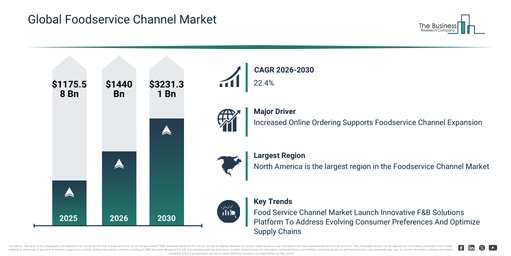
The foodservice channel market size has seen substantial growth recently. It is forecast to expand from $1175.58 billion in 2025 to $1440 billion in 2026, exhibiting a compound annual growth rate (CAGR) of 22.5%. This historical growth can be linked to the development of the hospitality sector, the increase in various restaurant formats, changes in urban consumer lifestyles, the advancement of organized retail, and the initial foodservice distribution models.
The foodservice channel market size is anticipated to experience substantial growth over the coming years. This market is projected to reach $3231.31 billion by 2030, exhibiting a compound annual growth rate (CAGR) of 22.4%. This expansion during the forecast period is primarily driven by factors such as the rise of digital food platforms, an increase in travel and tourism dining, the broadening of workplace foodservice options, the implementation of omni-channel strategies, and a growing need for quicker service models. Key trends expected within this period encompass the development of online and mobile food channels, the proliferation of delivery and takeaway services, the integration of digital ordering systems, an increasing appetite for convenience in dining, and the broadening of foodservice distribution channels.
Request A Free Foodservice Channel Market Sample From The Business Research Company:
How Is The Key Growth Driver Influencing The Foodservice Channel Market?
The future expansion of the foodservice channel market is anticipated to be driven by the rise in online food ordering. This involves a digital method allowing customers to choose and buy meals via websites or mobile applications from restaurants or delivery providers, offering convenient, direct ordering and payment without needing to physically go to the venue. The uptick in online food orders stems from a rising demand for convenience and efficiency, fueled by pervasive smartphone usage and improved internet access, along with consumer desire for quick and simple meal options. The foodservice channel facilitates online food ordering by offering diverse restaurant and delivery choices accessible through digital platforms, thereby simplifying the ordering process and enabling consumers to easily view menus, place orders, and get prompt deliveries. For example, data from the Hotel Tech report, a US-based online platform focused on the hotel technology sector, indicates that the percentage of American consumers ordering food via meal delivery apps climbed from 15% in 2021 to 25% in 2023. Consequently, the expanding trend of online food ordering is a key driver for the food service channel market.
Foodservice Channel Market Segmentation By Category: What Does The 2026 Report Cover?
The foodservice channel market covered in this report is segmented –
1) By Channel Outlook: Accommodation, Leisure, Mobile Operators, Pubs, Clubs, And Bars, Restaurants, Retail, Travel, Workplace
2) By Service: Commercial, Non-Commercial
3) By Systems: Conventional Foodservice System, Centralized Foodservice System, Ready Prepared Foodservice System, Assembly-Serve Foodservice System
Subsegments:
1) By Accommodation: Hotels And Resorts, Bed And Breakfasts (B And Bs), Motels, Hostels, Lodges And Inns
2) By Leisure: Amusement Parks And Theme Parks, Zoos And Aquariums, Entertainment Complexes, Sports Venues (Stadiums, Arenas), Cruise Ships And Resorts
3) By Mobile Operators: Food Delivery Apps, Online Food Ordering Platforms, Virtual Kitchens, On-demand Food Services
4) By Pubs, Clubs, And Bars: Public Houses (Pubs), Nightclubs And Dance Bars, Cocktail Bars And Lounges, Beer Gardens, Karaoke Bars
5) By Restaurants: Quick Service Restaurants (Qsrs), Full-Service Restaurants, Casual Dining, Fine Dining, Fast-Casual Chains
6) By Retail: Supermarkets And Hypermarkets, Convenience Stores, Food Retailers, Meal Kits And Grocery Stores, Online Food Retail Platforms
7) By Travel: Airports And Airlines, Railways And Bus Stations, Travel Plazas And Service Areas, Travel And Tourism Centers, Train Dining Cars
8) By Workplace: Corporate Cafeterias, Office Building Food Courts, Employee Meal Programs, On-Site Catering Services, Staff Dining Facilities
How Are Industry Players Changing The Foodservice Channel Market Landscape?
Major companies operating within the foodservice channel market are prioritizing the development of innovative platforms, such as food and beverage solutions (F&B) platforms, to deliver customized solutions for efficient inventory management, menu planning, and supply chain optimization. F&B Solutions is engineered to sharpen its focus on addressing evolving consumer preferences and accommodating diverse customer requirements. For example, in January 2024, Ofi, a Singapore-based company specializing in sustainable food ingredients, launched F&B Solutions, specifically designed to enhance its focus on responding to changing consumer tastes and supporting a broad spectrum of customer needs. This F&B Solutions platform holds particular significance for the food service channel, as it aims to fulfill the demands of global and regional customers across various sectors, including fast-moving consumer goods (FMCG), retail, and quick-service restaurants (QSR). The strong emphasis on co-creation and innovative product ideation directly aligns with food service operators’ objectives to improve their offerings and respond effectively to shifting consumer trends.
Foodservice Channel Market Global Key Players And Competitive Overview
Major companies operating in the foodservice channel market are McDonald’s Corporation, Darden Restaurants Inc., Chipotle Mexican Grill Inc., Yum! Brands Inc., Restaurant Brands International Inc., Panera Bread Company, Domino’s Pizza Inc., Bloomin’ Brands Inc., Texas Roadhouse Inc., Brinker International Inc., Zaxby’s Franchising Inc., Wendy’s Company, BJ’s Restaurants Inc., Shake Shack Inc., Cheesecake Factory Incorporated, First Watch Restaurant Group Inc., White Castle System Inc., Cava Group Inc., Noodles & Company, El Pollo Loco Holdings Inc., Sweetgreen Inc., Wingstop Inc., Fogo de Chão Inc., Dunkin’ Brands Group Inc.
Explore Comprehensive Foodservice Channel Market Coverage In The Full Report:
Regional Analysis Of The Foodservice Channel Market: Where Is The Industry Concentrated?
North America was the largest region in the foodservice channel market in 2025. Asia-Pacific is expected to be the fastest-growing region in the forecast period. The regions covered in the foodservice channel market report are Asia-Pacific, South East Asia, Western Europe, Eastern Europe, North America, South America, Middle East, Africa.
Reach Out To Our Team:
The Business Research Company: https://www.thebusinessresearchcompany.com/
Americas: +1 310-496-7795
Asia: +44 7882 955267 & +91 8897263534
Europe: +44 7882 955267
Email us at: marketing@tbrc.info
Follow us on:
LinkedIn: https://in.linkedin.com/company/the-business-research-company
YouTube: https://www.youtube.com/channel/UC24_fI0rV8cR5DxlCpgmyFQ
Global Market Model: https://www.thebusinessresearchcompany.com/global-market-model

Wasay has over a decade of experience in market research, data modelling, and analytics, with prior experience at GlobalData and Decision Tree Consulting Services. At The Business Research Company , he leads research operations across syndicated studies, customized consulting engagements, and the Global Market Model platform. His professional experience includes supporting organizations such as Boston Consulting Group, KPMG, and Ernst & Young. Wasay holds a degree in Electronics and Communications Engineering, postgraduate management qualifications from International Management Institute Belgium and Indian School of Business and Entrepreneurship, and completed the Integrated Program in Business Analytics from Indian Institute of Management Indore.