With a focus on actionable insights and strategic value, The Business Research Company’s 2026 market reports include market attractiveness scoring, total addressable market sizing, company benchmarking matrices, interactive Excel dashboards, deeper supply chain intelligence, emerging startup tracking, and granular product-level insights.
How Much Will The Luxury Beauty Market Be Worth By 2030?
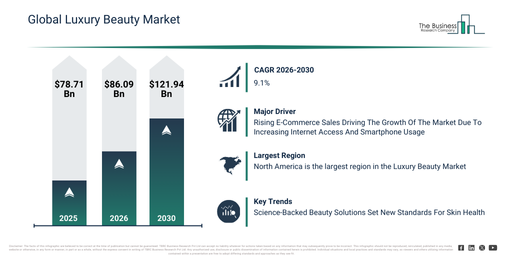
The luxury beauty market size has experienced robust growth in recent years. It is projected to expand from $78.71 billion in 2025 to $86.09 billion in 2026, achieving a compound annual growth rate (CAGR) of 9.4%. Historically, this growth has been driven by brand driven consumer demand, rising disposable incomes, premiumization of beauty products, retail expansion, and celebrity and influencer marketing.
The luxury beauty market is projected to experience substantial expansion over the upcoming years. Its size is anticipated to reach $121.94 billion by 2030, driven by a compound annual growth rate (CAGR) of 9.1%. This projected growth is largely attributable to factors such as the rise of digital luxury shopping, the increasing adoption of sustainable ingredients, advancements in biotechnology-based formulations, the development of personalization technologies, and growing luxury demand from emerging markets. Key trends anticipated during this period encompass an escalating demand for high-end skincare products, a stronger inclination towards clean and eco-friendly beauty options, the broadening of online and digital luxury retail channels, a heightened emphasis on sophisticated formulations, and the desire for personalized and bespoke beauty experiences.
Get Access To A Free Luxury Beauty Market Report Sample:
The Key Driver Behind The Luxury Beauty Market’s 9.1% CAGR
The increasing prominence of e-commerce sales is anticipated to drive the future expansion of the luxury beauty market. E-commerce involves the exchange of goods or services conducted online via digital platforms, where transactions and order processing are handled electronically. The surge in e-commerce sales stems from enhanced internet access and widespread smartphone adoption, making online shopping more convenient and reachable for a broader demographic. This digital channel empowers luxury beauty brands to reach a wider audience, deliver customized shopping experiences, and showcase exclusive products, which can foster greater engagement and potential sales growth. For instance, in February 2025, the Census Bureau, a US-based government agency, estimated total e-commerce sales in 2024 at $1,192.6 billion, representing an 8.1% increase (±1.1) compared to 2023. Furthermore, in 2024, e-commerce sales accounted for 16.1% of overall retail sales, rising from 15.3% in 2023, which highlights the growing importance of online channels in retail. Therefore, the upward trend in e-commerce sales is poised to generate opportunities for expansion within the luxury beauty market.
Luxury Beauty Market Classification: Main Segments And Detailed Subsegments
The luxury beauty market covered in this report is segmented –
1) By Product Type: Skincare, Haircare, Makeup, Fragrances, Other Product Types
2) By Application: Personal Care And Self-Grooming, Hospitality And Spa Industry, Fashion And Entertainment Industry, Retail And Travel Retail
3) By Distribution Channel: Online Retail, Specialty Stores, Department Stores, Other Distribution Channels
4) By End-User: Men, Women, Unisex
Subsegments:
1) By Skincare: Anti-Aging Creams, Hydrating Serums, Exfoliators, Brightening Creams, Night Creams, Face Oils, Sheet Masks, Pore Refiners
2) By Haircare: Volumizing Shampoos, Leave-In Conditioners, Heat Protection Sprays, Hair Repair Masks, Hair Gloss Treatments
3) By Makeup: Liquid Foundations, Lip Glosses, Eyeliners, Brow Pencils, Compact Powders, Makeup Removers
4) By Fragrances: Floral Scents, Woody Scents, Citrus Scents, Oriental Scents, Fresh Scents, Spicy Scents
5) By Other Product Types: Body Scrubs, Hand Creams, Foot Care Products, Nail Polishes, Makeup Brushes, Beauty Blenders, Beard Oils, Deodorants
Luxury Beauty Market Strategic Shifts: What Leading Players Are Prioritizing
Leading companies operating in the luxury beauty market are focusing on developing innovative solutions, such as premium haircare and skincare brands, to meet the increasing demand for high-performance, science-backed beauty products. These premium haircare and skincare brands are high-end beauty lines that utilize advanced formulations, quality ingredients, and innovative technologies to deliver superior results and a luxury experience. For instance, in October 2024, Reliance Retail Limited, an India-based retail company, through its beauty platform Tira, introduced the global luxury skincare and haircare brand Augustinus Bader in India. The brand is distinguished by its patented TFC8 technology, a unique combination of natural amino acids, high-grade vitamins, and peptides developed from over 30 years of regenerative medicine research. This technology promotes cellular renewal and skin healing, helping to reduce fine lines, wrinkles, redness, hyperpigmentation, stretch marks, and damage caused by environmental stressors, resulting in healthier, firmer, and more even-toned skin. The formulations are designed to adapt to individual skin needs across all genders, ages, and ethnicities, making them suitable for a wide variety of skin types and conditions.
Luxury Beauty Market Company Analysis: Major Industry Participants
Major companies operating in the luxury beauty market are Christian Dior, L’Oréal, Kering Group, Chanel, Estée Lauder, Gucci, Shiseido, Coty, Puig, Burberry, Amorepacific, Clarins, La Colline Skincare, La Prairie, La Mer, Decorté, POLA Orbis, Sisley Paris, Helena Rubinstein, SK‑II, Giorgio Armani Beauty, Tom Ford Beauty, Dolce & Gabbana Beauty, Valentino Beauty, Givenchy Beauty, Yves Saint Laurent Beauté, Lancôme, Hermès Parfums, Prada Beauty, Bvlgari Parfums, Creed Fragrance & Beauty, Maison Francis Kurkdjian, Diptyque, Byredo
Get Full Access To The Luxury Beauty Market Report 2026:
Luxury Beauty Market Global Regional Breakdown: Key Regions Analyzed
North America was the largest region in the luxury beauty market in 2025. Asia-Pacific is expected to be the fastest-growing region in the forecast period. The regions covered in the luxury beauty market report are Asia-Pacific, South East Asia, Western Europe, Eastern Europe, North America, South America, Middle East, Africa
Reach Out To Our Team:
The Business Research Company: https://www.thebusinessresearchcompany.com/
Americas: +1 310-496-7795
Asia: +44 7882 955267 & +91 8897263534
Europe: +44 7882 955267
Email us at: marketing@tbrc.info
Follow us on:
LinkedIn: https://in.linkedin.com/company/the-business-research-company
YouTube: https://www.youtube.com/channel/UC24_fI0rV8cR5DxlCpgmyFQ
Global Market Model: https://www.thebusinessresearchcompany.com/global-market-model

Wasay has over a decade of experience in market research, data modelling, and analytics, with prior experience at GlobalData and Decision Tree Consulting Services. At The Business Research Company , he leads research operations across syndicated studies, customized consulting engagements, and the Global Market Model platform. His professional experience includes supporting organizations such as Boston Consulting Group, KPMG, and Ernst & Young. Wasay holds a degree in Electronics and Communications Engineering, postgraduate management qualifications from International Management Institute Belgium and Indian School of Business and Entrepreneurship, and completed the Integrated Program in Business Analytics from Indian Institute of Management Indore.