Market attractiveness scoring, total addressable market sizing, company benchmarking matrices, interactive Excel dashboards, deeper supply chain intelligence, emerging startup tracking, and granular product-level insights are among the key offerings featured in The Business Research Company’s 2026 market reports, designed to deliver more actionable and strategically valuable research.
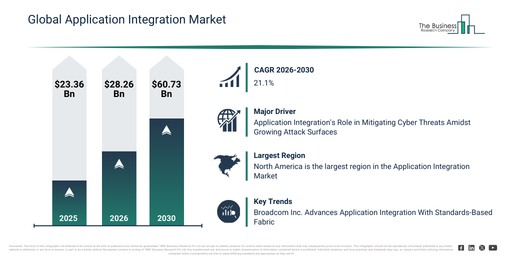
Application Integration Market Valued At $28.26 Billion In 2026, Projected To Reach $60.73 Billion By 2030
The application integration market has seen substantial growth in recent years. It is projected to increase from $23.36 billion in 2025 to $28.26 billion in 2026, achieving a compound annual growth rate (CAGR) of 21.0%. This historical growth can be attributed to factors such as the rise in enterprise software adoption, the need for seamless data exchange, the increasing deployment of ERP and CRM systems, the demand for process automation, and the early adoption of middleware solutions.
The application integration market is projected to experience substantial expansion over the upcoming years. Its valuation is set to reach $60.73 billion by 2030, driven by a compound annual growth rate (CAGR) of 21.1%. This anticipated growth can be linked to several factors, including the proliferation of iPaaS solutions, the increasing embrace of multi-cloud and hybrid integration approaches, a rising need for real-time analytical capabilities, an emphasis on API-driven connectivity, and the spread of integration solutions into new markets. Key trends anticipated during this period encompass the optimization of middleware, enhanced API management and standardization, wider adoption of hybrid integration, real-time data synchronization, and the prevalence of cloud-based integration platforms.
Request A Complimentary Application Integration Market Research Sample:
Key Factor Propelling The Application Integration Market Forward
The expanding cyber threat attack surface is anticipated to drive the future growth of the application integration market. A cyber threat involves malicious actions aimed at computer systems, networks, devices, or data, intending to compromise their availability, confidentiality, or integrity. This attack surface is enlarging because of increased cloud adoption, a surge in connected devices, widespread remote work setups, and the escalating intricacy of digital infrastructures. The application integration market addresses this requirement by facilitating smooth data exchange across various systems, enhancing security oversight, reinforcing threat detection, and improving coordinated responses to incidents. For example, in September 2023, data from the Australian Cyber Security Centre (ACSC), an Australian government cybersecurity body, indicated that roughly 0.000094 billion cybercrime reports were filed in FY 2022–23. This figure represents a significant jump from the prior year, underscoring the increasing vulnerability to cyber threats. Consequently, the expanding attack surface for cyber threats is propelling the development of the application integration market.
Application Integration Market Segments And Subsegments Explained
The application integration market covered in this report is segmented –
1) By Integration Type: Point-To-Point Integration, Enterprise Application Integration, Enterprise Service Bus, Integration Platform As A Service, Hybrid Integration
2) By Integration Technologies: Middleware Solutions, Application Programming Interface Management, Integration Platform as a Service (iPaaS)
3) By Offering: Platforms, Services
4) By Application: Consumer Relationship Management, Enterprise Resource Planning, Human Resource Management System, Supply Chain Management, Business Intelligence, Electronic Health Record Management, Other Applications
5) By Vertical: Banking, Financial Services, And Insurance, Retail And E-Commerce, Manufacturing, Healthcare And Life Sciences, Energy And Utilities, Automotive, Transportation And Logistics, Government And Public Sector, Other Verticals
Subsegments:
1) By Point-To-Point Integration: Direct Integration, Peer-To-Peer Integration
2) By Enterprise Application Integration: Middleware-Based Integration, Cloud-based Application Integration, Data Integration
3) By Enterprise Service Bus: Cloud-based Enterprise Service Bus, On-premises Enterprise Service Bus
4) By Integration Platform As A Service (iPaaS): Cloud Integration, Hybrid Integration
5) By Hybrid Integration: Cloud And On-premises Integration, Multi-cloud Integration
Emerging Trends Transforming The Application Integration Market
Leading firms within the application integration market prioritize boosting seamless interoperability and standardized connectivity, including approaches like standards-based fabric integration, to achieve a competitive edge. This type of integration allows businesses to link various applications, platforms, and data sources via a consolidated architecture, thereby simplifying operations and enhancing the real-time movement of data across different systems. As an illustration, during November 2025, Broadcom Inc., a US-based semiconductor and infrastructure software company, launched a standards-based fabric designed for application integration. This offering includes automated policy enforcement, built-in support for multi-cloud environments, and real-time monitoring dashboards, all aimed at optimizing system performance.
Application Integration Market Key Players: Major Companies In The 2026 Report
Major companies operating in the application integration market are Microsoft Corporation; Dell Inc.; International Business Machines Corporation; Deloitte Touche Tohmatsu Limited; Oracle Corporation; SAP SE; Salesforce Inc.; Zebra Technologies Corporation; Informatica Inc.; OSI Digital Inc.; TIBCO Software Inc.; Software AG; InterSystems Corporation; QlikTech International AB; Boomi Inc.; Tavant Technologies Inc.; Neudesic LLC; MuleSoft LLC; Zapier Inc.; Axway; Actian Corporation; Workato Inc.; WSO2 LLC; SnapLogic Inc.; ScienceSoft Corporation; Cleo; Celigo Inc.; DBSync; Flowgear; OpenLegacy Inc.
Explore The Full Application Integration Market Report With Forecasts To 2030:
Application Integration Market By Region: Where Is Demand Strongest?
North America was the largest region in the application integration market in 2025. Asia-Pacific is expected to be the fastest-growing region in the forecast period. The regions covered in the application integration market report are Asia-Pacific, South East Asia, Western Europe, Eastern Europe, North America, South America, Middle East, Africa.
Reach Out To Our Team:
The Business Research Company: https://www.thebusinessresearchcompany.com/
Americas: +1 310-496-7795
Asia: +44 7882 955267 & +91 8897263534
Europe: +44 7882 955267
Email us at: marketing@tbrc.info
Follow us on:
LinkedIn: https://in.linkedin.com/company/the-business-research-company
YouTube: https://www.youtube.com/channel/UC24_fI0rV8cR5DxlCpgmyFQ
Global Market Model: https://www.thebusinessresearchcompany.com/global-market-model

Wasay has over a decade of experience in market research, data modelling, and analytics, with prior experience at GlobalData and Decision Tree Consulting Services. At The Business Research Company , he leads research operations across syndicated studies, customized consulting engagements, and the Global Market Model platform. His professional experience includes supporting organizations such as Boston Consulting Group, KPMG, and Ernst & Young. Wasay holds a degree in Electronics and Communications Engineering, postgraduate management qualifications from International Management Institute Belgium and Indian School of Business and Entrepreneurship, and completed the Integrated Program in Business Analytics from Indian Institute of Management Indore.