With a focus on actionable insights and strategic value, The Business Research Company’s 2026 market reports include market attractiveness scoring, total addressable market sizing, company benchmarking matrices, interactive Excel dashboards, deeper supply chain intelligence, emerging startup tracking, and granular product-level insights.
How Large Could The Augmented And Virtual Reality in Manufacturing Market Become By 2030 At A 25.4% CAGR?
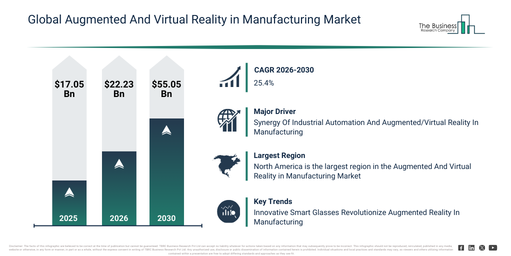
The augmented and virtual reality in manufacturing market size has experienced rapid expansion in recent years. It is anticipated to expand from $17.05 billion in 2025 to $22.23 billion in 2026, achieving a compound annual growth rate (CAGR) of 30.4%. This historical growth can be attributed to factors such as the rising adoption of AR/VR technologies within manufacturing, the demand for improved workforce training, the need for enhanced safety protocols, an increased focus on production efficiency, and advancements in industrial hardware and software.
The augmented and virtual reality in manufacturing market is projected to experience substantial growth in the coming years. It is anticipated to expand to $55.05 billion by 2030, achieving a compound annual growth rate (CAGR) of 25.4%. This anticipated growth during the forecast period can be attributed to factors such as the integration of AI with AR/VR platforms, the expansion of digital twin applications, the adoption of cloud-based simulation tools, the rising demand for remote assistance solutions, and increasing investments in smart manufacturing infrastructure. Significant trends expected in the forecast period include virtual training and simulation solutions, AR-assisted maintenance and repair, 3D visualization for product design, real-time operational monitoring, and measures for safety compliance and risk reduction.
Get A Free Augmented And Virtual Reality in Manufacturing Market Sample With 2030 Forecast Insights:
Augmented And Virtual Reality in Manufacturing Market Outlook: Key Driver Supporting Long-Term Growth
The future expansion of augmented and virtual reality in the manufacturing market is anticipated to be driven by the rise in industrial automation. This automation involves the deployment of control systems, machinery, and various technologies to streamline industrial processes and tasks, primarily within manufacturing and production settings. The growing uptake of industrial automation stems from economic, technological, and market pressures that necessitate manufacturers adopt it as a key strategy for operational excellence, competitive advantage, and long-term viability in an evolving business environment. Augmented and virtual reality facilitates overlaying real-time performance data onto physical equipment, offering operators crucial insights into aspects such as robot performance, production metrics, and maintenance schedules. This capability supports proactive decision-making and the optimization of manufacturing processes. For example, reports from the International Federation of Robotics (IFR), a Germany-based non-profit organization, indicated that in September 2024, industrial robot installations in the UK increased by 51%, reaching 3,830 units. Concurrently, in the Americas, over 50,000 units were installed for the third consecutive year, amounting to 55,389 units in 2023. Consequently, the expansion of industrial automation fuels the growth of augmented and virtual reality in the manufacturing market.
Segmentation Of The Augmented And Virtual Reality in Manufacturing Market: Key Categories Explained
The augmented and virtual reality in manufacturing market covered in this report is segmented –
1) By Component: Hardware, Software, Services
2) By Technology: Augmented Reality, Virtual Reality
3) By Device Type: Head-Mounted Display, Head-Up Display, Handheld Devices
4) By Organization Size: Large Enterprises, Small And Medium-Sized Enterprises
5) By Application: Product Design And Development, Safety And Training, Maintenance And Repair
Subsegments:
1) By Hardware: AR Or VR Headsets, Sensors, Cameras, Display Units, Processors, Wearables
2) By Software: AR Or VR Development Tools, Simulation Software, 3D Visualization Software, Data Analytics And Management Software, Application Software For Specific Use Cases
3) By Services: Integration Services, Consulting Services, Support And Maintenance Services, Training And Education Services
Augmented And Virtual Reality in Manufacturing Market Evolving Trends: What Businesses Should Know
Leading companies operating in the augmented and virtual reality in manufacturing market are developing sophisticated smart glasses, such as the Z100 smart glasses, to better serve customers with enhanced features. Z100 smart glasses function as wearable computers that enable a hands-free experience by overlaying digital information onto the user’s field of view, typically through a transparent display. For instance, in January 2024, Vuzix Corporation, a US-based technology company, launched the Z100 smart glasses to establish a seamless connection between workers and AI optimization tools. The unique aspect of the Z100 smart glasses elevates enterprise usage of AR glasses by offering workers a hands-free wearable device that closely resembles standard eyeglasses. With a battery life of up to 48 hours on a single charge, the Vuzix Z100 smart glasses integrate industry-leading heads-up waveguide technology into a stylish, lightweight design, weighing just 35 grams, equivalent to the weight of typical glasses. Enhanced by advanced monocular waveguide optics and Vuzix’s proprietary microdisplay engine, these glasses produce a sharp, transparent, monochrome image, presenting vital information directly before the wearer’s eyes from their Android or iOS device without requiring hands. Users benefit from instant access to critical task details, ranging from language translation and closed captioning to navigation, health tracking, messaging, workflow updates, and more.
Who Competes In The Augmented And Virtual Reality in Manufacturing Market? Major Companies Listed
Major companies operating in the augmented and virtual reality in manufacturing market are Apple Inc; Google LLC; Panasonic Holdings Corporation; Microsoft Corporation; Sony Group Corporation; Intel Corporation; Lenovo Group Limited; PTC Inc; Magic Leap Inc; Vuzix Corporation; Scope AR; Atheer Inc; Varjo Technologies Oy; Unity Technologies Inc; TeamViewer AG; RealWear Inc; Meta Platforms Reality Labs; NVIDIA Corporation; Siemens AG; Zebra Technologies; Honeywell International Inc; General Electric Company; Rockwell Automation Inc
Read The Complete Augmented And Virtual Reality in Manufacturing Market Forecast Report Through 2030:
Augmented And Virtual Reality in Manufacturing Market Regional Ranking: Which Geography Comes First?
North America was the largest region in the augmented and virtual reality in manufacturing market in 2025. Asia-Pacific is expected to be the fastest-growing region in the forecast period. The regions covered in the augmented and virtual reality in manufacturing market report are Asia-Pacific, South East Asia, Western Europe, Eastern Europe, North America, South America, Middle East, Africa.
Reach Out To Our Team:
The Business Research Company: https://www.thebusinessresearchcompany.com/
Americas: +1 310-496-7795
Asia: +44 7882 955267 & +91 8897263534
Europe: +44 7882 955267
Email us at: marketing@tbrc.info
Follow us on:
LinkedIn: https://in.linkedin.com/company/the-business-research-company
YouTube: https://www.youtube.com/channel/UC24_fI0rV8cR5DxlCpgmyFQ
Global Market Model: https://www.thebusinessresearchcompany.com/global-market-model

Wasay has over a decade of experience in market research, data modelling, and analytics, with prior experience at GlobalData and Decision Tree Consulting Services. At The Business Research Company , he leads research operations across syndicated studies, customized consulting engagements, and the Global Market Model platform. His professional experience includes supporting organizations such as Boston Consulting Group, KPMG, and Ernst & Young. Wasay holds a degree in Electronics and Communications Engineering, postgraduate management qualifications from International Management Institute Belgium and Indian School of Business and Entrepreneurship, and completed the Integrated Program in Business Analytics from Indian Institute of Management Indore.