The Business Research Company’s 2026 market reports are designed to deliver research that is more actionable and strategically valuable. Key offerings include market attractiveness scoring, total addressable market sizing, company benchmarking matrices, interactive Excel dashboards, deeper supply chain intelligence, emerging startup tracking, and granular product-level insights.
Automated Fingerprint Identification System Market Revenue Projected To Rise To $39.24 Billion By 2030
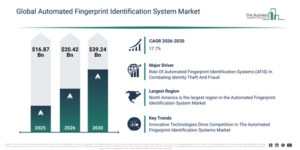
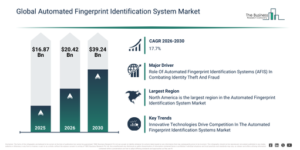
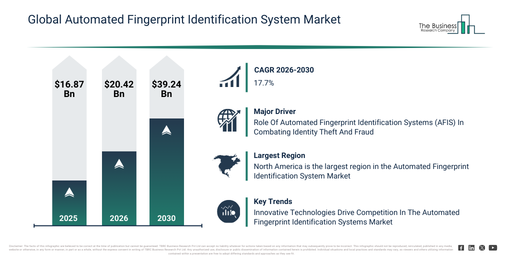
The automated fingerprint identification system market has experienced significant expansion in recent years. It is projected to grow from $16.87 billion in 2025 to $20.42 billion in 2026, demonstrating a compound annual growth rate (CAGR) of 21.0%. The growth observed in the historic period can be attributed to factors such as the increasing demand for security and surveillance, advancements in biometric sensor technology, government initiatives for digital identity programs, the rising adoption of fingerprint systems in banking and finance, and an increase in criminal investigations requiring accurate identification.
The automated fingerprint identification system market is anticipated to experience substantial expansion in the coming years. Projections indicate it will reach a valuation of $39.24 billion by 2030, exhibiting a compound annual growth rate (CAGR) of 17.7%. This growth throughout the forecast period is primarily driven by several factors, including the incorporation of artificial intelligence and machine learning into fingerprint analysis, the broader application of fingerprint identification across healthcare and transportation sectors, the increasing uptake of cloud-based biometric solutions, the need for mobile and remote authentication systems, and the development of multimodal biometric platforms. Key trends anticipated during this period encompass the integration of biometric data, the rise of cloud-based fingerprint solutions, the deployment of multi-modal identification systems, advancements in real-time identification analytics, and the widespread use of mobile fingerprint authentication.
Want Deeper Automated Fingerprint Identification System Market Insights? Get A Free Sample Report:
Primary Growth Driver Shaping The Automated Fingerprint Identification System Market Outlook
The escalating occurrence of identity theft and fraud is expected to drive the expansion of the automated fingerprint identification system market. Identity theft and fraud is characterized as a criminal act where an individual’s personal information, such as their name, social security number, or financial account details, is illegally acquired and subsequently used by another person for deceptive purposes. The rise in these criminal activities stems from the extensive adoption of digital technologies and online platforms, the growth of dark web marketplaces, insufficient security practices, and inadequate cybersecurity safeguards. Automated fingerprint identification systems are crucial in addressing identity theft and fraud by offering secure biometric authentication methods and protecting against unauthorized access and fraudulent transactions. For example, in June 2024, the Identity Theft Resource Center (ITRC), a US-based non-profit organization focused on identity theft, indicated that attempted misuse affected 1% of all identity crime victims in 2023. This represented an 11% increase in reports of attempted misuse compared to the previous year. The organization observed year-over-year increases in attempted misuse across diverse account types: checking accounts experienced an 8% rise, credit card accounts increased by 30%, mortgage loans rose by 50%, and personal loans saw an 11% increase. Consequently, the increasing prevalence of identity theft and fraud acts as a key driver for the growth of the automated fingerprint identification system market.
Automated Fingerprint Identification System Market Structure: A Detailed Look At Segments And Subsegments
The automated fingerprint identification system market covered in this report is segmented –
1) By Component: Hardware, Software, Services
2) By Identification: Latent Print Identification, Tenprint Identification
3) By End Use: Banking And Finance, Consumer Electronics, Defense And Security, Government, Healthcare, Transportation Or Logistics, Other End Uses
Subsegments:
1) By Hardware: Fingerprint Scanners, Sensors, Other Hardware Devices
2) By Software: Fingerprint Matching Software, Enrollment Software, Image Processing Software
3) By Services: Integration Services, Maintenance And Support Services, Consulting Services
Automated Fingerprint Identification System Market Innovation And Strategy Trends Among Leading Companies
Major companies operating in the automated fingerprint identification systems market concentrate on developing inventive technologies, such as NADIR, to maintain their market position. NADIR is an automatic fingerprint identification technology widely utilized in diverse applications, including law enforcement, border control, access control, attendance tracking, and financial transactions, due to the high accuracy and reliability of fingerprint biometrics for personal identification. For example, in April 2023, the National Database and Registration Authority, a Pakistan-based government agency, introduced NADIR, an automatic fingerprint identification technology (AFIS). NADRA’s creation of AFIS technology represents a pioneering accomplishment in civil identification and nation-building, highlighting Pakistan’s ability to offer its product internationally for enhancing civil identification, border control, and e-governance. This system employs the unique characteristics of fingerprints to establish a strong and dependable method of identity verification, thereby improving security measures for various applications, from immigration and border control to social services.
Top Companies Competing In The Automated Fingerprint Identification System Market
Major companies operating in the automated fingerprint identification system market are Fujitsu Limited; Safran Group; Thales Group; Gemalto Cogent Inc; NEC Technologies India Private Limited; HID Global Corporation; secunet Security Networks AG; M2SYS Technology; Suprema Incorporation; Crossmatch; Dermalog Identification Systems GmbH; 3M Cogent Inc; AFIX Technologies Inc; Papillon Systems; Aware Inc; Biometrics4ALL Inc; BIO-key International Inc; Precise Biometrics AB; East Shore Technologies; Fulcrum Biometrics LLC; Morpho SA
View The Complete Automated Fingerprint Identification System Market Study With Segment And Regional Data:
Automated Fingerprint Identification System Market Regional Outlook Across Major Geographies
North America was the largest region in the automated fingerprint identification system market in 2025. Asia-Pacific is expected to be the fastest-growing region in the forecast period. The regions covered in the automated fingerprint identification system market report are Asia-Pacific, South East Asia, Western Europe, Eastern Europe, North America, South America, Middle East, Africa.
Reach Out To Our Team:
The Business Research Company: https://www.thebusinessresearchcompany.com/
Americas: +1 310-496-7795
Asia: +44 7882 955267 & +91 8897263534
Europe: +44 7882 955267
Email us at: marketing@tbrc.info
Follow us on:
LinkedIn: https://in.linkedin.com/company/the-business-research-company
YouTube: https://www.youtube.com/channel/UC24_fI0rV8cR5DxlCpgmyFQ
Global Market Model: https://www.thebusinessresearchcompany.com/global-market-model

Wasay has over a decade of experience in market research, data modelling, and analytics, with prior experience at GlobalData and Decision Tree Consulting Services. At The Business Research Company , he leads research operations across syndicated studies, customized consulting engagements, and the Global Market Model platform. His professional experience includes supporting organizations such as Boston Consulting Group, KPMG, and Ernst & Young. Wasay holds a degree in Electronics and Communications Engineering, postgraduate management qualifications from International Management Institute Belgium and Indian School of Business and Entrepreneurship, and completed the Integrated Program in Business Analytics from Indian Institute of Management Indore.