Market attractiveness scoring, total addressable market sizing, company benchmarking matrices, interactive Excel dashboards, deeper supply chain intelligence, emerging startup tracking, and granular product-level insights are among the key offerings featured in The Business Research Company’s 2026 market reports, designed to deliver more actionable and strategically valuable research.
Automation Components Market On Course To Reach $296.53 Billion By 2030: Size And Growth Overview
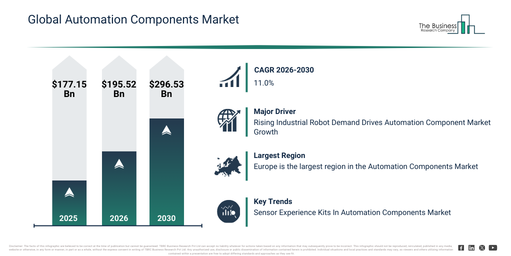
The automation components market has experienced significant expansion in recent years. This market is projected to expand from $177.15 billion in 2025 to $195.52 billion in 2026, demonstrating a compound annual growth rate (CAGR) of 10.4%. Historically, this expansion has been driven by factors such as heightened demand from the automotive and consumer electronics sectors, the increasing uptake of industrial automation, a greater need for precision motion control, the enlargement of semiconductor and packaging industries, and innovations in linear guides and bearing technologies.
The automation components market is projected to experience substantial expansion in the coming years. This market is anticipated to reach $296.53 billion by 2030, exhibiting a compound annual growth rate (CAGR) of 11.0%. This projected growth is driven by factors such as the integration with smart factory solutions, the adoption of IoT-enabled components, the expansion of 3D printing and robotics applications, the rising demand for high-performance and modular components, and an increased emphasis on plant asset management and functional safety. Key trends during this period are expected to involve advanced linear motion components, high-precision bearings and gears, seamless integration with PLC, SCADA, and DCS systems, customizable couplings and shaft solutions, and robust automation component lifecycle management.
Need Automation Components Market Forecasts? Get Your Free Sample Report Here:
Automation Components Market Growth Factors: What Is Strengthening Demand Worldwide?
The rising need for industrial robots in manufacturing processes is projected to boost the automation component market moving forward. Industrial robots are defined as programmable mechanical devices utilized for automation tasks in production settings, such as assembly, welding, painting, and material handling. Their increasing demand in manufacturing operations is primarily due to their ability to enhance efficiency, precision, and productivity, while simultaneously reducing labor costs and improving safety. The automation component further optimizes the efficiency and functionality of these industrial robots, thereby streamlining manufacturing processes. For instance, in September 2024, the International Federation of Robotics (IFR), a Germany-based non-profit organization, reported that industrial robot installations in the UK saw a 51% increase, totaling 3,830 units. Meanwhile, in the Americas, over 50,000 units were installed for the third consecutive year, reaching 55,389 units in 2023. Thus, the growing demand for industrial robots in manufacturing processes is a significant factor driving the expansion of the automation component market.
Automation Components Market By Segment: Complete Category And Subcategory Breakdown
The automation components market covered in this report is segmented –
1) By Component: Rollers, Stages, Linear Shafts, Bushings, Linear Guides, Locating Pins, Bearings, Gears, Couplings, Other Components
2) By Solution: Supervisory Control And Data Acquisition, Programmable Logic Controller, Distributed Control System, Plant Asset Management, Functional Safety, Product Lifecycle Management, Manufacturing Execution System
3) By End User Industry: Automotive, Consumer Electronics, Pharmaceuticals, Food And Beverage, Packaging, 3D Printing, Semiconductors, Chemical, Other End-User Industries
Subsegments:
1) By Rollers: Conveyor Rollers, Guide Rollers, Idler Rollers, Ball Transfer Rollers
2) By Stages: Linear Stages, Rotary Stages, XY Stages, Precision Stages
3) By Linear Shafts: Hardened Linear Shafts, Ground Linear Shafts, Non-Ground Linear Shafts
4) By Bushings: Linear Bushings, Sleeve Bushings, Flanged Bushings, Bearings and Bushings Assemblies
5) By Linear Guides: Roller Linear Guides, Ball Linear Guides, Cross Roller Guides
6) By Locating Pins: Spring Loaded Locating Pins, Manual Locating Pins, Pneumatic Locating Pins
7) By Bearings: Ball Bearings, Roller Bearings, Thrust Bearings, Needle Bearings
8) By Gears: Spur Gears, Helical Gears, Bevel Gears, Worm Gears, Planetary Gears
9) By Couplings: Flexible Couplings, Rigid Couplings, Universal Couplings, Shaft Couplings
10) By Other Components: Fasteners, Clamps, Mounting Brackets, Drive Units, Sensors, Other Supporting Automation Components
Automation Components Market Trend Outlook: Developments Defining The Forecast Period
Leading firms within the automation components market are creating sophisticated products like sensor experience kits specifically designed for IoT engineering, addressing the increasing need for comprehensive and adaptable IoT solutions. Such kits generally feature diverse sensors, development boards, connectivity modules, and software instruments, all intended to support the accelerated prototyping and creation of IoT applications. As an illustration, during February 2023, the German manufacturing entity, Henkel AG & Co. KGaA, introduced its Sensor INKxperience Kit, intended for IoT engineering. This particular kit provides four pre-configured printed electronics technologies, complete with hardware and software, enabling professional engineers to investigate and test printed sensor technologies in the context of IoT applications. The package contains a leak detection sensor, a non-contact liquid level sensor, a positive temperature coefficient (PTC) heater, and both single and multi-zone force sensitive resistor (FSR) sensors, thereby allowing engineers to swiftly prototype and evaluate sensor solutions.
Who Is Competing For Share In The Automation Components Market?
Major companies operating in the automation components market are Siemens AG; General Electric Company; Mitsubishi Electric Corporation; Schneider Electric SE; Honeywell International Inc.; ABB Ltd; Eaton Corporation; Nidec Corporation; TE Connectivity Ltd.; Parker Hannifin Corporation; Emerson Electric Co.; Svenska Kullagerfabriken; Rockwell Automation Inc.; Danfoss; Omron Corporation; Bosch Rexroth AG; FANUC Corporation; SMC Corporation; Keyence Corporation; Yaskawa Electric Corporation; Festo AG & Co. KG; KUKA AG; Yokogawa Electric Corporation; National Instruments Corporation; Automotion Components Ltd
Get The Full Picture With The Automation Components Market Report:
Automation Components Market Regional Snapshot: Leading Geography In 2025
Europe was the largest region in the automation component market in 2025. Asia-Pacific is expected to be the fastest-growing region in the forecast period. The regions covered in the automation components market report are Asia-Pacific, South East Asia, Western Europe, Eastern Europe, North America, South America, Middle East, Africa.
Reach Out To Our Team:
The Business Research Company: https://www.thebusinessresearchcompany.com/
Americas: +1 310-496-7795
Asia: +44 7882 955267 & +91 8897263534
Europe: +44 7882 955267
Email us at: marketing@tbrc.info
Follow us on:
LinkedIn: https://in.linkedin.com/company/the-business-research-company
YouTube: https://www.youtube.com/channel/UC24_fI0rV8cR5DxlCpgmyFQ
Global Market Model: https://www.thebusinessresearchcompany.com/global-market-model

Wasay has over a decade of experience in market research, data modelling, and analytics, with prior experience at GlobalData and Decision Tree Consulting Services. At The Business Research Company , he leads research operations across syndicated studies, customized consulting engagements, and the Global Market Model platform. His professional experience includes supporting organizations such as Boston Consulting Group, KPMG, and Ernst & Young. Wasay holds a degree in Electronics and Communications Engineering, postgraduate management qualifications from International Management Institute Belgium and Indian School of Business and Entrepreneurship, and completed the Integrated Program in Business Analytics from Indian Institute of Management Indore.