The Business Research Company’s 2026 market reports combine market attractiveness scoring, total addressable market sizing, company benchmarking matrices, interactive Excel dashboards, deeper supply chain intelligence, emerging startup tracking, and granular product-level insights to deliver research that is more actionable and strategically valuable.
Intelligent Transportation Systems Market Revenue Forecast: $41.51 Billion In 2026 Rising To $62.52 Billion In 2030
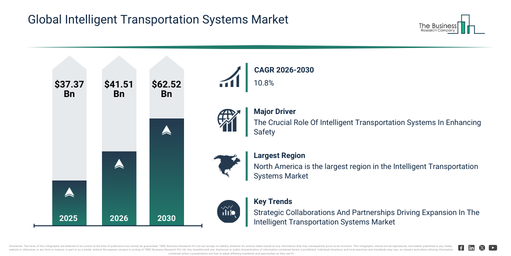
The intelligent transportation systems market has seen considerable growth in recent years. This market is forecast to increase from $37.37 billion in 2025 to $41.51 billion in 2026, exhibiting a compound annual growth rate (CAGR) of 11.1%. Historically, this expansion has been driven by factors like increasing urbanization rates, the expansion of road and transport infrastructure, rising traffic congestion levels, the adoption of electronic tolling systems, and investments in smart city initiatives.
The intelligent transportation systems market is projected to experience substantial expansion in the coming years. This market is anticipated to reach a valuation of $62.52 billion by 2030, exhibiting a compound annual growth rate (CAGR) of 10.8%. This expansion during the projection period stems from factors such as heightened investments in connected mobility solutions, a greater emphasis on reducing transportation emissions, broader integration of autonomous vehicles, increased deployment of AI-based traffic analytics, and the growing uptake of multimodal transportation systems. Key developments expected over the forecast horizon involve the expanding implementation of smart traffic management systems, a surge in the adoption of connected vehicle technologies, wider utilization of real-time traffic analytics, the broadening of intelligent public transportation systems, and an intensified focus on traffic safety and efficiency.
Free Sample Report: Intelligent Transportation Systems Market Size, Trends And Forecast To 2030:
Intelligent Transportation Systems Market Growth Catalyst: What Is Creating New Demand?
The market for intelligent transportation systems is anticipated to be boosted by a growing count of road fatalities. A road fatality refers to an individual who dies immediately or within 30 days due to a road accident or injury. An intelligent transportation system is a technology designed to help drivers prevent collisions by identifying nearby cars, motorcycles, and pedestrians, consequently modifying driving speed and maintaining appropriate distance from other vehicles. Furthermore, an increase in road traffic congestion has also positively influenced the need for intelligent transportation systems. For example, data from September 2025, provided by the UK Department for Transport, revealed that motorcyclists accounted for 21% of all road fatalities in 2024, which marked an 8% increase compared to the statistics from 2023. Consequently, the escalating number of road fatalities is expected to fuel the intelligent transportation systems market.
Intelligent Transportation Systems Market Segment Overview: Categories Covered In The 2026 Report
The intelligent transportation systems market covered in this report is segmented –
1) By Offering: Hardware, Software, Services
2) By System: Advanced Traffic Management System, Cooperative Vehicle System, Advanced Public Transportation System, Advanced Traveler Information System, Advanced Transportation Pricing Systems
3) By Application: Roadways, Aviation, Railways, Maritime
Subsegments:
1) By Hardware: Traffic Management Devices, Communication Equipment, Onboard Units (OBUs) For Vehicles, Electronic Toll Collection (ETC) Devices
2) By Software: Traffic Management Software, Fleet Management Software, Advanced Traveler Information Systems (ATIS), Incident Management Software, Data Analytics Software
3) By Services: Consulting Services, System Integration Services, Maintenance And Support Services, Training And Education Services
How Are Leading Companies Shaping Intelligent Transportation Systems Market Trends?
Leading corporations are strategically forming alliances and collaborations with startups and mid-sized enterprises within the intelligent transportation systems market to diversify their product and service portfolios. These strategic collaborations and partnership agreements facilitate companies in expanding their existing product offerings and geographical presence. For example, in August 2023, Vix Technology, an Australia-based provider of intelligent transportation systems, partnered with myBus, a Barcelona-based transit SaaS provider, to develop a new ITS product. This product enhances myBus’s cloud-native passenger information and fleet management system by integrating Vix’s expertise in data management and operations technology. As more urban centers adopt intelligent transport solutions for their residents, this partnership enables Vix to provide agencies with a comprehensive and resilient ITS product. This product offers real-time vehicle monitoring, driver communications, and passenger information capabilities, empowering riders to use public transit more safely, efficiently, and intelligently. Through this collaboration, Vix Technology extends its reach into new markets. Together, they deliver a truly end-to-end solution that provides passengers with current information on their journey while allowing operators to effectively manage and monitor their fleets.
Intelligent Transportation Systems Market Players: Key Companies Shaping Competition
Major companies operating in the intelligent transportation systems market are Denso Corporation; EFKON GmbH; Garmin Ltd.; Thales Group; Kapsch TrafficCom AG; Lanner Electronic Inc.; Siemens Aktiengesellschaft; Cubic Corporation; TomTom International B.V.; Indra Sistemas S.A.; Q-Free ASA; Iteris Inc.; Hitachi Ltd.; Teledyne FLIR LLC; The International Business Machines Corporation; Advantech Co. Ltd.; TransCore Holdings Inc.; Savari Inc.; Ricardo PLC; Traffic Tech Inc.; Alstom SA; Cisco Systems Inc.; Intel Corporation; Omnitracs LLC; Panasonic Corporation; Qualcomm Technologies Inc.; Trimble Inc.
Access Complete Intelligent Transportation Systems Market Data, Forecasts And Competitive Insights:
Intelligent Transportation Systems Market Regional Performance And Geographic Coverage
North America was the largest region in the intelligent transportation system market in 2025. Asia-Pacific is expected to be the fastest-growing region in the global intelligent transportation systems optical components market share during the forecast period. The regions covered in the intelligent transportation systems market report are Asia-Pacific, South East Asia, Western Europe, Eastern Europe, North America, South America, Middle East, Africa.
Reach Out To Our Team:
The Business Research Company: https://www.thebusinessresearchcompany.com/
Americas: +1 310-496-7795
Asia: +44 7882 955267 & +91 8897263534
Europe: +44 7882 955267
Email us at: marketing@tbrc.info
Follow us on:
LinkedIn: https://in.linkedin.com/company/the-business-research-company
YouTube: https://www.youtube.com/channel/UC24_fI0rV8cR5DxlCpgmyFQ
Global Market Model: https://www.thebusinessresearchcompany.com/global-market-model

Wasay has over a decade of experience in market research, data modelling, and analytics, with prior experience at GlobalData and Decision Tree Consulting Services. At The Business Research Company , he leads research operations across syndicated studies, customized consulting engagements, and the Global Market Model platform. His professional experience includes supporting organizations such as Boston Consulting Group, KPMG, and Ernst & Young. Wasay holds a degree in Electronics and Communications Engineering, postgraduate management qualifications from International Management Institute Belgium and Indian School of Business and Entrepreneurship, and completed the Integrated Program in Business Analytics from Indian Institute of Management Indore.