The Business Research Company’s 2026 market reports are designed to deliver research that is more actionable and strategically valuable. Key offerings include market attractiveness scoring, total addressable market sizing, company benchmarking matrices, interactive Excel dashboards, deeper supply chain intelligence, emerging startup tracking, and granular product-level insights.
Mobile 3D Market Revenue Projected To Rise To $286.71 Billion By 2030
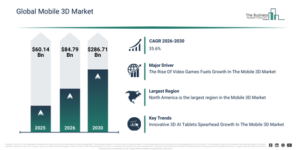
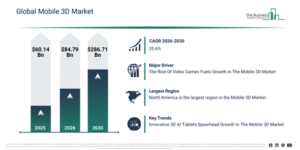
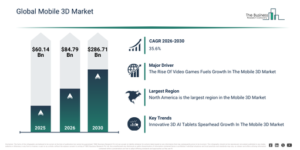
The mobile 3D market size has shown substantial growth in recent years. It is projected to expand from $60.14 billion in 2025 to $84.79 billion in 2026, reflecting a compound annual growth rate (CAGR) of 41.0%. This historical increase can be attributed to advancements like smartphone hardware evolution, the rise of mobile gaming, progress in graphics processors, the initial uptake of 3D displays, and the broadening of the app ecosystem.
The mobile 3D market is poised for significant expansion in the near future, with projections indicating it will climb to $286.71 billion by 2030, exhibiting a compound annual growth rate (CAGR) of 35.6%. This anticipated increase throughout the forecast period stems from various factors, including heightened consumer desire for immersive applications, the expansion of mobile augmented reality content, improvements in mobile chipsets, the adoption of cloud-assisted rendering, and a wider availability of 3D-enabled devices. Noteworthy trends expected during this time comprise real-time 3D rendering, enhancements in mobile gaming graphics, 3D navigation and mapping capabilities, device-level 3D visualization, and interactive 3D advertising.
Want Deeper Mobile 3D Market Insights? Get A Free Sample Report:
Primary Growth Driver Shaping The Mobile 3D Market Outlook
The increasing popularity of video games is projected to significantly boost the growth of the mobile 3D market moving forward. Video games themselves are electronic forms of entertainment where users interact with a visual interface to receive visual feedback on a two- or three-dimensional display, such as a TV, computer monitor, or handheld device. Mobile 3D devices are utilized in these games to create graphics that offer a visually engaging and immersive experience, adding depth and dimension to characters, objects, and environments. For instance, in 2024, the US-based Entertainment Software Association reported that 190.6 million Americans (ages 5-90) play video games. Moreover, 61% of the US population states they play video games for at least one hour every week. This rising engagement with video games is, therefore, a key driver for the expansion of the mobile 3D market.
Mobile 3D Market Structure: A Detailed Look At Segments And Subsegments
The mobile 3D market covered in this report is segmented –
1) By Type: Tablets, Smartphones, Notebooks, Other Types
2) By Device Component: Image Sensors, 3D Displays
3) By Application: Animations, Maps And Navigation, Mobile Gaming, Mobile Advertisements, Other Applications
Subsegments:
1) By Tablets: 3D-Enabled Tablets, 3D Gaming Tablets
2) By Smartphones: 3D-Enabled Smartphones, 3D Gaming Smartphones
3) By Notebooks: 3D-Enabled Laptops, Gaming Notebooks With 3D Capability
4) By Other Types: Wearable Devices, Portable Gaming Consoles
Mobile 3D Market Innovation And Strategy Trends Among Leading Companies
Leading companies in the mobile 3D market are focusing on launching next-generation solutions, such as 3D AI tablets, to boost their profitability. 3D AI tablets are devices that combine artificial intelligence (AI) technology with a 3D display to deliver an immersive and interactive user experience. For instance, in February 2023, Leia Inc., a US-based supplier of 3D display hardware and software solutions, released the Lume Pad 2. The Lume Pad 2 is a 3D tablet featuring a 12.4-inch glass panel with a resolution of 2560 x 1600. It enables faster and more efficient 2D to 3D conversion, enhanced 3D viewing, realistic 3D capture, and unlimited 3D creation. This device provides an immersive 3D experience without the need for specialized glasses and is designed to offer a broad spectrum of 3D content, including 3D videos, images, and games. It also supports a variety of 3D applications and games.
Top Companies Competing In The Mobile 3D Market
Major companies operating in the mobile 3D market are Apple Inc.; Samsung Electronics Co. Ltd.; Sony Corporation; LG Corporation; Intel Corporation; Qualcomm Technologies Inc.; NVIDIA Corporation; Sharp Corporation; Adobe Inc.; Epic Games Inc.; Dassault Systèmes SE; PTC Inc.; Magic Leap Inc.; HTC Corporation; Imagination Technologies Limited; Eon Reality; Blippar; Microvision Inc.; YUVsoft; Masterimage 3D; Unity Technologies; Autodesk Inc.; Niantic Inc.; Google LLC; Microsoft Corporation; Facebook Technologies LLC
View The Complete Mobile 3D Market Study With Segment And Regional Data:
Mobile 3D Market Regional Outlook Across Major Geographies
North America was the largest region in the mobile 3D market in 2025. Asia-Pacific is expected to be the fastest-growing region in the forecast period. The regions covered in the mobile 3D market report are Asia-Pacific, South East Asia, Western Europe, Eastern Europe, North America, South America, Middle East, Africa.
Reach Out To Our Team:
The Business Research Company: https://www.thebusinessresearchcompany.com/
Americas: +1 310-496-7795
Asia: +44 7882 955267 & +91 8897263534
Europe: +44 7882 955267
Email us at: marketing@tbrc.info
Follow us on:
LinkedIn: https://in.linkedin.com/company/the-business-research-company
YouTube: https://www.youtube.com/channel/UC24_fI0rV8cR5DxlCpgmyFQ
Global Market Model: https://www.thebusinessresearchcompany.com/global-market-model

Wasay has over a decade of experience in market research, data modelling, and analytics, with prior experience at GlobalData and Decision Tree Consulting Services. At The Business Research Company , he leads research operations across syndicated studies, customized consulting engagements, and the Global Market Model platform. His professional experience includes supporting organizations such as Boston Consulting Group, KPMG, and Ernst & Young. Wasay holds a degree in Electronics and Communications Engineering, postgraduate management qualifications from International Management Institute Belgium and Indian School of Business and Entrepreneurship, and completed the Integrated Program in Business Analytics from Indian Institute of Management Indore.