Market attractiveness scoring, total addressable market sizing, company benchmarking matrices, interactive Excel dashboards, deeper supply chain intelligence, emerging startup tracking, and granular product-level insights are among the key offerings featured in The Business Research Company’s 2026 market reports, designed to deliver more actionable and strategically valuable research.
Location Intelligence Market Valued At $23.29 Billion In 2026, Projected To Reach $35.61 Billion By 2030
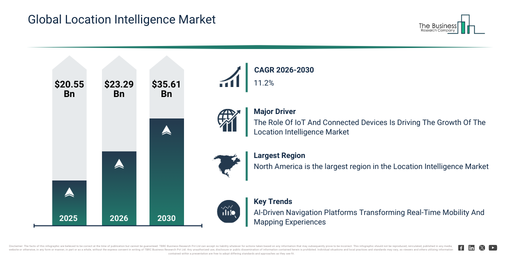
The location intelligence market has experienced substantial expansion in recent years. Its size is expected to grow from $20.55 billion in 2025 to $23.29 billion in 2026, exhibiting a compound annual growth rate (CAGR) of 13.4%. Historically, this market growth stemmed from factors including limited geospatial data availability, manual GIS processing, a deficiency in integrated analytics, fragmented location data sources, and a reliance on desktop GIS tools.
The location intelligence market is anticipated to experience substantial expansion in the coming years. Its size is projected to reach $35.61 billion by 2030, exhibiting a compound annual growth rate (CAGR) of 11.2%. This growth over the forecast period is primarily driven by factors such as the increasing deployment of IoT, a rising need for real-time spatial intelligence, enhanced integration with business intelligence tools, the expansion of smart city initiatives, and AI-powered predictive analytics. Furthermore, significant trends expected during this period include real-time location data analysis, optimization and tracking of assets, predictive analytics for traffic and logistics, analysis of customer behavior and footfall, and advanced risk and disaster management strategies.
Request A Complimentary Location Intelligence Market Research Sample:
Key Factor Propelling The Location Intelligence Market Forward
The expanding integration of IoT and connected gadgets is anticipated to boost the growth of the location intelligence market in the foreseeable future. These devices form a network of physical objects embedded with sensors, software, and connectivity, allowing them to collect and exchange data. The increasing uptake of IoT and connected devices is attributed to technological advancements, reduced costs, insights driven by data, widespread industry adoption, and consumer demand for convenience. IoT devices featuring location sensors monitor the real-time position of assets such as vehicles, equipment, or inventory. Location intelligence systems then analyze this data to track asset movements, optimize routes, prevent theft or loss, and ensure efficient asset utilization. For instance, in August 2025, Eurostat, the Luxembourg-based statistical office of the European Union (EU), reported that 70.9% of people in the EU used internet-connected devices in 2024, with the Netherlands recording the highest usage at 94.8%. Hence, the escalating adoption of IoT and connected devices is propelling the growth of the location intelligence market.
Location Intelligence Market Segments And Subsegments Explained
The location intelligence market covered in this report is segmented –
1) By Component: Software, Service
2) By Deployment: On-Premise, Cloud
3) By Location Type: Indoor, Outdoor
4) By Application: Workforce Management, Asset Management, Facility Management, Risk Management, Remote Monitoring, Sales And Marketing Optimization, Customer Management, Other Application
5) By Vertical: Retail And Consumer Goods, Government And Defense, Manufacturing And Industrial, Transportation And Logistics, Banking, Financial Services, and Insurance (BFSI), Information Technology (IT) And Telecom, Utilities And Energy, Media And Entertainment
Subsegments:
1) By Software: Geospatial Software, Data Analytics Software, Location-Based Analytics Software
2) By Service: Consulting Services, Integration Services, Support And Maintenance Services
Emerging Trends Transforming The Location Intelligence Market
Leading companies within the location intelligence market are concentrating on developing innovative solutions, such as artificial intelligence (AI)-enhanced navigation platforms, to provide more intelligent, quicker, and precise real-time mobility and mapping experiences. These AI-driven navigation platforms are sophisticated mapping and routing systems that utilize AI to analyze real-time geospatial data, predict traffic patterns, understand user context, and deliver smarter, highly accurate navigation. This significantly benefits the market by facilitating faster decision-making, boosting mobility efficiency, elevating the user’s journey, and stimulating demand for next-generation location intelligence solutions. For instance, in January 2024, Mapbox, a US-based location technology company, introduced its AI-powered Navigation SDK, which features several advanced capabilities: it embeds MapGPT, an AI voice assistant enabling natural, conversational interactions to manage navigation, entertainment, climate systems, autonomous driving features, and integrations with services like OpenTable, TripAdvisor, and The Weather Company. The SDK also includes Mapbox for EV, offering electric vehicle-specific routing by integrating with the vehicle’s battery system to monitor energy usage, predict range, recommend charging stations based on real-time availability, and support secure payments. Additionally, it provides an advanced in-vehicle map experience with 3D landmarks, adaptive lighting, live sensor-integrated navigation, and an AI-enhanced traffic model that refines predicted drive times using real-world driving data.
Location Intelligence Market Key Players: Major Companies In The 2026 Report
Major companies operating in the location intelligence market are Google LLC; Microsoft Corporation; IBM Corporation; Qualcomm Technologies Inc.; Uber Technologies Inc.; Nokia Corporation; Baidu Inc.; Hexagon AB; Autodesk Inc.; Lyft Inc.; Trimble Inc.; Pitney Bowes Inc.; Esri Inc.; TIBCO Software Inc.; Liberty Broadband Corporation; Alteryx Inc.; MDA Corporation; TomTom International B.V.; INRIX Inc.; Mapbox; SpotHero Inc.; CARTO; Cuebiq Inc.; Navizon Inc.; Foursquare Labs Inc.
Explore The Full Location Intelligence Market Report With Forecasts To 2030:
Location Intelligence Market By Region: Where Is Demand Strongest?
North America was the largest region in the location intelligence market in 2025. Asia-Pacific is expected to be the fastest-growing region in the forecast period. The regions covered in the location intelligence market report are Asia-Pacific, South East Asia, Western Europe, Eastern Europe, North America, South America, Middle East, Africa.
Reach Out To Our Team:
The Business Research Company: https://www.thebusinessresearchcompany.com/
Americas: +1 310-496-7795
Asia: +44 7882 955267 & +91 8897263534
Europe: +44 7882 955267
Email us at: marketing@tbrc.info
Follow us on:
LinkedIn: https://in.linkedin.com/company/the-business-research-company
YouTube: https://www.youtube.com/channel/UC24_fI0rV8cR5DxlCpgmyFQ
Global Market Model: https://www.thebusinessresearchcompany.com/global-market-model

Wasay has over a decade of experience in market research, data modelling, and analytics, with prior experience at GlobalData and Decision Tree Consulting Services. At The Business Research Company , he leads research operations across syndicated studies, customized consulting engagements, and the Global Market Model platform. His professional experience includes supporting organizations such as Boston Consulting Group, KPMG, and Ernst & Young. Wasay holds a degree in Electronics and Communications Engineering, postgraduate management qualifications from International Management Institute Belgium and Indian School of Business and Entrepreneurship, and completed the Integrated Program in Business Analytics from Indian Institute of Management Indore.