The Business Research Company’s 2026 market reports combine market attractiveness scoring, total addressable market sizing, company benchmarking matrices, interactive Excel dashboards, deeper supply chain intelligence, emerging startup tracking, and granular product-level insights to deliver research that is more actionable and strategically valuable.
What Is The Marine Acoustic Sensors Market Growth Rate? A 6.5% CAGR Outlook Through 2030
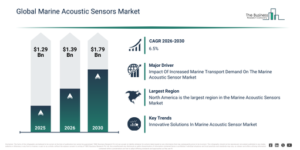
The marine acoustic sensors market has experienced robust expansion recently. Projections indicate it will expand from $1.29 billion in 2025 to $1.39 billion in 2026, demonstrating a compound annual growth rate (CAGR) of 7.7%. Historically, this growth was driven by factors such as naval defense modernization programs, expanded offshore exploration, heightened maritime surveillance demands, increased marine research, and the early adoption of sonar technology.
The marine acoustic sensors market is projected to experience substantial expansion over the upcoming years. This market is anticipated to reach $1.79 billion by 2030, exhibiting a compound annual growth rate (CAGR) of 6.5%. Several factors will contribute to this growth during the forecast period, including heightened underwater security issues, the proliferation of autonomous underwater vehicles, a rise in offshore energy initiatives, innovations in acoustic signal processing, and a need for environmental monitoring solutions. Key trends expected to emerge within this timeframe encompass advanced underwater sound detection, improved passive acoustic monitoring, long-range acoustic surveillance systems, high-resolution sonar imaging, and integrated multi-sensor marine systems.
Access A Free Sample Of The Latest Marine Acoustic Sensors Market Analysis:
Why Is The Marine Acoustic Sensors Market Growing? The Key Demand Driver Explained
The anticipated growth of the marine acoustic sensor market is expected to be propelled by the rising demand for marine transport. Marine transport involves moving goods and passengers across waterways such as oceans, seas, rivers, and canals, utilizing ships, boats, or other watercraft. This increased demand is attributed to the growing need for commodities, driven by population growth and urbanization, which in turn boosts trade volumes. Marine transport also facilitates the deployment and maintenance of marine acoustic sensors by enabling the transport of equipment to offshore locations and allowing access to diverse marine environments for research and monitoring purposes. For example, in July 2024, the United Nations Conference on Trade and Development (UNCTAD), a Switzerland-based intergovernmental body, reported that global maritime trade volumes reached 12,292 million tons in 2023, representing a 2.4% increase following a contraction in 2022. Consequently, the increasing demand for marine transport is a key driver for the growth of the marine acoustic sensor market.
What Are The Main Segments Of The Marine Acoustic Sensors Market?
The marine acoustic sensors market covered in this report is segmented –
1) By Product: Hydrophones, Underwater Transducer, Acoustic Towed Array, Side-Scan Sonar
2) By Application: Mine Countermeasures (MCM), Intelligence Surveillance And Reconnaissance, Identification (ID), Anti-Submarine Warfare (ASW)
3) By End Use: Original Equipment Manufacturers (OEMs), Aftermarket
Subsegments:
1) By Hydrophones: Oceanographic Hydrophones, Sonar Hydrophones, Monitoring Hydrophones
2) By Underwater Transducer: Low-Frequency Transducers, High-Frequency Transducers, Broadband Transducers
3) By Acoustic Towed Array: Active Towed Array, Passive Towed Array
4) By Side-Scan Sonar: Single-Beam Side-Scan Sonar, Multi-Beam Side-Scan Sonar
Marine Acoustic Sensors Market Trend Analysis: Where Leading Companies Are Focusing
Leading companies in the marine acoustic sensors market are emphasizing capabilities such as passive acoustic monitoring (PAM) to enhance the effectiveness of underwater surveillance and environmental observation. Passive acoustic monitoring (PAM) refers to a method involving the detection and analysis of underwater sound without the use of actively transmitted signals. For instance, in March 2024, Jaia Robotics Inc., a US-based aquatic robots company, in partnership with Marine Acoustics, Inc., a US-based scientific and engineering company, introduced JaiaBot-PAM. This product includes passive acoustic monitoring (PAM) functionality, integrating broad-spectrum acoustic sensors that operate from 2 Hz to 30 kHz. These sensors gather diverse data, including conductivity, temperature, depth, bathymetry, bottom composition, current flow, wave height, and wave period. JaiaBot-PAM delivers economical and adaptable acoustic monitoring solutions suitable for defence, national security, offshore renewable energy, aquaculture, and other sectors.
Which Companies Are Major Players In The Marine Acoustic Sensors Market?
Major companies operating in the marine acoustic sensors market are Lockheed Martin Corporation; Thales Group; L3Harris Technologies Inc.; Teledyne Marine Technologies Incorporated; Kongsberg Maritime AS; Nortek AS; Fugro N.V.; Ultra Electronics Holdings plc; MacArtney A/S; Sonardyne International Ltd; General Oceans Ltd; EdgeTech Marine; Kraken Robotics Inc.; JASCO Applied Sciences Ltd; 3D at Depth Inc.; Cetacean Research Technology; RTsys; Rowe Technologies Inc.; Evologics GmbH; GeoSpectrum Technologies Inc.; Ocean Sonics Ltd; EOM Offshore LLC; BlueView Technologies Inc.; RJE International Inc.; DSPComm
Get The Complete Marine Acoustic Sensors Market Analysis Here:
Which Region Held The Largest Share Of The Marine Acoustic Sensors Market In 2025?
North America was the largest region in the marine acoustic sensors market in 2025. Asia-Pacific is expected to be the fastest-growing region in the forecast period. The regions covered in the marine acoustic sensors market report are Asia-Pacific, South East Asia, Western Europe, Eastern Europe, North America, South America, Middle East, Africa.
Reach Out To Our Team:
The Business Research Company: https://www.thebusinessresearchcompany.com/
Americas: +1 310-496-7795
Asia: +44 7882 955267 & +91 8897263534
Europe: +44 7882 955267
Email us at: marketing@tbrc.info
Follow us on:
LinkedIn: https://in.linkedin.com/company/the-business-research-company
YouTube: https://www.youtube.com/channel/UC24_fI0rV8cR5DxlCpgmyFQ
Global Market Model: https://www.thebusinessresearchcompany.com/global-market-model

Wasay has over a decade of experience in market research, data modelling, and analytics, with prior experience at GlobalData and Decision Tree Consulting Services. At The Business Research Company , he leads research operations across syndicated studies, customized consulting engagements, and the Global Market Model platform. His professional experience includes supporting organizations such as Boston Consulting Group, KPMG, and Ernst & Young. Wasay holds a degree in Electronics and Communications Engineering, postgraduate management qualifications from International Management Institute Belgium and Indian School of Business and Entrepreneurship, and completed the Integrated Program in Business Analytics from Indian Institute of Management Indore.