The Business Research Company’s 2026 market reports combine market attractiveness scoring, total addressable market sizing, company benchmarking matrices, interactive Excel dashboards, deeper supply chain intelligence, emerging startup tracking, and granular product-level insights to deliver research that is more actionable and strategically valuable.
Is The Game Engine Market Expanding? Latest Size Estimates And 2030 Projections
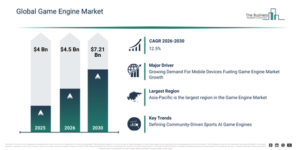
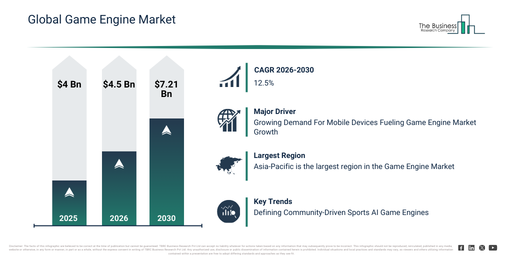
The game engine market has seen swift expansion in recent years. Its valuation is anticipated to climb from $4 billion in 2025 to $4.5 billion in 2026, demonstrating a compound annual growth rate (CAGR) of 12.5%. Factors contributing to this historical growth include the rise in video game consumption, the broadening reach of PC and console gaming, the necessity for more rapid game development cycles, the emergence of independent game developers, and its initial integration into animation and simulation.
The game engine market is anticipated to experience substantial growth over the next few years, with projections indicating it will expand to $7.21 billion in 2030, reflecting a compound annual growth rate (CAGR) of 12.5%. This growth during the forecast period is primarily driven by increasing demand for immersive gameplay experiences, the expansion of non-gaming applications, the proliferation of cloud-based development environments, rising adoption in virtual production, and a growing need for scalable development platforms. Concurrently, major trends expected in this period encompass cross-platform engine compatibility, enhancements in real-time rendering capabilities, the development of modular asset frameworks, integrated physics and animation systems, and streamlined developer toolchains.
Free Game Engine Market Sample: Market Size, Growth Drivers And Competitive Landscape:
Game Engine Market Drivers Explained: What Is Supporting A 12.5% CAGR?
The increasing demand for mobile devices is anticipated to propel the expansion of the game engine market moving forward. Mobile devices are defined as portable electronic tools or gadgets crafted for convenient mobility, typically featuring built-in or wireless connectivity for communication and information access. Game engines are crucial for the development of mobile games, significantly contributing to their success and performance on these devices. For example, in June 2024, Ericsson, a Sweden-based telecommunications company, indicated that mobile subscriptions in the region are projected to grow from 1.2 billion in 2023 to 1.3 billion by 2029. Consequently, the rising demand for mobile devices is fueling the growth of the game engine market.
Game Engine Market Segment Guide: Main Divisions And Subsegments
The game engine market covered in this report is segmented –
1) By Type: 3D Game Engines, 2.5D Game Engines, 2D Game Engines, Other Types
2) By Component: Solution, Services
3) By Platform: Mobile, Console, Computer, Other Platforms
4) By Genre: Action And Adventure, Multiplayer Online Battle Arena (MOBA), Real-time Strategy (RTS), Role-playing Games (RPG), Sandbox, Shooter (FPS And TPS), Simulation And Sports, Other Genres
5) By End-User: Game Development Studios, Independent Developers, Academic And Research Institutes, Other End-Users
Subsegments:
1) By 3D Game Engines: Cross-Platform 3D Game Engines, Console-Specific 3D Game Engines
2) By 2.5D Game Engines: Isometric 2.5D Game Engines, Side-Scrolling 2.5D Game Engines
3) By 2D Game Engines: 2D Mobile Game Engines, 2D Console Or PC Game Engines
4) By Other Types: VR/AR Game Engines, Custom Game Engines
Game Engine Market Trends And Opportunities For 2026–2030
Major companies in the game engine market are advancing their position by developing innovative technologies, including community-driven sports AI game engines. This type of game engine is specifically engineered for creating sports-themed video games that incorporate artificial intelligence (AI) elements, drawing significant input and contributions from a community of game developers, enthusiasts, and users. For instance, in August 2023, LootMogul, a US-based athlete-led sports technology platform, introduced MogulX.AI for game developers. This platform empowers users to generate their own AI avatars, referred to as non-player characters (NPCs), and leverage LootMogul’s open AI architecture to build their own games. It acts as a community-driven sports AI game engine that facilitates collaboration among athletes, fans, and game developers to create AI-driven sports games.
Which Major Players Are Active In The Game Engine Market?
Major companies operating in the game engine market are Epic Games Inc.; Unity Software Inc.; Crytek GmbH; YoYo Games Ltd.; Silicon Studio Corp.; GameSalad; Scirra Ltd.; Corona Labs Inc.; Clickteam LLC; Stencyl; Delta Engine GmbH; Argentics; Solarus Technologies Inc.; Stride Inc.; QBurst; Hyperlink InfoSystem; Appinventiv Technology Pvt. Ltd.; Belitsoft; The NineHertz; Algoworks Solutions Inc.; VironIT; Daffodil Software; Redwerk LLC; Dev Technosys; Softeq Development Corporation
Unlock The Complete Game Engine Market Report With Company Benchmarking:
Game Engine Market World Regions Compared: Which Leads In Revenue?
Asia-Pacific was the largest region in the game engine market in 2025. Middle East is expected to be the fastest-growing region in the forecast period. The regions covered in the game engine market report are Asia-Pacific, South East Asia, Western Europe, Eastern Europe, North America, South America, Middle East, Africa.
Reach Out To Our Team:
The Business Research Company: https://www.thebusinessresearchcompany.com/
Americas: +1 310-496-7795
Asia: +44 7882 955267 & +91 8897263534
Europe: +44 7882 955267
Email us at: marketing@tbrc.info
Follow us on:
LinkedIn: https://in.linkedin.com/company/the-business-research-company
YouTube: https://www.youtube.com/channel/UC24_fI0rV8cR5DxlCpgmyFQ
Global Market Model: https://www.thebusinessresearchcompany.com/global-market-model

Wasay has over a decade of experience in market research, data modelling, and analytics, with prior experience at GlobalData and Decision Tree Consulting Services. At The Business Research Company , he leads research operations across syndicated studies, customized consulting engagements, and the Global Market Model platform. His professional experience includes supporting organizations such as Boston Consulting Group, KPMG, and Ernst & Young. Wasay holds a degree in Electronics and Communications Engineering, postgraduate management qualifications from International Management Institute Belgium and Indian School of Business and Entrepreneurship, and completed the Integrated Program in Business Analytics from Indian Institute of Management Indore.