Designed to make market research more actionable and strategically valuable, The Business Research Company’s 2026 market reports feature market attractiveness scoring, total addressable market sizing, company benchmarking matrices, interactive Excel dashboards, deeper supply chain intelligence, emerging startup tracking, and granular product-level insights.
What Is The Projected CAGR Of The Global Navigation Satellite System (GNSS) Chip Market Through 2030?
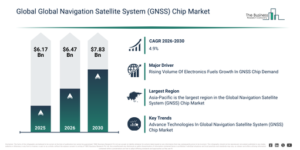
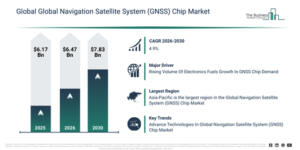
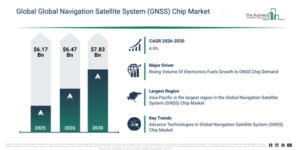
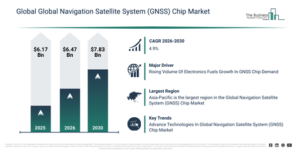
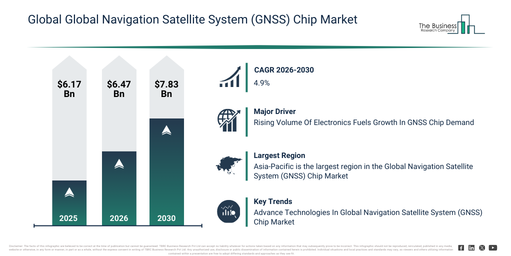
The global navigation satellite system (gnss) chip market size has demonstrated steady expansion in recent years. It is anticipated to increase from $6.17 billion in 2025 to $6.47 billion in 2026, exhibiting a compound annual growth rate (CAGR) of 4.9%. The market’s historical development can be ascribed to factors such as the increasing adoption of smartphones and wearables, the advancement of navigation and mapping applications, a growing need for personal tracking devices, the widespread deployment of automotive navigation systems, and the integration of drones and robotics for commercial uses.
The global navigation satellite system (gnss) chip market size is projected to experience consistent expansion over the coming years, reaching $7.83 billion by 2030, with a compound annual growth rate (CAGR) of 4.9%. This anticipated growth during the forecast period is attributable to several factors, including advancements in low-power asset tracking technologies, the incorporation of gnss chips into AR/VR and IoT devices, the proliferation of autonomous and connected vehicles, increasing demand across agricultural and construction sectors, and the broadening scope of military and defense uses. Key trends expected during this period encompass high-precision positioning capabilities, the design of low-power gnss chips, seamless integration with IoT devices, support for multiple constellations, and improved timing and synchronization features.
Claim Your Free Global Navigation Satellite System (GNSS) Chip Market Sample Report With Key Data And Trends:
Global Navigation Satellite System (GNSS) Chip Market Demand Analysis: The Driving Force Behind Expansion
The escalating demand for consumer electronics is anticipated to stimulate the expansion of the global navigation satellite system (GNSS) chip market moving forward. Consumer electronics defines an industry focused on the conception, evolution, and fabrication of electronic gadgets intended for individual utilization. GNSS chips integrated into consumer electronics facilitate precise positional services, thereby enhancing navigation and location-based functionalities in devices such as smartphones and wearables, supplying crucial data for emergency response and search and rescue missions. For example, in May 2023, according to the Japan Electronics and Information Technology Industries Association, a Japan-based trade organization, the overall manufacturing of electronic devices in Japan amounted to $6,722 million (¥771,457 million), with consumer electronics device production climbing from $230.9 million (¥25,268 million) in May 2022 to $280 million (¥32,099 million) in May 2023. Consequently, the growing demand for consumer electronics is a primary driver for the global navigation satellite system (GNSS) chip market.
Breaking Down The Global Navigation Satellite System (GNSS) Chip Market By Segment
The global navigation satellite system (gnss) chip market covered in this report is segmented –
1) By Device Type: Smartphones, Tablets And Wearables, Personal Tracking Devices, Low-Power Asset Trackers, In-Vehicle Systems, Drones, Other Device Types
2) By Application: Navigation, Mapping, Location-Based Services, Surveying, Telematics, Timing And Synchronization, Other Applications
3) By Industry Vertical: Consumer Electronics, Construction, Agriculture, Automotive, Military And Defense, Marine, Transport
Subsegments:
1) By Smartphones: High-End Smartphones, Mid-Range Smartphones, Entry-Level Smartphones
2) By Tablets And Wearables: Tablets, Smartwatches, Fitness Trackers, Augmented Reality (AR) Glasses
3) By Personal Tracking Devices: GPS Trackers, Pet Trackers, Personal Emergency Response Systems (PERS)
4) By Low-Power Asset Trackers: Cargo Tracking Devices, Vehicle Tracking Devices, Equipment Tracking Devices
5) By In-Vehicle Systems: Navigation Systems, Telematics Systems, Fleet Management Systems
6) By Drones: Consumer Drones, Commercial Drones, Military Drones
7) By Other Device Types: IoT Devices, Robotics, Smart Home Devices
Top Trend Influencing The Global Navigation Satellite System (GNSS) Chip Market Outlook
Leading companies within the global navigation satellite system (GNSS) chip market are concentrating on developing innovative products that feature advanced technological solutions, like wide-area real-time kinematics technology, to solidify their competitive standing. Wide-area real-time Kinematics (WARTK) is a technology offering precise, real-time positioning across expansive geographic regions. For example, in October 2023, LOCOSYS Technology Inc., a Taiwan-based producer of GPS/GNSS positioning and navigation products and modules, introduced its 100km Wide-Area Real-Time Kinematics (WARTK) support technology. This 100km Wide-Area Real-Time Kinematics (WARTK) support technology is engineered to enable high-precision positioning over extended distances, applicable in both densely populated metropolitan areas and isolated rural settings, playing a crucial role in geographic information system (GIS) applications, environmental monitoring, and natural resource management. Global navigation satellite systems, specifically Real-Time Kinematics (RTK), are being integrated into intelligent transportation systems for applications such as vehicle navigation, fleet management, transportation system management, highway construction, and other emerging uses including connected and automated vehicles, smart cities, transportation infrastructure, and advanced vehicle control systems.
Global Navigation Satellite System (GNSS) Chip Market Competitive Landscape And Major Players
Major companies operating in the global navigation satellite system (gnss) chip market are Sony Group Corporation; Intel Corporation; Qualcomm Technologies Inc.; Broadcom Inc.; Fujitsu Limited; Thales Group; Mediatek Inc.; STMicroelectronics N.V.; Skyworks Solutions Inc.; Trimble Inc.; Quectel Wireless Solutions Co. Ltd; Topcon Corporation; Furuno Electric Co. Ltd; U-blox Holdings AG; Telit Communications PLC; NovAtel Inc.; STONEX Srl; Rakon Limited; Hemisphere GNSS; Harxon Corporation; Septentrio N.V.; LOCOSYS Technology Inc.; Syntony GNSS; ComNav Technology Ltd.; Hunan Bynav Technology; Tallysman Wireless Inc.; OriginGPS Ltd.
Read The Full Global Navigation Satellite System (GNSS) Chip Market Report By The Business Research Company:
Where Is The Global Navigation Satellite System (GNSS) Chip Market Largest? Key Regional Insights
Asia-Pacific was the largest region in the global navigation satellite system (GNSS) chip market in 2025. Asia-Pacific is expected to be the fastest-growing region in the forecast period. The regions covered in the global navigation satellite system (gnss) chip market report are Asia-Pacific, South East Asia, Western Europe, Eastern Europe, North America, South America, Middle East, Africa.
Reach Out To Our Team:
The Business Research Company: https://www.thebusinessresearchcompany.com/
Americas: +1 310-496-7795
Asia: +44 7882 955267 & +91 8897263534
Europe: +44 7882 955267
Email us at: marketing@tbrc.info
Follow us on:
LinkedIn: https://in.linkedin.com/company/the-business-research-company
YouTube: https://www.youtube.com/channel/UC24_fI0rV8cR5DxlCpgmyFQ
Global Market Model: https://www.thebusinessresearchcompany.com/global-market-model

Wasay has over a decade of experience in market research, data modelling, and analytics, with prior experience at GlobalData and Decision Tree Consulting Services. At The Business Research Company , he leads research operations across syndicated studies, customized consulting engagements, and the Global Market Model platform. His professional experience includes supporting organizations such as Boston Consulting Group, KPMG, and Ernst & Young. Wasay holds a degree in Electronics and Communications Engineering, postgraduate management qualifications from International Management Institute Belgium and Indian School of Business and Entrepreneurship, and completed the Integrated Program in Business Analytics from Indian Institute of Management Indore.