Market attractiveness scoring, total addressable market sizing, company benchmarking matrices, interactive Excel dashboards, deeper supply chain intelligence, emerging startup tracking, and granular product-level insights are among the key offerings featured in The Business Research Company’s 2026 market reports, designed to deliver more actionable and strategically valuable research.
Global System For Mobile Communication (GSM) Antenna Market Size Overview: From Historical Performance To The 2030 Forecast
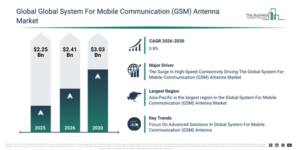
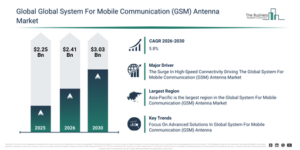
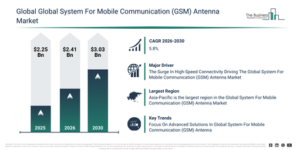
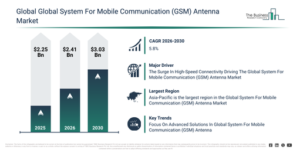
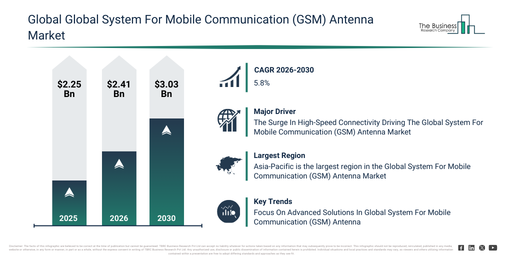
The global system for mobile communication (gsm) antenna market has experienced significant growth in recent years. This market is expected to expand from $2.25 billion in 2025 to $2.41 billion in 2026, exhibiting a compound annual growth rate (CAGR) of 7.0%. Historically, this growth can be attributed to the rapid adoption of GSM-based mobile phones, the expansion of mobile network infrastructure, the proliferation of smartphones and dumbphones, the increased deployment of routers and modems, and the development of multi-band antenna technologies.
The global system for mobile communication (gsm) antenna market size is projected to experience robust expansion over the coming years. Its value is anticipated to reach $3.03 billion by 2030, exhibiting a compound annual growth rate (CAGR) of 5.8%. This growth during the forecast period is primarily driven by factors such as the rollout of 5G networks, greater integration with IoT devices, an increasing need for high-gain and compact antenna solutions, the broadening scope of industrial and commercial uses, and developments in adaptive beamforming and millimeter-wave (mmWave) antennas. Key trends expected in the same period involve improved signal reception capabilities, the adoption of multi-band antenna designs, seamless integration with IoT and 5G technologies, the prevalence of compact and high-gain antennas, and the use of adaptive beamforming technology.
Get A Free Sample Of The Business Research Company’s Global System For Mobile Communication (GSM) Antenna Market Report:
What Factor Is Increasing Demand In The Global System For Mobile Communication (GSM) Antenna Market?
The increasing need for high-speed connectivity is expected to drive the future growth of the global system for mobile communication (GSM) antenna market. High-speed connectivity refers to an internet or network connection that provides rapid data transmission rates, allowing for the efficient and swift transfer of information between devices or users. This demand for high-speed connectivity arises from evolving consumer behaviors, economic imperatives, and societal requirements. GSM antennas are essential for transmitting and receiving signals from mobile devices, ensuring users experience strong and stable connections. These antennas are engineered to amplify signals and reduce interference, which helps maintain high signal quality and supports faster data transmission speeds for users accessing the network. For instance, in June 2023, according to 5G Americas, a US-based wireless industry trade association, global 5G connections reached 1.2 billion in the first half of 2023 and are anticipated to grow to 1.9 billion by the end of the same year, and 6.8 billion by the end of 2027. Consequently, the growing demand for high-speed connectivity is driving the growth of the global system for mobile communication (GSM) antenna market.
Which Segments Make Up The Global System For Mobile Communication (GSM) Antenna Market?
The global system for mobile communication (gsm) antenna market covered in this report is segmented –
1) By Type: 2G, 2G Or 3G, 3G, LTE, 5G
2) By Application: Smartphones, Dumbphones, Internet Of Things (IoT) Devices, Routers And Modems
3) By End-User: Residential, Commercial, Industrial
Subsegments:
1) By 2G: GSM, EDGE (Enhanced Data Rates For GSM Evolution)
2) By 2G Or 3G: GSM + WCDMA (Wideband Code Division Multiple Access), EDGE + UMTS (Universal Mobile Telecommunications System)
3) By 3G: WCDMA (Wideband Code Division Multiple Access), UMTS (Universal Mobile Telecommunications System), HSPA (High-Speed Packet Access)
4) By LTE: LTE FDD (Frequency Division Duplex), LTE TDD (Time Division Duplex), LTE Advanced
5) By 5G: Sub-6 GHz 5G (Sub-6 GHz spectrum), mmWave 5G (Millimeter Wave), 5G NR (New Radio)
Global System For Mobile Communication (GSM) Antenna Market Emerging Trends: What Are Industry Leaders Focusing On?
Leading companies within the global system for mobile communication (GSM) antenna market are intensifying their efforts to develop dual-band routers to secure a competitive edge. These dual-band routers are networking devices designed to operate on both the 2.4 GHz and 5 GHz frequency bands, facilitating simultaneous connections across multiple bands to optimize performance and reduce interference in wireless networks. For example, in January 2023, Consistent Infosystems Private Limited, an India-based company specializing in IT services and computer hardware manufacturing, unveiled a dual-band GSM wireless router. This device is characterized by dual-band connectivity, GSM compatibility, long-range operation, versatile functions, high-speed data networking, and remote surveillance capabilities. This router supports the swift progress in 5G technology by offering dual-band connectivity with LTE support, thereby preparing users for the shift to advanced networks and influencing the evolution of the global system for mobile communication (GSM) antenna market to accommodate modern devices and technologies.
Major Companies To Know In The Global System For Mobile Communication (GSM) Antenna Market
Major companies operating in the global system for mobile communication (gsm) antenna market are Huawei Technologies Co. Ltd.; Qualcomm Inc.; Broadcom Inc.; Telefonaktiebolaget LM Ericsson; Nokia Corporation; ZTE Corporation; Amphenol Corporation; CommScope Holding Company Inc.; Cobham Wireless; Kathrein SE; ADTRAN Inc.; Calix Inc.; Comba Telecom Systems Holdings Ltd.; Ceragon Networks Ltd.; Cambium Networks Corporation; Hengxin Technology; Casa Systems Inc.; ACE Technologies Corporation; Airspan Networks Holdings Inc.; PCTEL Inc.; Laird Connectivity; Communication Components Inc.; Bird Technologies; Advanced RF Technologies
Read The In-Depth Global System For Mobile Communication (GSM) Antenna Market Report:
Global System For Mobile Communication (GSM) Antenna Market Regional Landscape: Largest Region In 2025
Asia-Pacific was the fastest region in the global system for mobile communication (GSM) antenna market in 2025. The regions covered in the global system for mobile communication (gsm) antenna market report are Asia-Pacific, South East Asia, Western Europe, Eastern Europe, North America, South America, Middle East, Africa.
Reach Out To Our Team:
The Business Research Company: https://www.thebusinessresearchcompany.com/
Americas: +1 310-496-7795
Asia: +44 7882 955267 & +91 8897263534
Europe: +44 7882 955267
Email us at: marketing@tbrc.info
Follow us on:
LinkedIn: https://in.linkedin.com/company/the-business-research-company
YouTube: https://www.youtube.com/channel/UC24_fI0rV8cR5DxlCpgmyFQ
Global Market Model: https://www.thebusinessresearchcompany.com/global-market-model

Wasay has over a decade of experience in market research, data modelling, and analytics, with prior experience at GlobalData and Decision Tree Consulting Services. At The Business Research Company , he leads research operations across syndicated studies, customized consulting engagements, and the Global Market Model platform. His professional experience includes supporting organizations such as Boston Consulting Group, KPMG, and Ernst & Young. Wasay holds a degree in Electronics and Communications Engineering, postgraduate management qualifications from International Management Institute Belgium and Indian School of Business and Entrepreneurship, and completed the Integrated Program in Business Analytics from Indian Institute of Management Indore.