With a focus on actionable insights and strategic value, The Business Research Company’s 2026 market reports include market attractiveness scoring, total addressable market sizing, company benchmarking matrices, interactive Excel dashboards, deeper supply chain intelligence, emerging startup tracking, and granular product-level insights.
How Large Could The Hardware Security Modules Market Become By 2030 At A 16.1% CAGR?
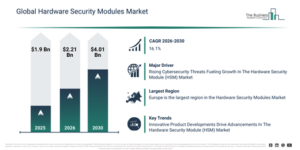
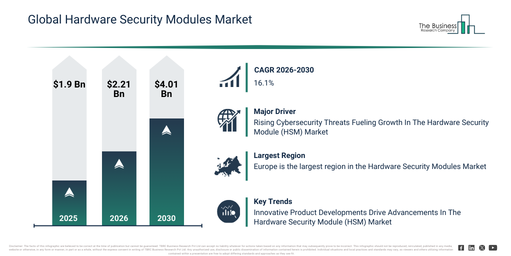
The hardware security modules market size has experienced rapid growth in recent years. It is projected to expand from $1.9 billion in 2025 to $2.21 billion in 2026, exhibiting a compound annual growth rate (CAGR) of 16.1%. This historical growth can be attributed to the rise of digital payment systems, increased deployment of encryption technologies, escalating cybersecurity threats, the expansion of online banking platforms, and the adoption of secure authentication frameworks.
The market for hardware security modules is projected to experience swift expansion over the coming years. It is anticipated to reach $4.01 billion by 2030, exhibiting a compound annual growth rate (CAGR) of 16.1%. This projected growth is driven by several factors, including the expanding embrace of cloud security frameworks, escalating regulatory mandates for safeguarding data, the proliferation of blockchain applications, the wider application of encryption within IoT environments, and the surging need for zero-trust security approaches. Key trends anticipated during this period encompass the growing preference for cloud-based HSMs, an increased requirement for robust digital key management, their broader utilization in payment and authentication processes, the wider implementation of HSMs in PKI settings, and a heightened emphasis on security for regulatory compliance.
Get A Free Hardware Security Modules Market Sample With 2030 Forecast Insights:
Hardware Security Modules Market Outlook: Key Driver Supporting Long-Term Growth
The future expansion of the hardware security module market is anticipated due to a rise in data breaches and cyberattacks. A cyberattack involves unauthorized attempts to access or inflict damage upon a computer system or network, whereas a data breach entails the theft or extraction of data from a system without the owner’s consent or knowledge. The hardware security module (HSM) functions as a physical device that protects data from both logical and inherent security threats, providing built-in vulnerability protection to keep information secure. Furthermore, the increasing adoption of digital payments has contributed to a surge in cyberattacks and data-breaching activities, thereby escalating the demand for hardware security modules. For instance, in October 2024, Check Point Software Technologies Ltd., an Israel-based cybersecurity company, reported that cyberattacks in the U.S. had increased by 56% year-over-year, with a weekly average of 1,300 attacks per organization, representing a 10% rise from the prior quarter. Therefore, the growing number of data breaches and cyberattacks is a significant driver for the hardware security module market’s growth.
Segmentation Of The Hardware Security Modules Market: Key Categories Explained
The hardware security modules market covered in this report is segmented –
1) By Type: LAN Based Or Network Attached, PCI-Based Or Embedded Plugins, USB Based Or Portable, Smart Cards
2) By Deployment Type: On-Premise, Cloud
3) By Application: Secure Sockets Layer (SSL), Transport Layer Security, Authentication, Payment Processing, Code And Document Signing, Application-Level Encryption, Database Encryption, Public Key Infrastructure (PKI), Credential Management
4) By End-User: Banking And Financial Services, Energy And Utilities, Retail And Consumer Products, Government Technology And Communication, Industrial And Manufacturing, Healthcare, Life Sciences
Subsegments:
1) By LAN Based Or Network Attached: Standalone HSMs, Clustered HSMs
2) By PCI-Based Or Embedded Plugins: Server-Side HSMs, PCI Express HSMs
3) By USB Based Or Portable: USB HSMs, Hardware Tokens
4) By Smart Cards: Contact Smart Cards, Contactless Smart Cards
Hardware Security Modules Market Evolving Trends: What Businesses Should Know
Key players within the hardware security module market are prioritizing the development and launch of sophisticated cloud-based solutions. These solutions are designed to deliver secure, scalable, and compliant cryptographic services, specifically catering to the digital payments ecosystem. The objective of these offerings is to streamline payment security management by providing adaptable, subscription-driven access to robust hardware-grade encryption functionalities via cloud infrastructure. As an example, in August 2023, Thales, a technology company headquartered in France, unveiled payShield Cloud HSM. This new service is a subscription-based, cloud-native payment Hardware Security Module (HSM) built upon their prominent payShield 10K payment HSM technology. This particular offering facilitates swift, cloud-ready deployment and seamless multi-cloud integration with major platforms like AWS, Microsoft Azure, and Google Cloud Platform. It also supports hybrid deployment models, allowing customers to transition gradually while ensuring compatibility with their existing on-premise payShield HSMs and custom code. Furthermore, it operates from several US and EU data centres that adhere to crucial payment security audit standards, including PCI PIN security. This setup enables scalable, low-latency, and compliant payment cryptography without the necessity of replacing physical hardware.
Who Competes In The Hardware Security Modules Market? Major Companies Listed
Major companies operating in the hardware security modules market are Thales e-Security Inc.; Utimaco GmbH; International Business Machines Corporation; FutureX LP; Yubico Inc.; SWIFT SCRL.; ATOS SE; Ultra Electronics Holdings plc; Entrust Corporation; Hewlett-Packard Enterprise Development LP; Securosys SA; Infineon Technologies AG; Ledger & Spyrus Inc.; Exceet Secure Solutions GmbH; Google LLC; Microchip Technology Inc.; Amazon Web Services Inc.; WIBU-SYSTEMS AG; Trustwave Holdings; Fortanix; Marvell Technology Group; Synopsys Inc.; Westone Information Industry Inc; Sansec Technology; Keyou; Beijing Dean Information Technology; Fortanix Data Security Manager
Read The Complete Hardware Security Modules Market Forecast Report Through 2030:
Hardware Security Modules Market Regional Ranking: Which Geography Comes First?
Europe was the largest region in the hardware security module market in 2025. The regions covered in the hardware security modules market report are Asia-Pacific, South East Asia, Western Europe, Eastern Europe, North America, South America, Middle East, Africa.
Reach Out To Our Team:
The Business Research Company: https://www.thebusinessresearchcompany.com/
Americas: +1 310-496-7795
Asia: +44 7882 955267 & +91 8897263534
Europe: +44 7882 955267
Email us at: marketing@tbrc.info
Follow us on:
LinkedIn: https://in.linkedin.com/company/the-business-research-company
YouTube: https://www.youtube.com/channel/UC24_fI0rV8cR5DxlCpgmyFQ
Global Market Model: https://www.thebusinessresearchcompany.com/global-market-model

Wasay has over a decade of experience in market research, data modelling, and analytics, with prior experience at GlobalData and Decision Tree Consulting Services. At The Business Research Company , he leads research operations across syndicated studies, customized consulting engagements, and the Global Market Model platform. His professional experience includes supporting organizations such as Boston Consulting Group, KPMG, and Ernst & Young. Wasay holds a degree in Electronics and Communications Engineering, postgraduate management qualifications from International Management Institute Belgium and Indian School of Business and Entrepreneurship, and completed the Integrated Program in Business Analytics from Indian Institute of Management Indore.