Market attractiveness scoring, total addressable market sizing, company benchmarking matrices, interactive Excel dashboards, deeper supply chain intelligence, emerging startup tracking, and granular product-level insights are among the key offerings featured in The Business Research Company’s 2026 market reports, designed to deliver more actionable and strategically valuable research.
Hazardous Waste Handling Automation Market Growth Outlook: How Much Bigger Will The Market Be By 2030?
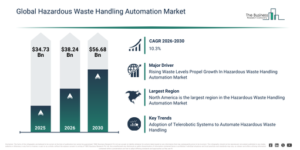
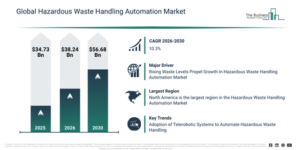
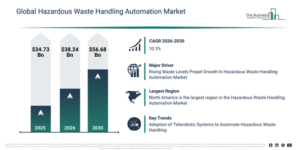
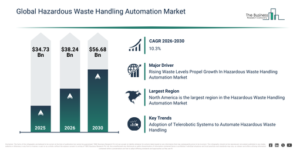
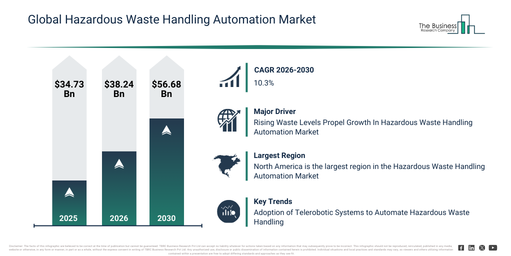
The hazardous waste handling automation market has experienced rapid expansion recently. Projections indicate a substantial increase from $34.73 billion in 2025 to $38.24 billion in 2026, reflecting a compound annual growth rate (CAGR) of 10.1%. Historically, this growth can be attributed to several key factors, including stringent environmental regulations, a rise in industrial waste generation, the necessity to minimize human exposure risks, the drive for enhanced operational efficiency, and the expansion of chemical manufacturing activities.
The hazardous waste handling automation market is anticipated to experience substantial growth in the near future, with its size projected to reach $56.68 billion in 2030, expanding at a compound annual growth rate (CAGR) of 10.3%. This expansion during the forecast period is largely driven by factors such as tightening environmental compliance norms, the increasing adoption of automation in waste facilities, the growth of hazardous waste recycling initiatives, a greater focus on worker safety, and the expansion of smart industrial infrastructure. Prominent trends for this period include robotic waste handling systems, automated hazardous material sorting, remote-controlled waste management equipment, AI-based waste identification, and sensor-enabled safety monitoring.
Request A Free Hazardous Waste Handling Automation Market Sample From The Business Research Company:
How Is The Key Growth Driver Influencing The Hazardous Waste Handling Automation Market?
The escalating volume of waste is anticipated to propel the growth of the hazardous waste handling automation market in the coming years. A swift increase in population and urbanization has led to an augmented generation of waste, including both hazardous and non-hazardous types. While non-hazardous waste is generally simpler to manage, the disposal of hazardous waste necessitates immediate consideration. Hazardous waste handling automation provides a secure method for disposing of this waste, which otherwise could endanger manual workers and the environment. For instance, in February 2024, reports issued by the UN Environment Programme, an organization based in Kenya, indicated that municipal solid waste generation is projected to climb from 2.3 billion tonnes in 2023 to 3.8 billion tonnes by 2050. Thus, the growing quantity of waste is a key driver for the hazardous waste handling automation market’s expansion.
Hazardous Waste Handling Automation Market Segmentation By Category: What Does The 2026 Report Cover?
The hazardous waste handling automation market covered in this report is segmented –
1) By Type: Manipulator Arms, Telescoping Masts, Cranes, Trusses, Size Reduction Systems
2) By Waste: Listed Wastes, Characteristic Waste, Universal Wastes, Mixed Wastes
3) By End-User Industry: Manufacturing, Chemical, Energy, Consumer Care, Government, Other End Users
Subsegments:
1) By Manipulator Arms: Robotic Arms, Articulated Manipulators, Linear Manipulators
2) By Telescoping Masts: Fixed Telescoping Masts, Adjustable Telescoping Masts, Pneumatic Telescoping Masts
3) By Cranes: Overhead Cranes, Gantry Cranes, Mobile Cranes
4) By Trusses: Modular Trusses, Fixed Trusses, Adjustable Trusses
5) By Size Reduction Systems: Shredders, Crushers, Granulators
How Are Industry Players Changing The Hazardous Waste Handling Automation Market Landscape?
Major companies in the hazardous waste handling automation market are concentrating on advancing technologies, such as dual-armed telerobotic systems, for managing high-risk waste. These systems aim to boost safety, refine operational accuracy, and minimize human interaction with dangerous environments. A dual-armed telerobotic system employs two agile robotic arms, controlled remotely through virtual reality (VR) and haptic interfaces that mimic human operator movements, enabling precise manipulation of hazardous substances. This also allows for safer engagement with confined or highly radioactive areas and reduces the likelihood of contamination or mishaps. For instance, in March 2024, the U.S.-based research institution, Argonne National Laboratory, successfully showcased its Dual-Armed Telerobotic System for Hazardous Waste Cleanup. This system incorporates two robotic arms equipped with multi-fingered end-effectors, VR-based digital twin control, and flexible manipulation capabilities for handling drums, containers, and various mixed hazardous materials. It enhances worker safety by reducing direct exposure, boosts operational efficiency through accurate remote operation, and is suitable for deployment in nuclear, chemical, and other high-risk waste locations.
Hazardous Waste Handling Automation Market Global Key Players And Competitive Overview
Major companies operating in the hazardous waste handling automation market are Clean Harbors Inc.; Konecranes Oyj; Penz Crane GmbH; PaR Systems Inc; Pallmann; Hosokawa Micron Powder Systems; Terex MHPS GmbH; Cargotec Corp.; Fritz Schäfer GmbH; Vecoplan AG; BHS-Sonthofen GmbH; Bühler Group; ANDRITZ AG; Komptech Group; Ecolab Inc.; Veolia Environnement S.A.; SUEZ India Private Limited; Stericycle Inc.; Cleanaway Waste Management Limited; Remondis SE & Co. KG; Republic Services Inc.; Advanced Disposal Services Inc.; Casella Waste Systems Inc.; Fomento de Construcciones y Contratas Environment Limited; Green For Life Environmental Inc.; Meridian Waste; Progressive Waste Solutions Ltd.; Recology; Rumpke Consolidated Companies Inc.
Explore Comprehensive Hazardous Waste Handling Automation Market Coverage In The Full Report:
Regional Analysis Of The Hazardous Waste Handling Automation Market: Where Is The Industry Concentrated?
North America was the largest region in the global hazardous waste handling automation market in 2025.Asia-Pacific is expected to be the fastest-growing region in the forecast period. The regions covered in the hazardous waste handling automation market report are Asia-Pacific, South East Asia, Western Europe, Eastern Europe, North America, South America, Middle East, Africa.
Reach Out To Our Team:
The Business Research Company: https://www.thebusinessresearchcompany.com/
Americas: +1 310-496-7795
Asia: +44 7882 955267 & +91 8897263534
Europe: +44 7882 955267
Email us at: marketing@tbrc.info
Follow us on:
LinkedIn: https://in.linkedin.com/company/the-business-research-company
YouTube: https://www.youtube.com/channel/UC24_fI0rV8cR5DxlCpgmyFQ
Global Market Model: https://www.thebusinessresearchcompany.com/global-market-model

Wasay has over a decade of experience in market research, data modelling, and analytics, with prior experience at GlobalData and Decision Tree Consulting Services. At The Business Research Company , he leads research operations across syndicated studies, customized consulting engagements, and the Global Market Model platform. His professional experience includes supporting organizations such as Boston Consulting Group, KPMG, and Ernst & Young. Wasay holds a degree in Electronics and Communications Engineering, postgraduate management qualifications from International Management Institute Belgium and Indian School of Business and Entrepreneurship, and completed the Integrated Program in Business Analytics from Indian Institute of Management Indore.