Designed to make market research more actionable and strategically valuable, The Business Research Company’s 2026 market reports feature market attractiveness scoring, total addressable market sizing, company benchmarking matrices, interactive Excel dashboards, deeper supply chain intelligence, emerging startup tracking, and granular product-level insights.
How Big Is The Healthcare Cognitive Computing Market In 2026, And How Fast Will It Grow?
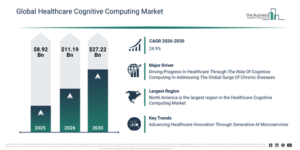
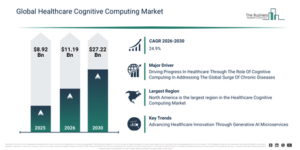
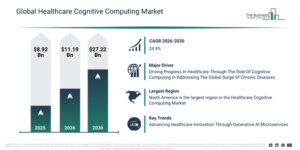
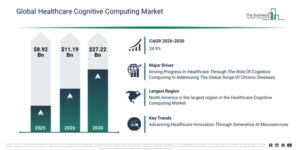
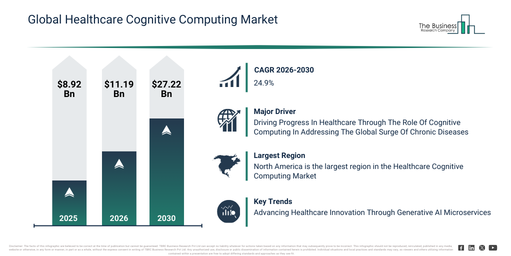
The healthcare cognitive computing market has demonstrated substantial growth in recent years. It is anticipated to increase from $8.92 billion in 2025 to $11.19 billion in 2026, showing a compound annual growth rate (CAGR) of 25.4%. Historically, this market’s expansion was fueled by factors such as an increasing volume of unstructured healthcare data, growth in electronic health record adoption, a rising need for clinical decision support, the expansion of medical research datasets, and the availability of advanced analytics platforms.
The healthcare cognitive computing market is projected to experience significant growth in the coming years. It is anticipated to expand to $27.22 billion in 2030, demonstrating a compound annual growth rate (CAGR) of 24.9%. This anticipated rise during the forecast period is driven by factors such as the increasing application of AI-driven clinical insights, a growing need for precision medicine analytics, the proliferation of cloud-based cognitive platforms, the expanding adoption of predictive healthcare models, and a heightened emphasis on data-driven patient outcomes. Prominent trends expected in this period include the wider use of NLP for clinical data analysis, a surge in the adoption of cognitive decision support systems, deeper integration of machine learning in diagnostics, the broadening scope of predictive analytics within healthcare, and an enhanced focus on interpreting unstructured data.
Download A Free Healthcare Cognitive Computing Market Sample Report With Size And Forecast Data:
Healthcare Cognitive Computing Market Growth Driver: The Key Factor Behind Rising Demand
The increasing occurrence of long-term illnesses is anticipated to fuel the expansion of the healthcare cognitive computing market. These chronic conditions, sometimes called non-communicable diseases (NCDs), are characterized by their prolonged duration and arise from a combination of genetic, physiological, environmental, and behavioral influences. Cognitive computing enables researchers to uncover novel insights into the relationships among genes, proteins, pathways, phenotypes, and various diseases. Furthermore, it can generate concise summaries that highlight critical aspects of a patient’s situation for both individuals and medical professionals, thereby stimulating growth in the healthcare cognitive computing market. For example, data from May 2024, provided by the British Diabetic Association (Diabetes UK), a UK-based patient, healthcare professional, and research charity, indicates that approximately 4.4 million individuals in the UK had a diabetes diagnosis as of 2022-23. Of these diagnosed cases, roughly 8% suffer from type 1 diabetes, while type 2 diabetes constitutes about 90%. Consequently, the rising prevalence of chronic diseases is a key driver for the expansion of the healthcare cognitive computing market.
Healthcare Cognitive Computing Market Segmentation: Key Segments And Subsegments Covered
The healthcare cognitive computing market covered in this report is segmented –
1) By Technology: Natural Language Processing, Machine Learning, Automated Reasoning, Other Technologies
2) By Deployment Mode: On-Premises, Cloud-Based
3) By End Use: Hospitals, Pharmaceuticals, Medical Devices, Insurance, Other End Uses
Subsegments:
1) By Natural Language Processing (NLP): Text Analytics, Speech Recognition, Sentiment Analysis
2) By Machine Learning: Supervised Learning, Unsupervised Learning, Reinforcement Learning
3) By Automated Reasoning: Rule-Based Systems, Logic Programming, Decision Support Systems
4) By Other Technologies: Image Recognition, Robotics And Automation, Predictive Analytics
Healthcare Cognitive Computing Market Trends: Key Developments Shaping 2026 And Beyond
Leading companies within the healthcare cognitive computing market are focusing their efforts on providing generative AI-powered microservices. These services aim to accelerate drug discovery, medical imaging, clinical workflows, and digital-health applications across both cloud and on-premises environments. Generative AI microservices are modular, GPU-accelerated building blocks, including optimized models and inference services, that developers can integrate into applications to perform tasks such as molecule generation, protein structure prediction, imaging segmentation, transcription, and clinical-grade summarization. For instance, in March 2024, NVIDIA, a US-based accelerated-computing company, launched a catalog featuring more than two dozen NVIDIA NIM and CUDA-X microservices. These are designed for biology, chemistry, imaging, and healthcare data and run on NVIDIA DGX Cloud and across major public clouds. The suite includes microservices and models for generative chemistry (MolMIM), protein folding (ESMFold), molecular docking (DiffDock), 3D imaging (VISTA 3D), and a Universal DeepVariant service that significantly speeds genomic variant calling. This offering is available through NVIDIA AI Enterprise 5.0 and NVIDIA-certified systems, and biopharma and medtech partners are already adopting it to embed AI into their drug-discovery, imaging, and clinical workflows.
Leading Companies Operating In The Healthcare Cognitive Computing Market
Major companies operating in the healthcare cognitive computing market are Apixio Inc.; CognitiveScale; Healthcare X.0 GmbH; MedWhat; Palantir Technologies Inc.; Google LLC; Microsoft Corporation; International Business Machines Corporation; Enterra Solutions; Saffron Technology Inc.; DeepMind Technologies Limited; Nuance Communications Incorporated; Ayasdi Inc.; Health Fidelity Inc.; Linguamatics Inc.; Suki Inc.; Welltok Inc.; Zephyr Health Inc.; Zebra Medical Vision Ltd.; Ada Health; Tempus AI Inc.; K Health; CitiusTech; Atomwise Inc.; Behold.AI Technologies Limited
Access The Full Healthcare Cognitive Computing Market Research Report:
Healthcare Cognitive Computing Market Regional Analysis: Largest Region And Key Geographies Covered
North America was the largest region in the healthcare cognitive computing market share in 2025. Asia-Pacific is expected to be the fastest-growing region in the forecast period. The regions covered in the healthcare cognitive computing market report are Asia-Pacific, South East Asia, Western Europe, Eastern Europe, North America, South America, Middle East, Africa.
Reach Out To Our Team:
The Business Research Company: https://www.thebusinessresearchcompany.com/
Americas: +1 310-496-7795
Asia: +44 7882 955267 & +91 8897263534
Europe: +44 7882 955267
Email us at: marketing@tbrc.info
Follow us on:
LinkedIn: https://in.linkedin.com/company/the-business-research-company
YouTube: https://www.youtube.com/channel/UC24_fI0rV8cR5DxlCpgmyFQ
Global Market Model: https://www.thebusinessresearchcompany.com/global-market-model

Wasay has over a decade of experience in market research, data modelling, and analytics, with prior experience at GlobalData and Decision Tree Consulting Services. At The Business Research Company , he leads research operations across syndicated studies, customized consulting engagements, and the Global Market Model platform. His professional experience includes supporting organizations such as Boston Consulting Group, KPMG, and Ernst & Young. Wasay holds a degree in Electronics and Communications Engineering, postgraduate management qualifications from International Management Institute Belgium and Indian School of Business and Entrepreneurship, and completed the Integrated Program in Business Analytics from Indian Institute of Management Indore.