Market attractiveness scoring, total addressable market sizing, company benchmarking matrices, interactive Excel dashboards, deeper supply chain intelligence, emerging startup tracking, and granular product-level insights are among the key offerings featured in The Business Research Company’s 2026 market reports, designed to deliver more actionable and strategically valuable research.
High-Precision GNSS Receiver Market Size Estimate For 2026 And Revenue Forecast Through 2030
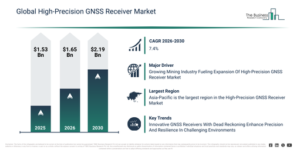
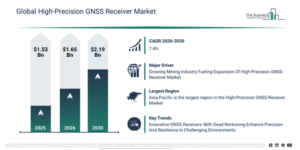
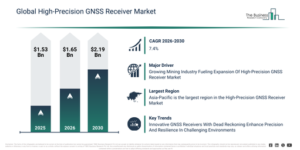
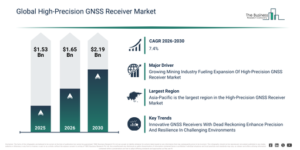
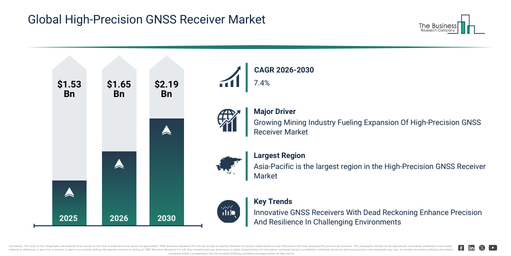
The high-precision gnss receiver market size has experienced strong growth in recent years. It is projected to expand from $1.53 billion in 2025 to $1.65 billion in 2026, at a compound annual growth rate (CAGR) of 7.5%. The historical growth of this market can be ascribed to its adoption in land surveying and mapping, the navigation requirements of defense and military, the development of satellite infrastructure, the demand for precision agriculture, and the broader expansion of geospatial data usage.
The high-precision GNSS receiver market is projected for substantial expansion in the coming years. By 2030, this market is anticipated to reach $2.19 billion, exhibiting a compound annual growth rate (CAGR) of 7.4%. This projected growth is driven by factors such as the increasing need for autonomous vehicle navigation, the deployment of smart infrastructure, the expansion of precision farming practices, integration with IoT platforms, and the rising demand for real-time location analytics. Key developments expected during this forecast period include advancements in centimeter-level positioning accuracy, sophisticated multi-constellation signal processing, integration of real-time kinematic (RTK) technology, the miniaturization of GNSS hardware, and improved resistance to interference and jamming.
Free High-Precision GNSS Receiver Market Report Sample Available For Download:
Why Is Demand In The High-Precision GNSS Receiver Market Expected To Keep Rising?
The expansion of the mining sector is projected to boost the high-precision GNSS receiver market in the future. This industry involves the exploration, extraction, processing, and movement of valuable minerals, metals, and other geological resources from the Earth. A major shift towards renewable energy technologies like solar panels, wind turbines, and electric vehicles necessitates substantial quantities of minerals and metals. Within mining, high-precision GNSS receivers are deployed to improve operational efficiency, safety, and productivity. They achieve this by supplying precise positioning and geospatial data for numerous applications, which in turn facilitates improved decision-making. As an illustration, the United States Geological Survey, a scientific government agency in the US, reported in March 2025 that US metal mine production reached a value of $33.5 billion in 2024, showing a modest rise from $33 billion in 2023. Consequently, the expanding mining industry is fueling the demand in the high-precision global navigation satellite system receiver market.
How Is The High-Precision GNSS Receiver Market Divided Across Segments And Subsegments?
The high-precision gnss receiver market covered in this report is segmented –
1) By Product: Core Satellite Navigation Systems, Regional Satellite Navigation Systems, Satellite – Based Augmentation Systems (SABS)
2) By Component: Devices, Services
3) By Application: Survey And Mapping, Astronomy, Military And Defense, Agriculture, Other Applications
Subsegments:
1) By Core Satellite Navigation Systems: GPS (Global Positioning System), GLONASS (Global Navigation Satellite System), Galileo, BeiDou
2) By Regional Satellite Navigation Systems: WAAS (Wide Area Augmentation System), EGNOS (European Geostationary Navigation Overlay Service), MSAS (Multi-functional Satellite Augmentation System), GAGAN (GPS Aided Geo Augmented Navigation)
3) By Satellite-Based Augmentation Systems (SBAS): Local Area Augmentation Systems (LAAS), Differential GPS (DGPS), Ground-Based Augmentation Systems (GBAS)
High-Precision GNSS Receiver Market Trends Reshaping Customer Demand And Business Strategies
Major companies operating in the high-precision GNSS receiver market are concentrating on introducing advanced technological improvements, such as dead reckoning (DR) functionalities. These innovations aim to guarantee precise positioning, enhance signal robustness, and facilitate navigation even in challenging environments. DR operates by calculating location changes using previous position information and motion sensors, ensuring accurate tracking when GNSS signals are scarce. An illustrative example occurred in September 2024 when Quectel Wireless Solutions Co. Ltd., an IoT solutions provider based in China, unveiled the QLM29H series GNSS receiver, which offers both high-precision localization and straightforward integration. The QLM29H, a dual-band device, includes an integrated antenna, supports L1 and L5 signals, and is compatible with various GNSS constellations including GPS, GLONASS, and Galileo. Furthermore, it incorporates sensitivity-enhancing filters, enabling smooth integration with existing systems and dependable operation across temperatures ranging from -40°C to +85°C, making it suitable for uses in agriculture and micromobility.
High-Precision GNSS Receiver Market Major Players: Companies At The Forefront Of The Industry
Major companies operating in the high-precision gnss receiver market are Raytheon Technologies Corporation; Qualcomm Incorporated; Broadcom Inc.; Texas Instruments Incorporated; Thales Group; Hexagon AB; Trimble Inc.; Cobham PLC; MiTAC Holdings Corp.; Topcon Positioning Systems Inc.; Hi-Target Surveying Instrument Co. Ltd.; Raven Industries Inc.; CHC Navigation Technology Ltd.; Beijing UniStrong Science And Technology Co. Ltd.; Carlson Systems Holdings Inc.; Swift Navigation Inc.; Septentrio N.V.; Javad GNSS Inc.; Unicore Communications Inc.; NavCom Technology Inc.; Tersus GNSS Inc.; AG Leader Technology Inc.; Geneq Inc.; ComNav Technology Ltd.; Hemisphere GNSS Inc.
Read More About The High-Precision GNSS Receiver Market In The Full Report:
High-Precision GNSS Receiver Market Regional Share Analysis For 2025
Asia-Pacific was the largest region in the high-precision GNSS receiver market in 2025. The regions covered in the high-precision gnss receiver market report are Asia-Pacific, South East Asia, Western Europe, Eastern Europe, North America, South America, Middle East, Africa.
Reach Out To Our Team:
The Business Research Company: https://www.thebusinessresearchcompany.com/
Americas: +1 310-496-7795
Asia: +44 7882 955267 & +91 8897263534
Europe: +44 7882 955267
Email us at: marketing@tbrc.info
Follow us on:
LinkedIn: https://in.linkedin.com/company/the-business-research-company
YouTube: https://www.youtube.com/channel/UC24_fI0rV8cR5DxlCpgmyFQ
Global Market Model: https://www.thebusinessresearchcompany.com/global-market-model

Wasay has over a decade of experience in market research, data modelling, and analytics, with prior experience at GlobalData and Decision Tree Consulting Services. At The Business Research Company , he leads research operations across syndicated studies, customized consulting engagements, and the Global Market Model platform. His professional experience includes supporting organizations such as Boston Consulting Group, KPMG, and Ernst & Young. Wasay holds a degree in Electronics and Communications Engineering, postgraduate management qualifications from International Management Institute Belgium and Indian School of Business and Entrepreneurship, and completed the Integrated Program in Business Analytics from Indian Institute of Management Indore.