Designed to make market research more actionable and strategically valuable, The Business Research Company’s 2026 market reports feature market attractiveness scoring, total addressable market sizing, company benchmarking matrices, interactive Excel dashboards, deeper supply chain intelligence, emerging startup tracking, and granular product-level insights.
How Big Is The Human-Computer Interaction Market In 2026, And How Fast Will It Grow?
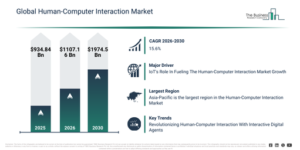
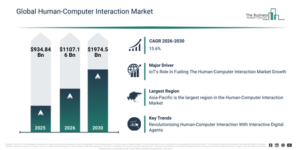
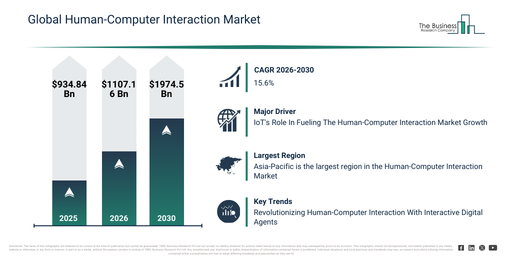
The human-computer interaction market size has experienced rapid growth in recent years. It is projected to expand from $934.84 billion in 2025 to $1107.16 billion in 2026, demonstrating a compound annual growth rate (CAGR) of 18.4%. This historical growth can be attributed to several factors, including the increase in personal computing devices, the expansion of graphical user interfaces, the implementation of early usability engineering practices, the rise of mobile computing, and a heightened focus on user experience.
The human-computer interaction market is anticipated to undergo significant expansion in the foreseeable future, with projections indicating a rise to $1974.5 billion in 2030, achieving a compound annual growth rate (CAGR) of 15.6%. This projected increase is propelled by advancements in brain-computer interfaces, a growing demand for intuitive digital interactions, the broadening of immersive interfaces, the proliferation of smart connected devices, and a greater emphasis on inclusive design. Notable trends during this period are expected to include user-centric interface design, multimodal interaction systems, natural language-based interfaces, the widespread adoption of gesture and voice control, and interaction design focused on accessibility.
Download A Free Human-Computer Interaction Market Sample Report With Size And Forecast Data:
Human-Computer Interaction Market Growth Driver: The Key Factor Behind Rising Demand
The expanding embrace of Internet of Things (IoT) solutions is anticipated to fuel the expansion of the human-computer interaction market in the future. IoT refers to a connected ecosystem of physical objects integrated with sensors, software, and network connectivity, enabling them to collect, share, and process data. The surge in demand for Internet of Things (IoT) solutions stems from enhanced connectivity, advanced data analytics, artificial intelligence (AI), and a growing consumer desire for smart technologies. Human-computer interaction (HCI) plays a crucial role by developing user-friendly interfaces and interaction modalities, empowering users to seamlessly interact with and manage IoT devices, retrieve data, and adjust configurations. For instance, a report from Ericsson, a Sweden-based telecommunications service provider, released in September 2023, stated that IoT connections totaled 15.7 billion in 2023, with an anticipated increase of 16% to reach 38.9 billion connections by 2029. Consequently, the expanding deployment of IoT solutions is propelling the development of the human-computer interaction market.
Human-Computer Interaction Market Segmentation: Key Segments And Subsegments Covered
The human-computer interaction market covered in this report is segmented –
1) By Component: Hardware, Software, Services
2) By Technology: Peripherals, Touch Screen Graphical User Interfaces, Gesture And Body Recognition, Speech And Voice Recognition, Natural Language Processing (NLP), Brain Computer Interface, Eye Tracking, Semiotics Solutions, Other Technologies
3) By Organization Size: Small And Medium Enterprises, Large Enterprise
4) By Application: Healthcare, Gaming And Entertainment, Smart Home And White Goods, Wearables, Education, Automotive, Industrial And Factories, Commercial And Businesses, Other Applications
Subsegments:
1) By Hardware: Input Devices (Keyboards, Mice, Touchscreens, Sensors), Output Devices (Displays, Haptic Feedback Devices), Wearables (Smartwatches, VR Or AR Headsets), Other Hardware (Gesture Recognition Devices, Eye-Tracking Devices)
2) By Software: Operating Systems (HCI-Enabled OS For Gesture, Voice Recognition), Application Software (Voice Assistants, Gesture Control Software), Development Platforms (SDKs, APIs For HCI Systems), User Interface (UI) And User Experience (UX) Design Tools
3) By Services: Integration And Consulting Services, Support And Maintenance Services, Training And Education Services, Managed Services
Human-Computer Interaction Market Trends: Key Developments Shaping 2026 And Beyond
Major firms within the human-computer interaction market concentrate on advancing technology, such as D-ID Agents, to enhance user experiences, boost task efficiency, and tailor interactions across various fields. D-ID Agents represents an interactive natural user interface (NUI) product leveraging large language models for numerous applications, including sales, support, and education. For example, in December 2023, D-ID AI, a US-based video startup known for its patented video reenactment technology, introduced D-ID Agents, marking a significant advancement in human-computer interaction for generating interactive digital humans. This innovation allows users to engage with technology through face-to-face conversations, signifying a considerable departure from conventional textual and graphical user interfaces. Enterprises can deliver customized global interactions by developing diverse Agents with varied characteristics and multilingual capabilities, while sophisticated development options provided by D-ID’s API facilitate scalability and personalization for enterprise clients, and SMBs and creators benefit from functionalities available in the creative reality studio.
Leading Companies Operating In The Human-Computer Interaction Market
Major companies operating in the human-computer interaction market are Amazon.com Inc.; Apple Inc.; Google LLC; Microsoft Corporation; Meta Platforms Inc.; Dell Technologies Inc.; Tencent Holdings Ltd.; Sony Corporation; LG Electronics Inc.; Intel Corporation; Panasonic Corporation; International Business Machines Corporation; NVIDIA Corporation; Texas Instruments Incorporated; Infineon Technologies AG; Microchip Technology Inc.; HaptX Inc.; GestureTek; Ommo Technologies Pvt. Ltd.; Cogniac Corporation; TANGI0 LTD
Access The Full Human-Computer Interaction Market Research Report:
Human-Computer Interaction Market Regional Analysis: Largest Region And Key Geographies Covered
Asia-Pacific was the largest region in the human-computer interaction market in 2025. Asia-Pacific is expected to be the fastest-growing region in the forecast period. The regions covered in the human-computer interaction market report are Asia-Pacific, South East Asia, Western Europe, Eastern Europe, North America, South America, Middle East, Africa.
Reach Out To Our Team:
The Business Research Company: https://www.thebusinessresearchcompany.com/
Americas: +1 310-496-7795
Asia: +44 7882 955267 & +91 8897263534
Europe: +44 7882 955267
Email us at: marketing@tbrc.info
Follow us on:
LinkedIn: https://in.linkedin.com/company/the-business-research-company
YouTube: https://www.youtube.com/channel/UC24_fI0rV8cR5DxlCpgmyFQ
Global Market Model: https://www.thebusinessresearchcompany.com/global-market-model

Wasay has over a decade of experience in market research, data modelling, and analytics, with prior experience at GlobalData and Decision Tree Consulting Services. At The Business Research Company , he leads research operations across syndicated studies, customized consulting engagements, and the Global Market Model platform. His professional experience includes supporting organizations such as Boston Consulting Group, KPMG, and Ernst & Young. Wasay holds a degree in Electronics and Communications Engineering, postgraduate management qualifications from International Management Institute Belgium and Indian School of Business and Entrepreneurship, and completed the Integrated Program in Business Analytics from Indian Institute of Management Indore.