Market attractiveness scoring, total addressable market sizing, company benchmarking matrices, interactive Excel dashboards, deeper supply chain intelligence, emerging startup tracking, and granular product-level insights are among the key offerings featured in The Business Research Company’s 2026 market reports, designed to deliver more actionable and strategically valuable research.
Nanotechnology In Energy Applications Market On Course To Reach $21.19 Billion By 2030: Size And Growth Overview
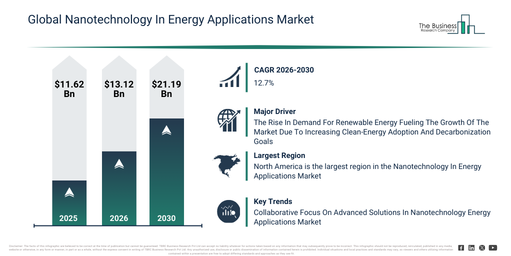
The nanotechnology in energy applications market has experienced rapid growth in recent years. This market is expected to expand from $11.62 billion in 2025 to $13.12 billion in 2026, achieving a compound annual growth rate (CAGR) of 13.0%. Historically, this growth can be attributed to factors such as the increasing demand for renewable energy solutions, breakthroughs in nanomaterial synthesis, the imperative for efficient energy storage systems, government investment in clean energy research, and stricter energy efficiency standards.
The market size for nanotechnology in energy applications is projected to experience significant expansion over the next few years, reaching $21.19 billion by 2030 with a compound annual growth rate (CAGR) of 12.7%. This growth during the forecast period is attributable to several factors, including the rising adoption of electric vehicles, the broadening of grid-scale energy storage, increased investment in renewable infrastructure, the demand for high-density batteries, and the development of innovative next-generation energy materials. Key trends anticipated in this period encompass the application of nanomaterials in advanced energy storage solutions, enhanced efficiency in solar photovoltaic systems, the creation of high-performance fuel cells, the incorporation of nanotechnology into smart energy systems, and the advancement of materials with improved thermal and electrical conductivity.
Need Nanotechnology In Energy Applications Market Forecasts? Get Your Free Sample Report Here:
Nanotechnology In Energy Applications Market Growth Factors: What Is Strengthening Demand Worldwide?
The projected increase in renewable energy demand is set to boost the expansion of nanotechnology within the energy applications market. Renewable energy sources offer sustainable alternatives to finite fossil fuels by tapping into naturally replenished resources. As there is a significant move towards a cleaner and more sustainable energy future, nanotechnology is employed in renewable energy applications to improve the efficiency, performance, and sustainability of technologies such as solar cells, energy storage devices, and fuel cells. For instance, in March 2024, the International Renewable Energy Agency (IRENA), a UAE-based intergovernmental organisation, reported that global renewable power capacity reached 3,870 GW in 2023, which was an increase of 473 GW from 2022, marking 13.9% year-on-year growth. This growth, however, is not evenly distributed across the world, indicating a trend far from the tripling of renewable power target by 2030. Thus, the growing demand for renewable energy is fundamentally driving the growth of nanotechnology in the energy applications market.
Nanotechnology In Energy Applications Market By Segment: Complete Category And Subcategory Breakdown
The nanotechnology in energy applications market covered in this report is segmented –
1) By Material Type: Nano-Structure Monolithic, Solid Nanoparticle, Nanosensor, Nanothin Film, Other Material Types
2) By Application: Petroleum Refining, Fuel Cell, Energy Storage Device, Solar Photovoltaics, Other Applications
3) By Industry Vertical: Manufacturing, Electrical, Transport, Other Industry Verticals
Subsegments:
1) By Nano-Structure Monolithic: Carbon Nanotubes (CNTs), Graphene-based Materials, Nanostructured Carbon Materials
2) By Solid Nanoparticle: Metal Nanoparticles (Silver, Gold, Copper), Metal Oxide Nanoparticles (Zinc Oxide, Titanium Dioxide), Semiconductor Nanoparticles (Silicon, Cadmium Selenide)
3) By Nanosensor: Chemical Sensors, Biological Sensors, Temperature And Pressure Sensors, Gas Sensors
4) By Nanothin Film: Transparent Conductive Films, Photovoltaic Films, Thin-film Batteries, Nano-coating For Energy Storage
5) By Other Material Types: Nanocomposites, Quantum Dots, Nanostructured Polymers, Nanostructured Coatings
Nanotechnology In Energy Applications Market Trend Outlook: Developments Defining The Forecast Period
Leading firms within the nanotechnology energy applications market are concentrating on advanced strategies, such as obtaining next-generation silicon anode material for electric vehicle (EV) batteries, to speed up innovation and tackle evolving energy challenges. This acquisition partnership involves securing state-of-the-art silicon-based anode material specifically designed for electric vehicle batteries to boost their performance and energy capacity. An example of this is the collaboration in December 2023 between Panasonic Energy Co. Ltd., a Japan-based battery company, and Sila Nanotechnologies Inc., a US-based battery producer. The Titan Silicon material from Sila Nanotechnologies, when incorporated into Panasonic Energy’s EV lithium-ion batteries, marks a substantial technological leap forward by managing silicon expansion during charging, which allows for increased capacity and better performance. This alliance illustrates a crucial step in nanotechnology for energy uses, aiming to sustainably satisfy global EV demand while decreasing emissions and encouraging localized manufacturing.
Who Is Competing For Share In The Nanotechnology In Energy Applications Market?
Major companies operating in the nanotechnology in energy applications market are Honeywell International Inc.; Johnson Matthey Plc; DuPont de Nemours Inc.; Exxon Mobil Corporation; The Chemours Company; A123 Systems LLC; Aspen Aerogels Inc.; Sila Nanotechnologies; Altair Nanotechnologies Inc.; Advanced Nano Products Co. Ltd.; Nanophase Technologies Corp.; Nanosolar Inc.; Nantero Inc.; Hyperion Catalysis International Inc.; Bayer MaterialScience LLC; Solaronix SA; Zeolyst International; He3Da Ltd.; Suzhou Sinlion Battery Tech Co. Ltd.; Ad Nano Technologies; NEI Corporation; Nanotech Energy Inc.; Black Diamond Structures
Get The Full Picture With The Nanotechnology In Energy Applications Market Report:
Nanotechnology In Energy Applications Market Regional Snapshot: Leading Geography In 2025
North America was the largest region in the nanotechnology in energy applications market in 2025. Asia-Pacific is expected to be the fastest-growing region in the forecast period. The regions covered in the nanotechnology in energy applications market report are Asia-Pacific, South East Asia, Western Europe, Eastern Europe, North America, South America, Middle East, Africa.
Reach Out To Our Team:
The Business Research Company: https://www.thebusinessresearchcompany.com/
Americas: +1 310-496-7795
Asia: +44 7882 955267 & +91 8897263534
Europe: +44 7882 955267
Email us at: marketing@tbrc.info
Follow us on:
LinkedIn: https://in.linkedin.com/company/the-business-research-company
YouTube: https://www.youtube.com/channel/UC24_fI0rV8cR5DxlCpgmyFQ
Global Market Model: https://www.thebusinessresearchcompany.com/global-market-model

Wasay has over a decade of experience in market research, data modelling, and analytics, with prior experience at GlobalData and Decision Tree Consulting Services. At The Business Research Company , he leads research operations across syndicated studies, customized consulting engagements, and the Global Market Model platform. His professional experience includes supporting organizations such as Boston Consulting Group, KPMG, and Ernst & Young. Wasay holds a degree in Electronics and Communications Engineering, postgraduate management qualifications from International Management Institute Belgium and Indian School of Business and Entrepreneurship, and completed the Integrated Program in Business Analytics from Indian Institute of Management Indore.