The Business Research Company’s 2026 market reports combine market attractiveness scoring, total addressable market sizing, company benchmarking matrices, interactive Excel dashboards, deeper supply chain intelligence, emerging startup tracking, and granular product-level insights to deliver research that is more actionable and strategically valuable.
What Is The Street Vendors Market Growth Rate? A 12.1% CAGR Outlook Through 2030
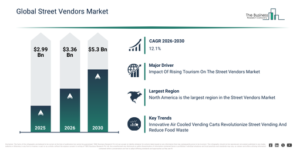
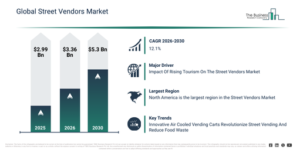
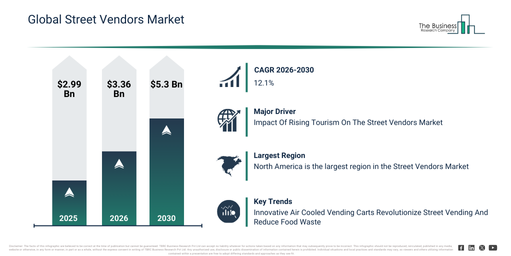
The street vendors market size has expanded significantly in recent years. It is projected to grow from $2.99 billion in 2025 to $3.36 billion in 2026, exhibiting a compound annual growth rate (CAGR) of 12.2%. The growth observed in previous periods can be linked to factors such as urban population growth, the expansion of informal employment, the demand for low cost goods, cultural food traditions, and limited access to formal retail.
The street vendors market size is anticipated to experience substantial growth in the upcoming years. It is forecast to expand to $5.3 billion in 2030, achieving a compound annual growth rate (CAGR) of 12.1%. This projected growth throughout the forecast period stems from factors like the integration of cashless payments, an uptick in urban street food tourism, regulatory formalization efforts, an increasing consumer demand for quick meals, and the expansion into organized vending zones. Noteworthy trends during this period include the wider adoption of digital payment systems, a rising appetite for affordable street food, the emergence of more mobile and pop-up vendors, an enhanced focus on hygiene and food safety, and market development in urban and semi-urban regions.
Access A Free Sample Of The Latest Street Vendors Market Analysis:
Why Is The Street Vendors Market Growing? The Key Demand Driver Explained
The expanding tourism sector is anticipated to boost the street vendors market in the future. This industry covers all activities, services, and enterprises serving travelers and tourists. The increase in tourism stems from the promotion and availability of travel and leisure pursuits, the wish to discover new locations, encounter various cultures, and participate in recreational endeavors. Tourism enables street vendors to gain visibility via travel guides, social media, and verbal recommendations, resulting in a broader customer base and enhanced business prospects. As an illustration, in December 2023, the Australian Bureau of Statistics, an Australian government body, reported that Australian domestic tourism spending in fiscal year 2022-23 climbed by $34.9 billion, totaling $124.9 billion. Concurrently, international tourism saw a $17.7 billion rise, achieving a total of $23.6 billion in chain volume terms. Consequently, the expanding tourism industry is stimulating the growth of the street vendor’s market.
What Are The Main Segments Of The Street Vendors Market?
The street vendors market covered in this report is segmented –
1) By Vendor Type: Stationary, Peripatetic, Mobile
2) By Area: Urban, Suburban, Rural
3) By Commodity: Food, Cosmetics, Clothing, Daily Necessities, Other Commodities
Subsegments:
1) By Stationary: Fixed Stalls, Kiosks, Pop-up Shops
2) By Peripatetic: Market Stall Operators, Street-Side Sellers, Hawkers
3) By Mobile: Food Trucks, Ice Cream Vans, Mobile Merchandise Sellers
Street Vendors Market Trend Analysis: Where Leading Companies Are Focusing
Major companies operating in the street vendor market are focusing on developing innovative products such as portable air-cooled vending carts to enhance food preservation and support vendor livelihoods. These mobile units are equipped with evaporative cooling technology that maintains optimal temperature and humidity levels, helping street vendors extend the shelf life of perishable goods and minimize food spoilage. For instance, in 2024, the Indian Institute of Technology Roorkee (IIT Roorkee), an India-based government-linked academic and research institution, developed an air-cooled vegetable vending cart under the Rural Technology Action Group (RuTAG) initiative. This cart reduces internal temperatures by 10–15°C and preserves fruits and vegetables for 2–3 days, significantly minimizing food loss and increasing income potential for small-scale vendors. The cart is also equipped with portable design features for easy mobility and user-friendly operation, representing a substantial advancement in street vending practices and improving the efficiency of food management, especially for last-mile sales in urban and semi-urban areas.
Which Companies Are Major Players In The Street Vendors Market?
Major companies operating in the street vendors market are Dippin’ Dots, Halal Guys, Kogi BBQ, Roaming Hunger, Curry Up Now, Wafels & Dinges, Coolhaus, Big Gay Ice Cream, Mister Softee, The Cinnamon Snail, Crepes Bonaparte, The Lime Truck, Rito Loco, Bizz On Wheels, The Taco Truck LLC, Kimchi Taco Truck, Buldogis, Fryborg Food Truck, Cousins Maine Lobster LLC, Fukuburger Truck, The Grilled Cheese Truck
Get The Complete Street Vendors Market Analysis Here:
Which Region Held The Largest Share Of The Street Vendors Market In 2025?
North America was the largest region in the street vendors market in 2025. The regions covered in the street vendors market report are Asia-Pacific, South East Asia, Western Europe, Eastern Europe, North America, South America, Middle East, Africa.
Reach Out To Our Team:
The Business Research Company: https://www.thebusinessresearchcompany.com/
Americas: +1 310-496-7795
Asia: +44 7882 955267 & +91 8897263534
Europe: +44 7882 955267
Email us at: marketing@tbrc.info
Follow us on:
LinkedIn: https://in.linkedin.com/company/the-business-research-company
YouTube: https://www.youtube.com/channel/UC24_fI0rV8cR5DxlCpgmyFQ
Global Market Model: https://www.thebusinessresearchcompany.com/global-market-model

Wasay has over a decade of experience in market research, data modelling, and analytics, with prior experience at GlobalData and Decision Tree Consulting Services. At The Business Research Company , he leads research operations across syndicated studies, customized consulting engagements, and the Global Market Model platform. His professional experience includes supporting organizations such as Boston Consulting Group, KPMG, and Ernst & Young. Wasay holds a degree in Electronics and Communications Engineering, postgraduate management qualifications from International Management Institute Belgium and Indian School of Business and Entrepreneurship, and completed the Integrated Program in Business Analytics from Indian Institute of Management Indore.