The Business Research Company’s 2026 market reports are designed to deliver research that is more actionable and strategically valuable. Key offerings include market attractiveness scoring, total addressable market sizing, company benchmarking matrices, interactive Excel dashboards, deeper supply chain intelligence, emerging startup tracking, and granular product-level insights.
Sushi Restaurants Market Revenue Projected To Rise To $24.1 Billion By 2030
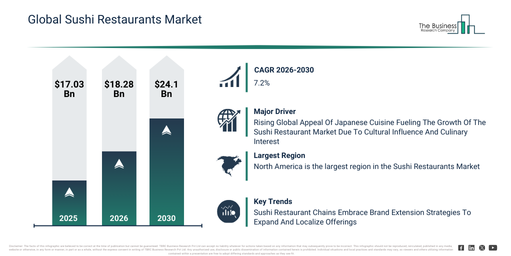
The sushi restaurants market has experienced robust growth in recent years. Its size is projected to increase from $17.03 billion in 2025 to $18.28 billion in 2026, demonstrating a compound annual growth rate (CAGR) of 7.3%. This historical expansion can be primarily attributed to the global popularity of Japanese cuisine, the expansion of urban dining culture, a rising demand for premium dining experiences, the proliferation of food delivery platforms, and the emergence of international restaurant chains.
The sushi restaurants market is anticipated to show robust expansion over the next few years. It is forecast to grow to $24.1 billion in 2030 at a compound annual growth rate (CAGR) of 7.2%. This growth during the forecast period can be attributed to factors such as the adoption of robotic sushi preparation, traceable seafood sourcing practices, the emergence of experiential dining formats, health-conscious menu innovation, and the global expansion of various sushi brands. Significant trends anticipated in the forecast period include a focus on premium and omakase dining experiences, increased automation in food preparation, an emphasis on sustainable seafood sourcing, widespread digital ordering and delivery systems, and the development of global sushi fusion menus.
Want Deeper Sushi Restaurants Market Insights? Get A Free Sample Report:
Primary Growth Driver Shaping The Sushi Restaurants Market Outlook
The growing worldwide popularity of Japanese cuisine is anticipated to fuel expansion within the sushi restaurant market in the future. Japanese cuisine encompasses Japan’s traditional culinary methods and dishes, distinguished by its focus on fresh, seasonal components, harmonious tastes, and visually appealing arrangements. This heightened interest in Japanese cuisine stems from globalization, which exposes individuals to various cultures, fosters the sharing of gastronomic customs, and enhances the global availability of ingredients and dining opportunities. Sushi establishments facilitate cultural exchange by upholding traditional preparation methods and presenting regional specialties to a global public. For example, data from May 2024, reported by the Japan National Tourism Organization (JNTO), a governmental agency for tourism promotion based in Japan, indicates that Japan received around 36.87 million international tourists. This figure represents an increase from 25.07 million in 2023, signifying a 46.9% year-on-year rise in incoming tourism. Consequently, the expanding global attraction of Japanese cuisine is propelling the expansion of the sushi restaurant market.
Sushi Restaurants Market Structure: A Detailed Look At Segments And Subsegments
The sushi restaurants market covered in this report is segmented –
1) By Type: Single Sushi Restaurant, Conveyor Belt Sushi Restaurant
2) By Restaurant Size: Small And Medium Sushi Bars, Large Scale Restaurants, Boutique Sushi Cafes, Fine Dining
3) By Consumer Preferences: Dine-In, Takeaway, Delivery
4) By Applications: Local Market, International Chain Market
5) By End-User: Residential, Commercial
Subsegments:
1) By Single Sushi Restaurant: Traditional Sushi Bars, Omakase Sushi Restaurants, Takeaway Or Grab-And-Go Sushi Outlets, High-End Fine Dining Sushi Establishments, Casual Dining Sushi Restaurants
2) By Conveyor Belt Sushi Restaurant: Automated Sushi Conveyor Restaurants, Touchscreen Ordering Conveyor Sushi Restaurants, All-You-Can-Eat Conveyor Sushi Chains, Compact Urban Conveyor Outlets, Family-Friendly Conveyor Sushi Restaurants
Sushi Restaurants Market Innovation And Strategy Trends Among Leading Companies
Leading businesses within the sushi restaurant sector are focusing on inventive approaches, like brand expansion efforts, to grow their market footprint, draw in a wider clientele, and strengthen customer allegiance. These brand expansion initiatives involve a marketing tactic where an organization utilizes the established reputation and recognition of an existing brand to introduce novel products, services, or restaurant concepts across diverse categories or market segments. A notable example is Food & Life Companies Ltd., a Japanese firm focused on food service and restaurant management, which launched its inaugural U.S. sushi izakaya establishment, Sakabayashi Sushi Tavern Back Bay, in Boston in May 2024. This tavern delivers a genuine sushi izakaya ambiance, presenting a menu that includes approximately 30 varieties of sushi, 50 individual dishes such as sashimi, tempura, and ramen, and roughly 40 beverage selections like sake and sake-based cocktails crafted for American patrons. The 82-seat establishment combines classic Japanese izakaya features with interior designs influenced by Boston, seeking to offer residents an authentic yet accessible Japanese culinary journey.
Top Companies Competing In The Sushi Restaurants Market
Major companies operating in the sushi restaurants market are Genki Sushi Co. Ltd., RA Sushi Bar Restaurant LLC, Kura Sushi USA Inc., Hamazushi Co. Ltd., Nobu Hospitality LLC, Sushi-Tei Pte Ltd., Sushi Zushi LLC, Sushi Samba, Itacho Sushi, Morimoto Management LLC, Sushi Itto S.A. de C.V., Sakae Sushi, Blue Ribbon Restaurants, Sushi Nakazawa LLC, Akindo Sushiro Co. Ltd., Fuji Sushi Inc., Innovative Dining Group LLC, Pisces Sushi Bistro Inc., Sukiyabashi Jiro Co. Ltd., Wasabi Sushi Bento Limited
View The Complete Sushi Restaurants Market Study With Segment And Regional Data:
Sushi Restaurants Market Regional Outlook Across Major Geographies
North America was the largest region in the sushi restaurants market in 2025. Asia-Pacific is expected to be the fastest-growing region in the forecast period. The regions covered in the sushi restaurants market report are Asia-Pacific, South East Asia, Western Europe, Eastern Europe, North America, South America, Middle East, Africa.
Reach Out To Our Team:
The Business Research Company: https://www.thebusinessresearchcompany.com/
Americas: +1 310-496-7795
Asia: +44 7882 955267 & +91 8897263534
Europe: +44 7882 955267
Email us at: marketing@tbrc.info
Follow us on:
LinkedIn: https://in.linkedin.com/company/the-business-research-company
YouTube: https://www.youtube.com/channel/UC24_fI0rV8cR5DxlCpgmyFQ
Global Market Model: https://www.thebusinessresearchcompany.com/global-market-model

Wasay has over a decade of experience in market research, data modelling, and analytics, with prior experience at GlobalData and Decision Tree Consulting Services. At The Business Research Company , he leads research operations across syndicated studies, customized consulting engagements, and the Global Market Model platform. His professional experience includes supporting organizations such as Boston Consulting Group, KPMG, and Ernst & Young. Wasay holds a degree in Electronics and Communications Engineering, postgraduate management qualifications from International Management Institute Belgium and Indian School of Business and Entrepreneurship, and completed the Integrated Program in Business Analytics from Indian Institute of Management Indore.