Market attractiveness scoring, total addressable market sizing, company benchmarking matrices, interactive Excel dashboards, deeper supply chain intelligence, emerging startup tracking, and granular product-level insights are among the key offerings featured in The Business Research Company’s 2026 market reports, designed to deliver more actionable and strategically valuable research.
What Is The Virtual Reality In Education Market Size In 2026, And Where Is It Heading By 2030?
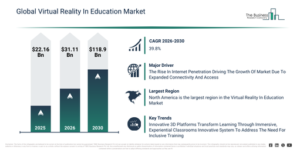
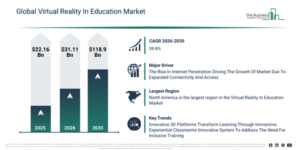
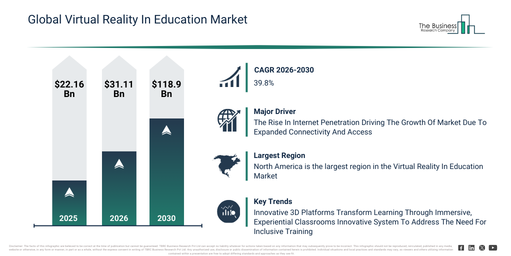
The virtual reality in education market has experienced substantial expansion in recent years. Its size is projected to increase from $22.16 billion in 2025 to $31.11 billion in 2026, demonstrating a compound annual growth rate (CAGR) of 40.4%. The historical rise in this market can be linked to factors such as the increasing adoption of digital learning platforms, a heightened demand for interactive educational tools, the expansion of e-learning infrastructure, the accessibility of affordable VR hardware, and an intensified focus on student engagement.
The virtual reality in education market size is projected to experience substantial growth in the coming years. It is anticipated to reach a valuation of $118.9 billion by 2030, demonstrating a compound annual growth rate (CAGR) of 39.8%. This expansion is driven by factors such as growing investments in immersive educational technologies, the increasing need for remote and hybrid learning solutions, the broadening of VR content libraries for educational purposes, the expanded adoption of simulation-based training, and a rise in institutional expenditure on edtech infrastructure. Key trends observed during this forecast period encompass the increasing integration of immersive learning environments, a greater reliance on VR-based skill training modules, the expanding incorporation of VR into STEM education, the proliferation of remote and virtual classrooms, and an elevated emphasis on experiential learning tools.
Request Your Free Virtual Reality In Education Market Sample With Segment And Regional Data:
Virtual Reality In Education Market Growth Drivers And Their Impact On Future Demand
Future expansion of virtual reality within the education market is anticipated to be driven by rising internet penetration. Internet penetration signifies the proportion of a population having regular internet access and usage. This growth in internet access stems from enhanced network infrastructure, which boosts connectivity, enabling more individuals in both urban and rural regions to connect to the internet. Broad, high-speed internet connectivity, facilitated by increasing penetration, fuels the integration of virtual reality in education, offering unobstructed entry to engaging learning environments and collaborative digital classrooms. For example, the Government of Canada, a federal administration based in Canada, reported in 2023 that by 2026, high-speed internet availability in Canada is expected to cover 98% of its population. This coverage is projected to expand to 100% by 2030, ensuring complete Internet penetration across the nation. Additionally, the International Telecommunication Union (ITU), a Switzerland-based agency for information and communication technologies, stated that global Internet use reached 5.1 billion people in 2022, constituting 65% of the total population. By 2023, this figure rose to 5.4 billion, reflecting 67% Internet penetration worldwide. Consequently, the expanding internet penetration is a key factor propelling the advancement of virtual reality within the education market.
What Categories Define The Virtual Reality In Education Market?
The virtual reality in education market covered in this report is segmented –
1) By Component: Hardware, Solutions And Software
2) By Deployment: Cloud, On-Premises
3) By Application: Academic And Training Institutions, Other Applications
Subsegments:
1) By Hardware: VR Headsets, Motion Controllers, Haptic Feedback Devices, Tracking Sensors
2) By Solutions And Software: Immersive Learning Platforms, Simulation And Training Software, Content Creation Tools, Classroom Management And Analytics Software
What New Developments Are Emerging In The Virtual Reality In Education Market?
Leading companies operating in the virtual reality in education market are concentrating on developing innovative solutions, such as VR metaverse platforms, to enhance interactive and experiential learning. VR metaverse platforms are digital environments that integrate virtual reality and interactive 3D spaces, allowing users to learn, collaborate, and engage in immersive experiences. For instance, in March 2025, the Indian Institute of Technology Guwahati, an India-based public technical university, introduced Gyandhara, the nation’s first VR-based metaverse platform specifically designed for school education. The platform provides immersive, interactive 3D learning environments that help students understand and interact with complex subjects like mathematics, science, and social studies in their local languages. It fosters creativity, critical thinking, and real-time collaboration by facilitating communication and teamwork within virtual classrooms. Furthermore, Gyandhara delivers a seamless, interconnected educational experience, enabling students to move effortlessly between different subjects and practical simulations, transforming traditional learning into an experiential journey.
Major Players Driving Competition In The Virtual Reality In Education Market
Major companies operating in the virtual reality in education market are Google LLC; Microsoft Corporation; Facebook Technologies LLC; HTC Corporation; Unimersiv; Samsung Electronics Co Ltd.; Lenovo Limited; Sony Corporation; Alchemy Immersive; Veative Labs Pvt Ltd.; VR Education Holdings plc; Schell Games LLC; Cornerstone OnDemand Inc.; EON Reality Inc.; Immersive VR Education Limited; ThingLink Incorporated; Nearpod Inc.; Filament Games LLC; Foundry 10; Labster Inc.; VictoryXR Inc.; Engage XR; Pearson Immersive; VirtualSpeech Limited
View The Comprehensive Virtual Reality In Education Market Analysis:
Virtual Reality In Education Market Regional Leaders: Insights From The 2026 Report
North America was the largest region in the virtual reality in education market in 2025. The regions covered in the virtual reality in education market report are Asia-Pacific, South East Asia, Western Europe, Eastern Europe, North America, South America, Middle East, Africa.
Reach Out To Our Team:
The Business Research Company: https://www.thebusinessresearchcompany.com/
Americas: +1 310-496-7795
Asia: +44 7882 955267 & +91 8897263534
Europe: +44 7882 955267
Email us at: marketing@tbrc.info
Follow us on:
LinkedIn: https://in.linkedin.com/company/the-business-research-company
YouTube: https://www.youtube.com/channel/UC24_fI0rV8cR5DxlCpgmyFQ
Global Market Model: https://www.thebusinessresearchcompany.com/global-market-model

Wasay has over a decade of experience in market research, data modelling, and analytics, with prior experience at GlobalData and Decision Tree Consulting Services. At The Business Research Company , he leads research operations across syndicated studies, customized consulting engagements, and the Global Market Model platform. His professional experience includes supporting organizations such as Boston Consulting Group, KPMG, and Ernst & Young. Wasay holds a degree in Electronics and Communications Engineering, postgraduate management qualifications from International Management Institute Belgium and Indian School of Business and Entrepreneurship, and completed the Integrated Program in Business Analytics from Indian Institute of Management Indore.